The way you space your kitchen island pendants has a powerful influence on how the entire room looks, feels, and functions. Well-planned spacing can elevate your island from a simple work surface to a true centerpiece that supports cooking, conversation, and everyday comfort. When pendants are thoughtfully placed, they also highlight the island’s proportions, guide the eye naturally across the room, and ensure the countertop is beautifully and evenly illuminated.
As you explore the possibilities, you will find that ideal spacing is far more than a fixed measurement. It involves understanding scale, sightlines, ceiling height, island shape, and how different zones of the island are actually used. By combining these elements with careful attention to both aesthetics and performance, you can create a lighting layout that feels balanced, cohesive, and perfectly aligned with your kitchen’s design.

Core Principles Behind Light Spacing Over a Kitchen Island
Understanding the core principles behind pendant spacing is essential for creating lighting that feels intentional, balanced, and tailored to the way you use your kitchen island. Scale and proportion determine how much breathing room each fixture needs, ensuring pendants neither overwhelm the island nor appear lost in the layout. Larger pendants require wider gaps to maintain clarity and prevent visual crowding, while smaller fixtures can sit closer together without compromising balance. By spacing pendants approximately one to one and a half times their diameter apart, you create a cohesive rhythm that supports both style and usability. This proportional spacing also helps maintain harmony with the island’s size, allowing each fixture to contribute to a unified visual flow.
As the eye moves across the kitchen, sightlines and functional lighting need further refine how pendants should be arranged. Aligning your fixtures with architectural elements, such as cabinetry lines or window placements, reinforces the room’s natural rhythm and keeps the lighting integrated within the larger design. Meanwhile, the way light spreads across the island determines how well the space performs. Tighter spacing eliminates shadows in prep zones, while slightly wider gaps above seating areas create a softer, more relaxed glow. By blending these aesthetic and practical considerations, you establish pendant spacing that not only enhances the look of your kitchen but also supports every activity that takes place around the island.

Spacing Pendants for Linear Kitchen Islands
Linear kitchen islands offer the most flexibility when it comes to pendant layouts, but the spacing must support both the proportions of the island and the way you use the surface. By tailoring placement to the island’s length and function, you can create lighting that feels cohesive, comfortable, and beautifully aligned.
Three or More Pendants Over Long Islands
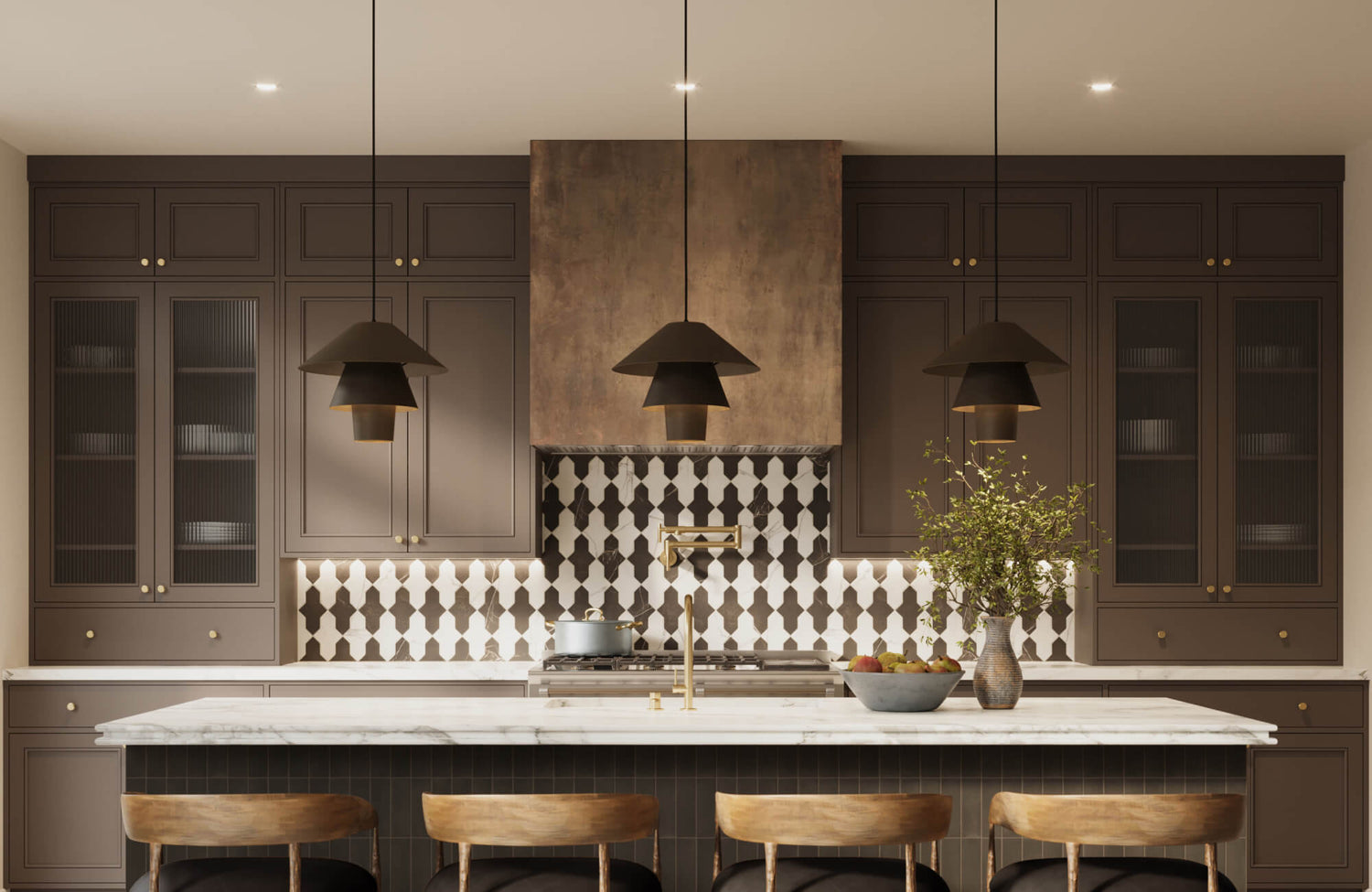
When your island is long enough to support three or more pendants, even distribution becomes essential for maintaining balance along the entire countertop. A practical way to achieve this is by dividing the usable length of the island into equal sections, allowing each pendant to occupy its own portion of the visual rhythm. To do this, measure the span you want the pendants to cover, typically leaving several inches of margin from each end of the island, and divide that length by the number of fixtures plus one. The resulting measurement becomes the spacing between each pendant and the distance from the ends. One standout example is our Theodore Pendant in Vintage Brass, with its warm brass finish and tailored silhouette, which works beautifully in a multi-pendant arrangement, creating a cohesive repetition that feels intentional and architecturally aligned. This approach also produces symmetry that feels deliberate while ensuring every area of the island receives consistent illumination.
As you refine these measurements, consider how the pendants will appear from different angles in the kitchen. Proper division prevents fixtures from clustering too closely in the center or drifting unevenly toward the ends. When spacing is adjusted with care, each pendant contributes to a clean, organized sequence that enhances both visibility and architectural harmony. This method also keeps the lighting visually anchored across the full length of the island, making the layout feel polished and purposeful.
Two Pendants on Medium-Length Islands
For medium-length islands, two pendants are often the ideal choice, though their placement demands precision to avoid shadowed areas or awkward gaps. A reliable guideline is to position each pendant approximately 15 to 18 inches from the centerline of the island. This creates a balanced separation that feels proportional to the length of the countertop while ensuring that light spreads evenly across the workspace. By centering the spacing around the island’s midpoint, you also create a natural visual anchor that makes the arrangement feel cohesive and properly aligned. A fixture like our Matthew 18" 1 Light Pendant in Aged Gold/White Linen, shown in the image above, featuring a warm gold finish paired with a soft white linen shade, illustrates how a well-scaled pendant can enhance both proportion and overall visual balance on a medium-length island.
Spacing becomes even more important in kitchens with high ceilings or open sightlines, where misalignment is easier to spot. Pendants placed too close together can leave the outer edges of the island underlit, while pendants spaced too far apart can cause the center to fall into shadow. When you follow an intentional spacing strategy, you maintain clarity, symmetry, and functional brightness across the entire surface.
One Large Pendant vs Multiple Smaller Pendants
In some kitchens, a single oversized pendant can deliver both drama and practicality, making it a strong alternative to multiple smaller fixtures. Large pendants draw the eye and can anchor the island with a bold focal point, especially when the island itself is wide or positioned under tall ceilings. When using a statement fixture, the primary consideration is ensuring it is centered precisely over the island so the light is evenly distributed and the visual weight feels balanced. The scale of the pendant should also relate to the island’s length, offering enough coverage without overwhelming the space. A striking option like our Carly 34" Pendant in Vintage Brass, finished in a warm brass tone that adds softness and depth, illustrates how a single, well-proportioned pendant can anchor the island beautifully while maintaining an elevated, contemporary feel.
However, if you prefer a pair of large pendants instead of a single one, spacing becomes a more nuanced process. Larger fixtures need more breathing room, often requiring distances wider than the typical one to one and a half times their diameter. This extra spacing preserves the individuality of each pendant while preventing them from visually merging. By choosing the right number of pendants and adjusting spacing to suit their scale, you can achieve a layout that feels refined, proportional, and perfectly suited to your island’s dimensions.

Spacing Pendants for Square or Compact Islands
Square or compact kitchen islands call for a more precise approach to pendant spacing, as even small placement errors can disrupt balance and affect how evenly the surface is lit. By tailoring your layout to the island’s proportions, you ensure your lighting feels intentional, well-scaled, and comfortably integrated into the space.
Two Pendants on Compact Islands
When you choose two pendants for a smaller island, the goal is to give each fixture enough breathing room without overwhelming the limited surface. Because compact islands offer less horizontal space, pendants placed too closely together can feel cluttered, while those spaced too far apart risk leaving the center of the island dim. A practical approach is to position each pendant at a comfortable distance from the centerline, ensuring that light reaches both the middle and outer edges evenly. This method also creates a sense of symmetry and maintains a visual anchor while keeping the lighting practical for both prep and seating areas.
As you refine the spacing, consider how the pendants relate to the island’s perimeter and the overall rhythms of the kitchen. In a small footprint, pendants become more prominent, so choosing fixtures with a clean profile helps maintain openness. A design like our Kaley 16" Pendant in Aged Brass, seen in the photo above, finished in warm brass and shaped with a softly rounded form, offers the kind of visual lightness that pairs beautifully in compact layouts. When spaced thoughtfully, two such pendants support each other without competing, producing a balanced composition that enhances both form and function.
Centering a Single Pendant Over a Small Island
A single pendant is often the simplest and most elegant choice for compact islands, especially when the goal is to avoid visual clutter. Although pendants remain the most common solution, certain compact chandeliers or linear-style fixtures can also work if they maintain a light visual profile and are scaled appropriately. A refined linear option, such as our Hailey 48" 4 Lights Linear Pendant in Aged Gold/Opal Matte Glass, offers an elongated, airy silhouette that provides generous illumination without feeling heavy in a smaller space.
To feel intentional rather than undersized, the fixture should span one-half to two-thirds of the island’s width. This proportion ensures the light has enough presence to anchor the island while still allowing the surrounding space to breathe. Centering the fixture directly above the island further reinforces a sense of order and clarity, creating a clean focal point that feels grounded within the room.
Clustered Pendants as an Alternative Solution
If a single pendant feels too minimal or two separate fixtures appear too busy, a clustered arrangement can offer the perfect middle ground. Clustered pendants combine multiple smaller lights into a single grouped composition, allowing you to achieve layered visual interest without sacrificing proportionality. Because the pendants are mounted from one canopy, they function as a unified design element, which makes them ideal for tight spaces where widely spaced fixtures would feel impractical.
The beauty of a cluster also lies in its flexibility. You can vary the heights or sizes of the individual lights to create depth and dimension, all while keeping the overall footprint compact. This arrangement brings sculptural character to the island and ensures that the light spreads evenly across the surface. With clusters, you gain the benefits of multiple pendants without overwhelming the proportions of a small island, making this an excellent solution for kitchens that demand both style and efficiency.

Adapting Spacing for Mixed-Use Islands with Seating and Prep Zones
When your kitchen island serves both as a workspace and a gathering area, your pendant spacing needs to shift according to the specific requirements of each zone. Tighter spacing above prep-intensive sections ensures stronger overlap of light beams, minimizing shadows and providing the brightness necessary for chopping, mixing, and other detailed tasks. This concentrated arrangement not only improves visibility but also reinforces the functional identity of the prep zone, giving it a sense of purpose and clarity within the overall island layout.
As the island transitions into the seating area, wider spacing helps create a softer, more relaxed atmosphere that supports conversation and comfort. By allowing the pendants to spread out slightly, the light diffuses more gently, reducing glare above seated guests and enhancing the inviting nature of the space. The shift between these zones can be further emphasized through gradual spacing adjustments or subtle height variations, resulting in a smooth visual transition that mirrors how the island is used. With thoughtful spacing, the island becomes a seamless blend of practicality and hospitality, serving both your cooking needs and your social moments with ease.
Choosing the right fixture style can further support this dual-purpose layout, especially when the pendants need to feel equally at home above task areas and seating zones. A versatile option like our Alma Pendant in Ecru Marble Solid, displayed in the picture above, brings both warmth and refinement through its softly veined stone shade, offering a gentle glow that adapts beautifully to shifting island functions. Its balanced silhouette provides focused illumination for prep work while still casting an inviting, ambient light over seating, making it an ideal companion for islands that must meet practical needs without compromising atmosphere.

Accounting for Ceiling Height, Island Size, and Room Scale
The ideal spacing for your kitchen island pendants depends not only on the size of the island itself but also on the scale and architecture of the room. Ceiling height plays a major role in determining how far apart pendants should be placed, since taller ceilings can accommodate larger fixtures and wider gaps without disrupting balance. The additional vertical space also allows pendants to cast broader beams and maintain visual harmony, while lower ceilings call for tighter spacing and smaller, more proportional fixtures to avoid overwhelming the room. At the same time, the island’s shape influences your layout. Extra-long islands often benefit from wider spacing to prevent a repetitive look, while curved or L-shaped islands may require pendants that follow the island’s flow.
Just as important is the way your pendants relate to the surrounding kitchen architecture. Introducing a piece like our Sable Pendant in Distressed Bronze and Ceramic Ivory Crackle, featured in the image above, can help illustrate how fixture style interacts with cabinetry lines, window placement, and other structural cues to create a cohesive visual rhythm. Aligning pendants with these architectural anchors ensures they don’t feel disconnected or awkwardly positioned. These subtle alignments also prevent visual clutter and strengthen the organizational structure of the room, giving the entire kitchen a more polished and intentional appearance. By accounting for ceiling height, island shape, and architectural cues, you create pendant spacing that not only looks balanced but also reinforces the overall harmony and functionality of your kitchen.
Finding the Ideal Pendant Spacing for Your Kitchen Island
The most effective pendant spacing is achieved when proportion, function, and architectural context work together, allowing your lights to enhance the island rather than compete with it. By tailoring the gaps between fixtures to the size of the pendants, the height of the ceiling, the geometry of the island, and the activities beneath each zone, you create lighting that feels intentional and beautifully integrated. This thoughtful approach also transforms pendant placement into a powerful design tool, ensuring your kitchen island becomes a well-lit, visually harmonious, and highly functional centerpiece within your space.
As you begin translating these guidelines into your own kitchen, choosing the right hanging lights becomes just as important as spacing them correctly. Scale, shape, and luminosity all play a role in how the fixtures ultimately perform and how cohesively they tie the island into the rest of the room. If you’re exploring options or need help selecting hanging lights that balance both beauty and proportion, our team is here to assist. Visit our Contact Us page for personalized guidance in finding the perfect fixtures for your space.