Deciding whether your bathroom mirror should be bigger or smaller than the vanity is a common question, and the answer is not one-size-fits-all. The right choice depends on how you use the space, the size and style of your vanity, and how you want the bathroom to feel daily. In this article, we’ll walk you through the practical, visual, and functional considerations that influence mirror sizing, so you can make a confident decision that supports comfort, balance, and long-term usability.

Proportion and Visual Balance
The way a mirror relates to the vanity establishes the overall visual structure of the bathroom. When these elements are properly aligned, the space feels cohesive and thoughtfully designed rather than assembled in parts. By focusing on proportion rather than short-lived trends, you can create a balanced look that remains visually comfortable and relevant over time.
Standard Width Relationships
In many bathrooms, a mirror that matches the vanity width or is slightly narrower creates a natural sense of balance. This alignment visually connects the mirror and vanity, allowing them to function as a unified element rather than two separate features competing for attention. Keeping the mirror just within the vanity’s width helps the eye move smoothly from the countertop upward, reinforcing a calm and orderly appearance.
This principle is clearly illustrated in the photo featured above, where Edward Martin’s Tristan Square Mirror in Shiny Steel is paired with the Bridgette 60" Double Vanity in Serenity Blue with a 3 cm White Zeus Quartz top. The mirror closely aligns with the vanity’s width, visually anchoring the upper wall to the cabinetry below. Because the vanity has defined proportions, drawers, and a solid presence, the closely sized mirror feels intentional and balanced, maintaining harmony without overpowering the space.
When Oversizing Improves Balance
In certain layouts, a mirror that extends beyond the vanity can actually create better visual balance. Long vanities, particularly those with clean profiles or floating designs, often feel visually lighter against the wall. A wider mirror adds stability by expanding the visual area above the vanity, helping the space feel more grounded and complete. This effect is especially noticeable in modern bathrooms where minimal detailing leaves more uninterrupted wall surface.
Extending the mirror slightly past the vanity can also visually tie the vanity into the surrounding wall, reducing the sense of separation between elements. The key is restraint. Oversizing is most effective when the mirror extends just enough to enhance cohesion while still allowing lighting, cabinetry, and other features to maintain their presence without being overshadowed.
Risks of Undersized Mirrors
When a mirror is significantly smaller than the vanity, the visual balance of the bathroom can feel off. The vanity tends to dominate the space, while the mirror appears secondary, as though it were added without careful consideration. This imbalance can make the wall above the vanity feel underutilized, even when the rest of the bathroom is carefully designed.
Smaller mirrors also tend to emphasize negative space rather than enhance the vanity itself. Instead of reinforcing the overall composition, they draw the eye to the unused wall area around them, which can make the vanity zone appear incomplete rather than cohesive.

Functional Use and Daily Comfort
Aside from looks, mirror size also plays a meaningful role in how comfortably the bathroom functions each day. When the decision is viewed from a practical standpoint, ease of use, clear visibility, and everyday routines become just as important as visual proportion.
Single vs. Shared Vanities
When a vanity is intended for a single user, mirror sizing tends to be more flexible. A mirror that suits personal height and daily grooming habits can work well, even if it is slightly smaller than the vanity. In these situations, comfort and ease of use take priority over full-width coverage.
Shared vanities, however, benefit from a more deliberate approach. This is well illustrated in the photo featured above, where Edward Martin’s Esmeralda Small Mirror in Iron Matte Black is paired with the Easton 72" Double Vanity in Whitewashed Walnut with a glossy white composite stone top. Using two individual mirrors allows each user to have a clearly defined space, improving visibility and reducing overlap during daily routines. This arrangement demonstrates how mirror size and placement can support comfort and functionality without creating visual or physical crowding.
Visibility and Height Coverage
Mirror height has a direct impact on how easily the space can be used. A taller mirror provides clear visibility of the face, hair, and upper body without requiring you to adjust your posture or step backward. This becomes particularly important in households where users differ in height or where the vanity supports a range of daily tasks.
Shorter mirrors often limit the viewing area, leading to awkward adjustments in lighting or body position. Over time, these small inconveniences add up. Selecting a mirror with sufficient height helps ensure it supports everyday routines instead of creating unnecessary limitations.
Storage and Accessories
In many bathrooms, mirrors must share wall space with storage and other functional elements. As a result, features such as medicine cabinets, open shelving, and wall-mounted sconces directly influence the size of the mirror. When storage is integrated into the mirror itself, slightly smaller dimensions often help maintain balance while keeping the area practical and easy to use.
On the other hand, when storage is placed elsewhere, the mirror can take on a more prominent role without making the wall feel crowded. In both situations, the mirror should work in coordination with surrounding elements, creating a layout that feels cohesive rather than visually competitive.

Bathroom Size and Spatial Perception
Mirror scale has a powerful effect on how a bathroom feels. Even without changing the layout, the right mirror size can shift the perception of space.
Small Bathroom Expansion
In compact bathrooms, a larger mirror can change the space's feel. Reflecting more light and surrounding surfaces, it helps the room appear wider and more open. When paired with a modestly sized vanity, a larger mirror can visually extend the space without making it feel crowded.
This approach is most effective when the mirror design remains simple and straightforward. Clean edges and minimal framing allow reflections to flow uninterrupted, reinforcing a sense of openness rather than drawing attention to the mirror itself.
Large Bathroom Control
In larger bathrooms, mirror sizing benefits from a more measured approach. Oversized mirrors can make the space feel impersonal if they are not carefully framed or balanced with surrounding elements. In many cases, a mirror that closely matches the vanity width offers ample reflection without overwhelming the wall.
In this context, the mirror serves to reinforce the overall design rather than simply occupy space. Thoughtful sizing helps preserve a sense of warmth while keeping visual focus where it belongs.
Ceiling Height Considerations
Ceiling height also plays an important role in determining mirror proportions. In bathrooms with lower ceilings, excessively tall mirrors can emphasize vertical tightness, making the space feel more constrained. Keeping the mirror height in proportion to the vanity helps maintain visual balance and comfort.
In contrast, bathrooms with higher ceilings can benefit from taller mirrors that guide the eye upward. This approach helps the space feel purposeful rather than underutilized, as long as the mirror height remains aligned with the room’s overall vertical scale.

Vanity Style and Design Intent
Vanity design provides valuable cues for selecting the appropriate mirror size and overall composition. The vanity itself often signals how large the mirror should be, as its style, structure, and visual weight all influence the right sense of scale.
Floating and Wall-Mounted Vanities
Floating and wall-mounted vanities often look best when paired with mirrors that closely match or slightly exceed their width. Without visible legs or a base, these vanities can appear visually lighter, and a properly sized mirror helps anchor them to the wall. This combination reinforces clean, continuous lines, allowing the bathroom to feel cohesive and modern without the need for additional decorative elements.
This balance is effectively demonstrated in the photo featured above, where Edward Martin’s Royce 72" Double Vanity in Chestnut with a 3 cm White Zeus Quartz top is paired with a generously sized round mirror. The mirror’s scale visually grounds the floating vanity while maintaining openness around the wall, showing how thoughtful mirror sizing can enhance both structure and style in wall-mounted designs.
Furniture Style Vanities
Traditional or furniture-style vanities often feature more decorative detail and visual weight. In these settings, a framed mirror that is slightly smaller than the vanity usually feels well-balanced, as it complements the vanity instead of competing with its design elements. This approach keeps the vanity as the primary focal point, while the mirror supports the overall composition without drawing attention away from the cabinetry.
Double Sink Symmetry
Double sink vanities introduce an important design choice. A single, larger mirror can visually unify the space, which often suits contemporary bathrooms with clean lines. In contrast, two smaller mirrors create symmetry while giving each user a defined personal area.
The right option depends on whether the design favors a unified look or individual definition. When proportions are carefully considered, either approach can feel balanced and intentional.

Lighting Integration and Reflection
Mirror size plays a key role in how light functions within the bathroom. Instead of focusing on decoration, the emphasis here is on how mirror dimensions influence illumination, visibility, and overall performance.
Built-In Mirror Lighting
Mirrors with integrated lighting perform best when their width closely aligns with the vanity. This proportional relationship helps deliver even illumination across the sink area, reducing shadows during everyday grooming tasks. When the mirror is significantly wider or narrower than the vanity, light distribution can become uneven. Over time, this imbalance affects both comfort and functionality, making proper sizing an important consideration.
Wall Sconce Placement
Wall sconces rely on the mirror’s width to achieve proper spacing and effective lighting. When a mirror is too narrow, sconces are pushed too close together, which can cause glare. If the mirror is too wide, sconces may sit too far apart, reducing their ability to illuminate the vanity area evenly.
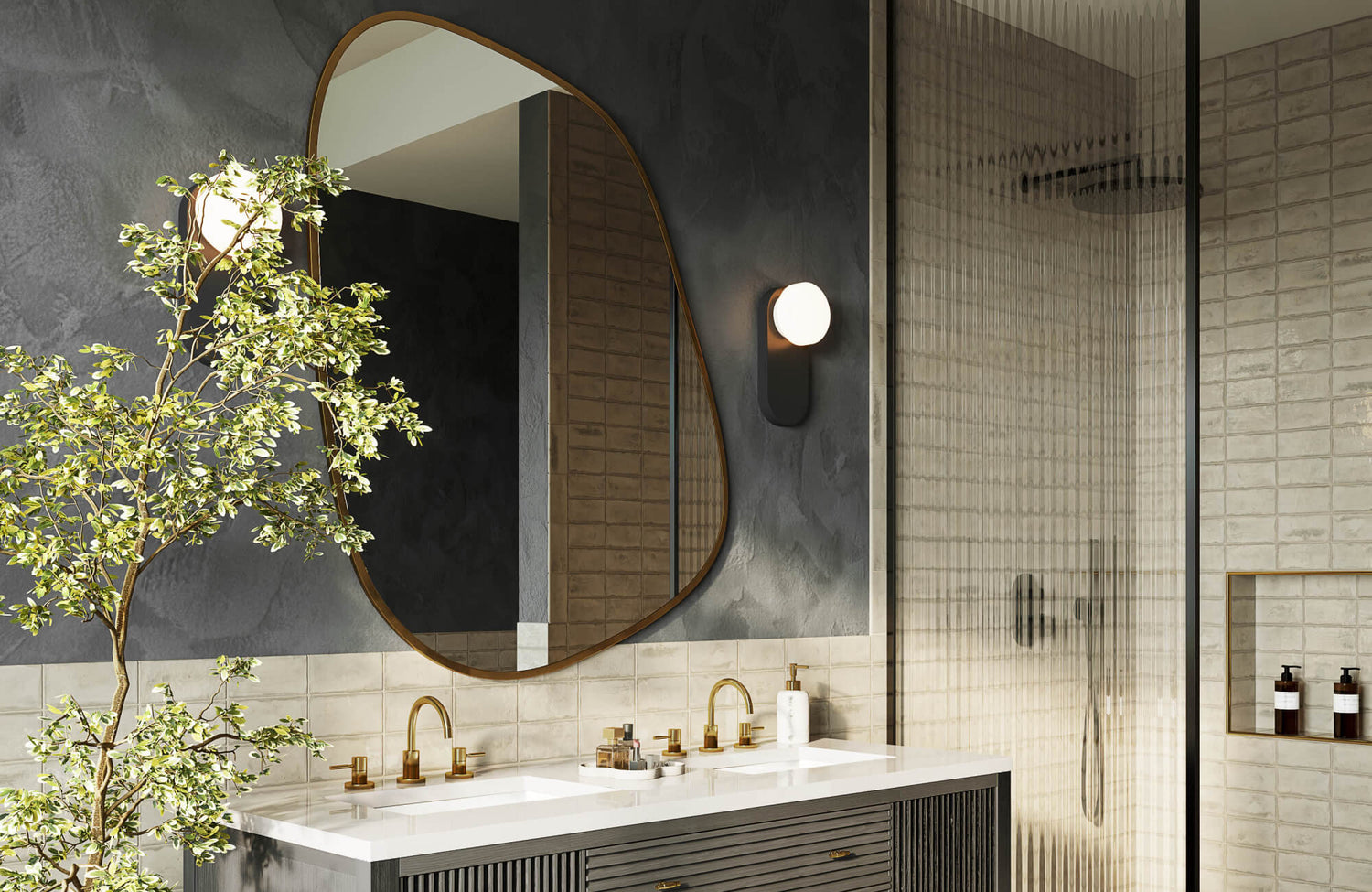
This relationship is clearly illustrated in the photo featured above, where Edward Martin’s Foley Wall Sconce in Old Bronze is positioned on either side of a well-proportioned mirror. The spacing feels intentional and balanced, allowing light to be distributed evenly across the vanity surface. Selecting a mirror that supports this type of sconce placement helps create comfortable lighting conditions while improving overall visibility at the sink.
Natural Light Amplification
Larger mirrors can reflect window light deeper into the bathroom, helping brighten areas that receive limited daylight. This effect is also useful in dim spaces, though it can become excessive if glare develops. In brighter bathrooms, more moderate mirror sizing helps manage reflections while still supporting a well-lit and comfortable environment.

Installation Constraints and Long-Term Flexibility
Practical considerations often play a larger role in mirror sizing than design preferences alone. Taking these factors into account early helps prevent limitations and allows for greater flexibility over time.
Wall Space and Obstructions
Available wall space often determines the maximum mirror size more than design preference. Outlets, switches, tile patterns, and windows all restrict mirror placement, so measuring the usable wall area early helps avoid selecting a mirror that requires awkward adjustments during installation. When a mirror fits cleanly within these boundaries, it appears intentional and is far easier to install correctly.
Future Vanity Replacement
Future updates are easier to manage when the mirror size allows for flexibility. If you plan to replace the vanity later, choosing a mirror that is slightly smaller or modular can easily adapt to new dimensions or styles, reducing the likelihood of needing a replacement. Planning with future changes in mind helps save time and expense while keeping design options open.
Maintenance and Cleaning
Ongoing upkeep is another factor that should not be overlooked when selecting mirror size. Larger mirrors tend to show water spots and splashes more easily, especially near sinks, which can require more frequent cleaning. Smaller mirrors are often easier to maintain but may limit usability. Choosing a mirror size that balances daily use with manageable upkeep helps keep the mirror practical in the long run.
Choosing the Right Bathroom Mirror Size
So, should a bathroom mirror be bigger or smaller than the vanity? In many cases, a mirror that matches the vanity width or is slightly smaller provides the most balanced combination of comfort and proportion. Larger mirrors are most effective when they enhance functionality, support lighting, and improve the overall feel of the space rather than simply filling wall space. By considering daily use, room proportions, and long-term plans for the bathroom, selecting the right mirror size becomes a more confident and well-informed decision.
If you are unsure how these considerations apply to your space, professional guidance can help simplify the decision. Our personalized design service lets you explore mirror sizing, layout, and lighting options that suit your bathroom. Contact us to discuss your project and move forward with clarity and confidence.