Thoughtfully designed bathroom light does more than illuminate—it shapes atmosphere, enhances daily rituals, and defines the character of the space. By combining multiple types of bathroom light, homeowners can achieve a refined balance between function and visual elegance. Layered bathroom light design allows illumination to transition effortlessly from practical clarity to ambient calm, adapting naturally to different moments of the day. When executed with technical precision, mixed lighting enhances comfort, supports accurate grooming, and highlights architectural details. This integrated approach transforms the bathroom into a space that feels intentional, harmonious, and beautifully illuminated.

Layered Lighting as the Foundation of Bathroom Illumination
A layered lighting strategy establishes structure and balance, allowing each lighting type to serve a distinct purpose without overwhelming the space. By integrating ambient, task, and accent lighting, the bathroom achieves a cohesive lighting system that supports both performance and visual refinement.
Ambient Lighting for General Visibility
Ambient lighting forms the visual backbone of the bathroom by providing consistent, overall illumination that supports safe movement and spatial awareness. Recessed LED downlights, flush-mount fixtures, and indirect ceiling lighting are commonly used to distribute light evenly throughout the space. Proper lumen output is also determined by room size, ceiling height, and surface reflectivity, ensuring the bathroom feels neither dim nor overly bright. Moreover, even illumination minimizes harsh contrasts and reduces eye strain, particularly in bathrooms with limited natural light. Wide beam angles further help eliminate shadows along walls and floors, creating a calm and balanced visual environment. As the foundational lighting layer, ambient lighting allows all other fixtures to function effectively without visual competition.
Task Lighting for Functional Precision
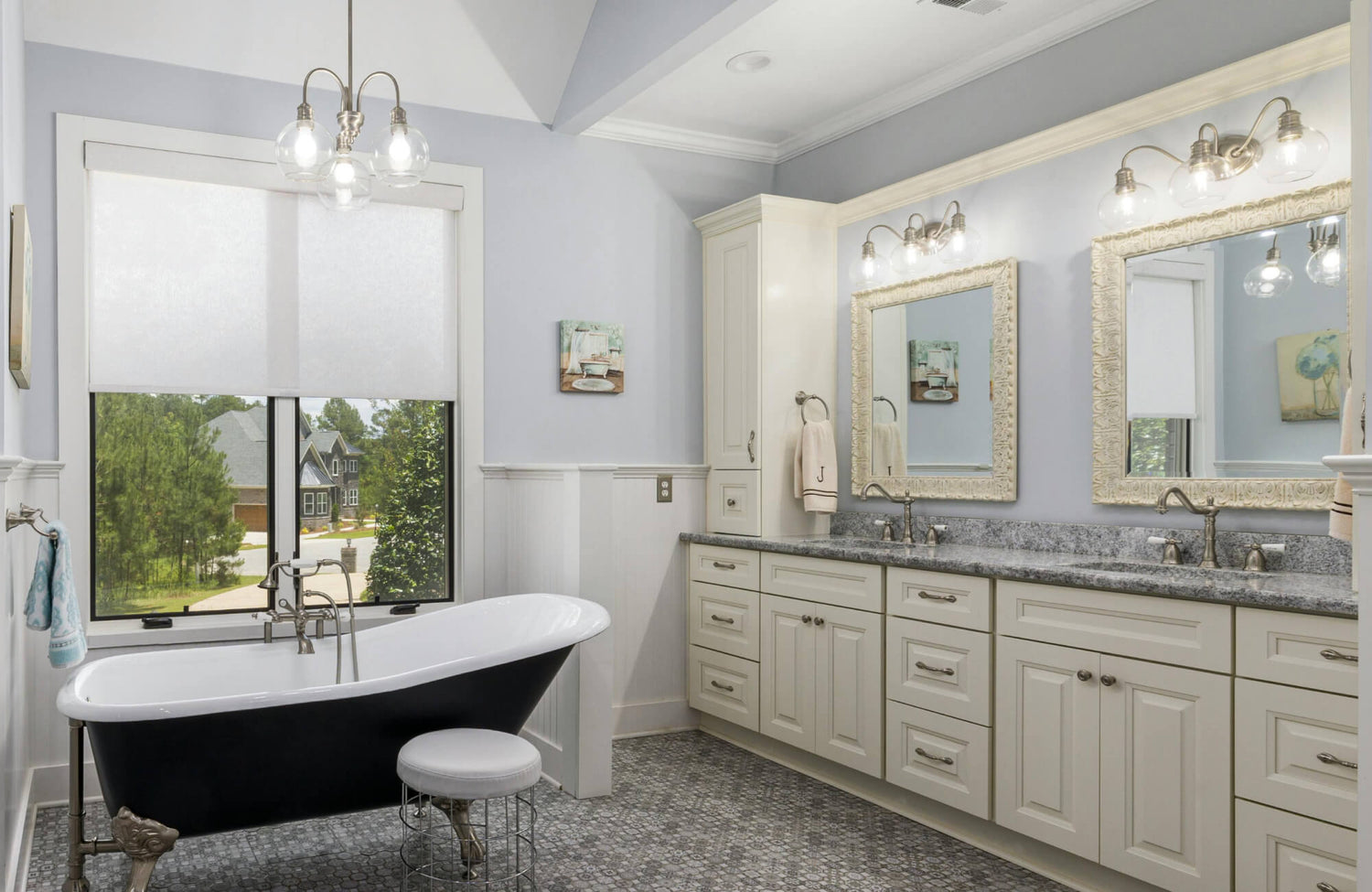
Task lighting becomes visually and functionally clear in this space through the use of wall-mounted sconces positioned on either side of the vanity mirror. These fixtures deliver balanced, forward-facing illumination that minimizes facial shadows, making them ideal for grooming tasks such as shaving, skincare, and makeup application. As displayed in the picture above, Edward Martin’s Therese Wall Sconce in Vintage Brass exemplifies this approach, combining a softly diffused globe with a warm metallic finish that enhances visibility without introducing glare. Mounted at eye level, this type of sconce also provides consistent vertical illumination that overhead lighting alone cannot achieve. Complementing the sconces, the Therese Pendant in Vintage Brass contributes to the layered lighting scheme by supplying gentle ambient light from above, helping to balance overall brightness throughout the room. Together, these fixtures demonstrate how task and ambient lighting can work in harmony, creating a bathroom that feels both visually comfortable and thoughtfully designed.
Accent Lighting for Visual Depth
Accent lighting introduces subtle contrast that enhances architectural definition and material texture. For example, LED strip lighting beneath floating vanities or within recessed niches adds dimension without increasing overall brightness. Lower lumen levels also ensure accent lighting remains understated and supportive rather than visually dominant. In addition, directional placement allows light to graze surfaces, emphasizing tile patterns, stone textures, or wall reliefs. This layered approach enhances spatial depth and visual interest. When integrated thoughtfully, accent lighting elevates the bathroom’s aesthetic while preserving balance and restraint.

Coordinating Light Output and Distribution Across Fixtures
Successfully mixing bathroom light requires careful coordination of brightness levels and directional flow. When light output is balanced across fixtures, the bathroom feels cohesive, comfortable, and visually intuitive.
Managing Lumen Levels Across Lighting Layers
Each lighting layer contributes a distinct level of brightness to the overall lighting scheme. For instance, ambient lighting delivers the highest cumulative lumen output to establish general visibility throughout the bathroom, while task lighting concentrates brightness in localized zones, reducing the need for excessive ambient illumination. At the same time, accent lighting operates at lower intensities to avoid visual distraction while adding depth. Excessive lumens can also cause glare on reflective surfaces such as mirrors and polished tile, while balanced lumen planning improves visual comfort and energy efficiency. This calibrated approach ensures lighting feels purposeful rather than overwhelming.
Beam Angles and Directional Control
Beam angle selection plays a critical role in how light spreads and interacts with the bathroom environment. Wide beam angles are ideal for ambient lighting, providing smooth and even coverage across surfaces, while narrow or asymmetric beams improve task lighting precision by focusing illumination exactly where it is required. Proper directional control also minimizes unwanted shadows and light spill. Moreover, adjustable trims allow fine-tuning during installation to achieve optimal results. This level of precision enhances lighting effectiveness without increasing wattage. Well-managed beam control contributes to a polished and professional lighting outcome.
Adaptive Control Through Dimming Systems
Dimming systems add valuable flexibility by allowing lighting layers to shift gradually throughout the day rather than operating at a single fixed level. Lower ambient settings paired with steady task lighting support nighttime routines, minimizing glare and reducing visual fatigue, while brighter settings improve daytime visibility and make cleaning tasks easier. By lowering output when full intensity isn’t needed, dimmers also help extend LED lifespan through reduced thermal stress on fixtures. When paired with smart controls, preset scenes can be tailored to different moods and activities, creating lighting that responds naturally to daily rhythms. Because transitions between levels occur smoothly rather than abruptly, the environment feels intuitive, comfortable, and visually refined, ultimately elevating the overall bathroom lighting experience.

Color Temperature and Color Rendering Consistency
Consistency in light color is essential when combining multiple bathroom light types. Aligning color temperature and color rendering ensures visual continuity and accurate perception across the space.
Selecting the Appropriate Kelvin Range
Choosing the correct color temperature establishes the emotional and functional tone of the bathroom light environment. Most bathroom light performs best within a 2700K to 3500K range, which balances warmth with visual clarity and avoids a clinical or overly yellow appearance. Warmer temperatures within this range also create a relaxing atmosphere suitable for evening use, while neutral whites support alertness and precision during grooming tasks. Moreover, mixing fixtures with noticeably different Kelvin ratings can create visual dissonance, making the space feel fragmented or poorly coordinated. Consistency across ambient, task, and accent lighting further allows the eye to transition smoothly without perceiving shifts in light color. This uniformity enhances comfort, supports accurate reflection in mirrors, and reinforces a cohesive bathroom light design.
Importance of High Color Rendering Index
Color Rendering Index (CRI) plays a critical role in how accurately colors appear under artificial light, which is especially important in spaces dedicated to personal care. When lighting is high-CRI, typically 90 or above, skin tones, cosmetics, and material finishes read as natural and true to life, supporting tasks where subtle color perception matters. This level of accuracy becomes essential during makeup application, shaving, and skincare routines, where even slight shifts in tone can influence results. By contrast, low-CRI lighting can distort hues, flatten texture, and cause surfaces to look dull or inaccurate, leading to visual confusion. Maintaining similar CRI levels across ambient, task, and accent lighting also prevents distracting shifts in appearance from one area of the bathroom to another. Altogether, high color rendering builds visual confidence and helps transform everyday bathrooms into environments that feel precise, flattering, and professionally lit.
Avoiding Spectral Inconsistencies
Even when fixtures share the same Kelvin rating, differences in LED technology can result in subtle spectral inconsistencies that affect perceived color quality. These variations are often most noticeable near mirrors, glossy tiles, and polished surfaces where reflected light amplifies discrepancies. In mixed lighting systems, inconsistent spectral output can cause certain areas to appear warmer, cooler, or slightly tinted. Specifying fixtures from the same manufacturer or LED family reduces this risk and improves color uniformity. Using a unified lighting platform also simplifies long-term maintenance and future replacements. By minimizing spectral variation, the bathroom light feels cohesive, refined, and intentionally designed.

Integrating Decorative Lighting Into Functional Schemes
Decorative lighting adds personality and visual interest, but it must align with functional lighting principles to remain effective. When integrated thoughtfully, decorative fixtures enhance the bathroom’s character without compromising performance or comfort.
Decorative Fixtures as Supporting Elements
Decorative lighting functions most effectively when it supports the overall lighting composition while adding visual character to the space. In the bathroom photo shown above, the Aida Pendant in Aged Brass acts as a sculptural pendant focal point above the bathing area, delivering soft ambient illumination that enhances mood without overpowering functional lighting layers. The pendant’s elegant profile and warm brass finish also introduce visual warmth while maintaining a balanced, diffused glow. Complementing the pendant, our Posey Wall Sconce in Aged Brass is positioned at the vanity, reinforcing symmetry and contributing decorative refinement alongside task lighting. Together, the pendant and wall sconces frame key architectural elements rather than competing for attention. Because decorative pendants and sconces typically produce lower lumen output, they layer naturally into the lighting plan while preserving comfort, clarity, and everyday usability.
Controlling Glare and Visual Comfort
Managing glare becomes especially important when decorative lighting is introduced into a bathroom environment where reflective surfaces are common. Exposed bulbs, clear glass shades, and polished metal finishes can create uncomfortable brightness that disrupts visual comfort, particularly in smaller bathrooms. This effect is often amplified by glossy tile, mirrors, and glass shower enclosures that reflect light unpredictably. Incorporating diffusers, frosted glass, or opal finishes also helps soften light output and reduce harsh contrasts. Shielded fixture designs further limit direct line-of-sight exposure, improving comfort at eye level. In addition, mounting height and fixture orientation play a significant role in glare control, ensuring decorative lighting enhances ambiance rather than becoming visually intrusive.
Aligning Aesthetics With Technical Performance
While decorative lighting is often selected for its visual appeal, it still needs to meet the same technical performance standards as functional fixtures. Integrated LED designs help achieve this balance by offering consistent lumen output, stable color temperature, and long-term reliability that retrofit bulb solutions don’t always provide. When the color temperature and Color Rendering Index (CRI) of decorative pieces are coordinated with surrounding ambient and task lighting, the entire bathroom maintains visual continuity rather than feeling pieced together.
It is also important that decorative fixtures carry the appropriate damp- or wet-location ratings based on where they are installed, ensuring safety as well as durability. Finally, finishes should harmonize with nearby materials such as tile, stone, and metal hardware to reinforce an overall sense of cohesion. When aesthetic intent and technical specifications work together in this way, decorative lighting becomes not only a focal point but also a dependable, fully integrated part of the bathroom lighting system.

Safety, Zoning, and Code Compliance in Mixed Lighting Systems
Safety considerations are fundamental to bathroom light design, particularly when multiple fixture types are used. Proper zoning and electrical compliance ensure reliable performance in moisture-rich environments.
Understanding Bathroom Light Zones
Bathroom light zones are defined by proximity to water sources and determine where specific fixture types may be safely installed. Wet zones include shower enclosures, tub interiors, and areas directly exposed to water spray, requiring fixtures rated for wet locations. Damp zones also extend beyond direct exposure and include areas surrounding sinks and tubs where humidity is consistently present. Meanwhile, dry zones encompass ceilings and wall areas away from moisture, allowing greater flexibility in fixture selection. Each zone imposes requirements for fixture construction and sealing. Properly identifying these zones ensures lighting placement supports safety and longevity. This zoning framework is essential for a compliant bathroom light plan.
Fixture Ratings and Moisture Protection
Fixture ratings indicate how well a light can withstand moisture, humidity, and airborne particles, making them an essential consideration in bathroom environments. Wet-rated fixtures are engineered with sealed housings that prevent water intrusion, while damp-rated fixtures are suitable for humid areas where direct spray is unlikely. Choosing fixtures with ratings below what the location requires can also increase the risk of corrosion and electrical failure, as moisture intrusion may gradually damage wiring and LED components. Selecting the correct rating, therefore, supports both durability and safety, ensuring that every element of a mixed lighting system performs reliably over time.
Electrical Safeguards and Installation Standards
Electrical safeguards are a fundamental requirement in bathroom lighting systems, ensuring that performance and safety work hand in hand. For instance, Ground Fault Circuit Interrupter (GFCI) protection helps reduce the risk of electric shock in areas exposed to water, while low-voltage lighting must be paired with properly rated drivers and transformers positioned outside wet zones to avoid overheating or moisture exposure. Careful attention to placement, along with proper grounding and bonding, further minimizes electrical hazards and supports system reliability. When installations follow established electrical codes, fixtures operate safely over the long term, and professional installation adds a layer of assurance, supporting both dependable performance and peace of mind.
Bathroom Light Designed for Everyday Living
Mixing different types of bathroom light creates a space that feels both functional and beautifully composed. When ambient, task, accent, and decorative lighting are layered with intention, the bathroom adapts effortlessly to daily routines. Consistent color temperature, controlled brightness, and proper zoning ensure comfort and safety. Thoughtful coordination transforms lighting from a technical necessity into a design feature. A well-executed mixed lighting plan elevates the bathroom into a refined, purposeful environment. This approach not only enhances visual clarity but also adds lasting value to the home.
Edward Martin’s design services help bring these lighting principles to life through expert guidance tailored to your space and style. Contact us to explore custom solutions and create a bathroom lighting design that feels both elevated and effortlessly functional!