Designing a small bathroom vanity layout with a mirror and integrated lighting requires balancing ergonomics, building-code considerations, proportion, and visual scale. With limited square footage, every inch of horizontal and vertical space must serve a functional and aesthetic purpose. The ideal dimensions also depend on user height, available wall clearance, plumbing placement, and desired storage capacity. Additionally, light fixture spacing, lumen output, and mirror proportions influence how spacious or constrained the room will feel. This article explores the optimal sizing strategies, industry standards, and layout guidelines that help homeowners achieve a high-performing, space-efficient vanity zone.

Determining Optimal Vanity Dimensions for Small Bathrooms
Choosing the correct vanity dimensions creates the foundation for a well-functioning compact bathroom, helping every subsequent decision fall naturally into place. When the vanity aligns with both ergonomic guidelines and spatial constraints, the entire layout operates more efficiently.
Recommended Widths for Compact Bathroom Vanities
A width between 18–30 inches supports small-bathroom circulation by keeping movement pathways open while still providing a functional sink zone, allowing the vanity to feel integrated rather than intrusive. This range works particularly well because it accommodates plumbing alignment without overwhelming the wall surface. A 24-inch vanity also often becomes the preferred choice, as it strikes a delicate balance between footprint and usability in narrow layouts. As the width shrinks, visual mass decreases, helping confined rooms maintain a lighter, more breathable appearance. Corner vanities extend this efficiency further, redirecting movement diagonally to reclaim lost square footage. Through these adjustments, vanity width becomes a powerful tool for shaping how spacious and navigable a small bathroom feels.
Ideal Depth for Maximizing Circulation Space
While standard vanities extend 21 inches from the wall, shallower options between 16–18 inches allow the user to maneuver comfortably, which becomes especially important where clearances are tight. The reduced depth prevents congestion around toilets and shower doors, creating a more intuitive flow through the room. Because the counter plane sits closer to the wall, the vanity feels visually lighter, which subtly enhances the room’s perceived width. These compact depths also pair well with wall-mounted designs, as the increased floor visibility reinforces a floating, weightless effect. In practical terms, decreased depth can simplify pipe routing and ease installation, further benefiting small-scale projects. As a whole, the transition to a shallow-depth vanity gracefully reshapes both movement and spatial perception.
Appropriate Vanity Heights for Ergonomic Comfort
A height of 34–36 inches aligns with modern ergonomic standards, ensuring that daily grooming tasks feel natural rather than physically demanding. When the counter sits at this level, users maintain a comfortable posture, which becomes increasingly important in smaller rooms where movement is more confined. Taller vanities work particularly well with undermount sinks, as they offset the lower basin depth to maintain ergonomic consistency. Conversely, shorter vanities around 32 inches serve transitional spaces but must be balanced carefully to avoid feeling diminutive in already compact environments. Vessel sinks also add visual height and require strategic adjustments, ensuring the final counter height remains functional rather than overwhelming. When all height variables align harmoniously, even a compact vanity supports ease of use without compromising style.

Proportioning the Mirror to Match the Vanity
A well-proportioned mirror not only enhances grooming functionality but also shapes the visual rhythm of the entire bathroom. When its size matches the vanity thoughtfully, the mirror becomes a central tool in expanding perceived space.
Ideal Mirror Width Relative to Vanity Size
A mirror that is 2–4 inches narrower than the vanity strikes a natural balance, giving the composition breathing room while maintaining strong alignment with the sink and fixtures. This proportional gap creates a controlled boundary that optimizes the placement of side-mounted sconces without feeling cramped. As the eye moves along this balanced arrangement, the mirror also reads as purposeful rather than oversized or compressed. For a 30-inch vanity, a mirror in the 26–28-inch range delivers optimal harmony, offering generous reflective coverage without overwhelming the wall.
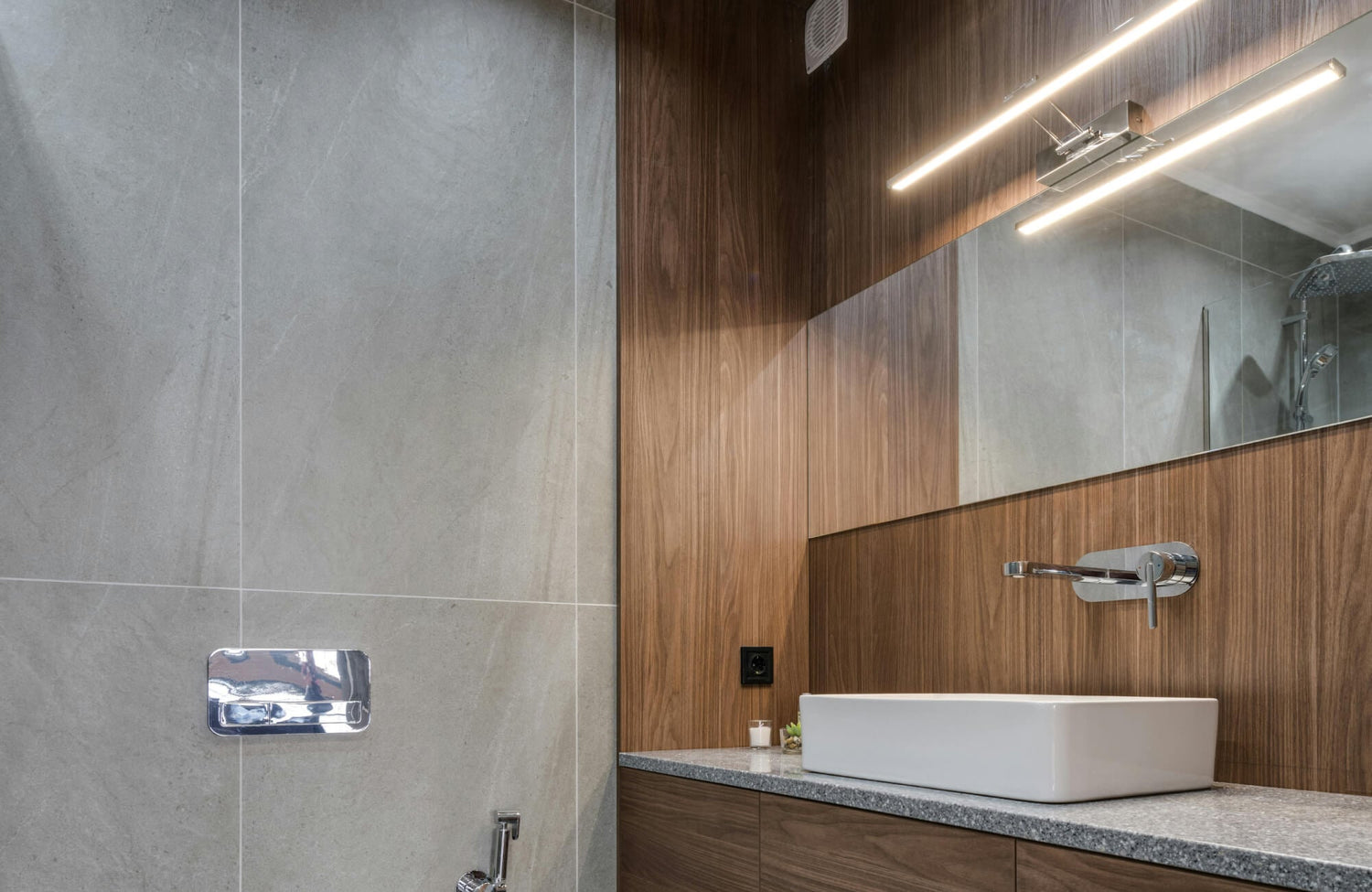
A practical example of this pairing, as displayed in the photo above, is the Demi 30" Single Vanity in Mid-Century Walnut with 3 cm White Zeus Quartz Top, which aligns beautifully with a compact, vertically oriented mirror. Edward Martin’s Esmeralda Small Mirror in Polished Brass, measuring 21" W x 2" D x 32" H, offers a refined alternative that introduces elongated height and warm metallic contrast, demonstrating how proportion and finish work together to shape a cohesive small-bathroom composition.
Height and Shape Considerations
Mirror height plays a pivotal role in manipulating vertical perception, as taller mirrors draw the eye upward and create an immediate sense of elevation. When the mirror extends near the ceiling, its reflective plane captures more ambient light, distributing brightness evenly across the space. Rounded-rectangle and pill-shaped silhouettes also add a softening influence, preventing harsh visual edges from crowding narrow walls. These gentle contours introduce movement that subtly redirects focus, helping the room feel more fluid and expansive. Moreover, recessed medicine cabinets contribute functional depth while maintaining a flush wall profile, ensuring that practicality never overshadows visual cohesion. Through deliberate height and shape selection, the mirror becomes an instrument for both aesthetic refinement and spatial enhancement.

Sizing and Positioning Lights for Maximum Task Visibilit
Lighting determines not only how clearly one sees but also how large or confined the room appears. By selecting appropriately scaled fixtures and thoughtful placement, the small bathroom gains both precision and warmth.
Best Fixtures and Placement for Small Bathrooms
Side-mounted sconces positioned 60–66 inches from the floor provide even, face-level illumination that removes harsh shadows and supports clear, comfortable grooming. This height creates a lighting envelope that works seamlessly with the mirror’s reflective plane, allowing both elements to function as a unified visual system. Spacing the sconces 26–30 inches apart also ensures consistent brightness across the face, which is especially valuable in compact bathrooms where wall space is limited.
As shown in the photo above, a vanity such as the Colton 36" Single Vanity in Sable with 3 cm White Zeus Quartz Top anchors the composition; this spacing helps maintain proportion and prevents the lighting from feeling compressed around a wider cabinet. Fixtures like our Leilani Wall Sconce in Patina Brass elevate the arrangement further, as their sculptural silhouette and warm metallic finish introduce soft, diffused light that complements natural tones and quartz-based surfaces. Through this interplay of scale, placement, and material harmony, the lighting layout enhances both visual clarity and the overall sense of spaciousness in a small bathroom.
Technical Lighting Attributes (Lumens, CRI, Color Temperature)
A lumen output between 1500–3000 lumens establishes a bright yet controlled lighting environment that supports grooming accuracy without producing distracting glare on reflective surfaces. Pairing this with a color temperature of 2700–3500K creates a warm, lifelike glow that remains comfortable to the eye while still offering clear visibility. Incorporating high-CRI LEDs, particularly those rated 90 and above, further enhances the setup by ensuring colors appear true and consistent, an essential quality for tasks such as makeup application or shaving. When fixtures include diffused lenses or frosted panels, the light softens across the room, preventing harsh hotspots common in compact spaces. This balanced distribution is further enhanced by reflective surfaces, which help disperse illumination evenly. Together, these lighting characteristics produce a small bathroom environment that feels bright, accurate, and visually consistent.

Space Planning, Clearance Rules and Building Standards
Clearance planning ensures that every movement around the vanity occurs naturally, preventing tight corners or obstructed pathways. By adhering to recommended spatial standards, small bathrooms maintain both comfort and functional reliability.
Essential Clearances Around the Vanity
A minimum of 30 inches of open floor space in front of the vanity creates a comfortable buffer zone, allowing users to stand and maneuver without strain. This clearance becomes especially valuable in compact rooms where multiple fixtures converge. Maintaining 4–6 inches of side spacing also prevents walls from feeling cramped and protects corners from moisture buildup. When drawers and cabinet doors require 18–24 inches of extension room, ensuring that space remains unobstructed supports long-term usability. A consistent circulation path further prevents awkward movement patterns that can arise in narrow bathrooms. Through these spatial allowances, the vanity integrates smoothly into the room without disrupting the flow.
Integrating Plumbing Constraints
Behind the vanity, 12–14 inches of depth typically accommodates supply lines and drain assemblies, creating a mechanical pocket that ensures efficient installation. In small bathrooms, compact P-traps or offset drains can reclaim valuable storage space within the cabinet interior. Wall-mounted vanities also enhance access to plumbing by exposing the floor plane, which simplifies maintenance and future adjustments. In addition, vertical routing of supply lines minimizes internal clutter, improving organization within the vanity base. As these components interact, a seamless relationship emerges between plumbing infrastructure and functional cabinetry. This integration ensures the vanity performs reliably without compromising storage or spatial clarity.

Harmonizing Vanity, Mirror, and Lighting for Spatial Balance
A well-coordinated vanity–mirror–lighting ensemble elevates both function and aesthetics, creating an environment that feels cohesive despite its compact footprint. When these elements align in proportion and finish, the small bathroom gains a sense of calm, order, and visual openness.
Balancing Visual Weight and Aesthetic Proportion
Light-reflective finishes, streamlined silhouettes, and softly rounded edges help the vanity maintain an airy presence, preventing it from overpowering the room. These brightened surfaces pair beautifully with warm undertones, softening contrast and creating a welcoming sense of balance. In the photo featured above, Edward Martin’s Maxine 55" Single Vanity in Black Wash Oak Veneer with a Carrara Marble Top introduces a richly textured wood grain anchored by a luminous marble surface, offering depth that feels substantial yet never visually heavy. The mirror enhances this vertical lift, especially when using the Esmeralda Wide Mirror in Iron Matte Black, whose elegant arched profile and slender frame draw the eye upward with a gentle, architectural rhythm. Complementing this geometry, the Coraline Wall Sconce in Patina Brass adds a refined sculptural presence, echoing the mirror’s curvature while casting a soft, diffused glow that warms the surrounding finishes.
As these elements converge, their interplay of weathered oak, matte-black accents, and patina-brass lighting creates a layered composition that feels intentionally calibrated rather than visually compressed. Through this harmony of scale, finish, and illumination, the entire arrangement strengthens spatial perception and brings a polished sense of cohesion to the bathroom.
Design Tactics That Expand Small Bathrooms
A wall-to-wall mirror multiplies available light and depth, transforming even compact bathrooms into brighter, more expansive spaces. This effect is enhanced by backlit mirrors, which create a floating glow that gently lifts the composition away from the wall. Complementary minimalist light fixtures also preserve open sightlines, helping the room feel continuous rather than fragmented. Reflective surfaces and bright finishes then further amplify light diffusion, reinforcing the impression of added volume. Moreover, maintaining a consistent colour temperature across both ambient and task lighting creates visual harmony, tying these elements together. When these strategies work in unison, the bathroom gains a polished spaciousness that maximizes every inch.
Elevating Small Bathroom Functionality Through Strategic Design
Thoughtful coordination of the vanity, mirror, and lighting ensures even the smallest bathrooms operate efficiently and maintain visual balance. By selecting dimensions that respect circulation space and human ergonomics, the layout becomes naturally intuitive. Properly scaled mirrors and lighting further elevate clarity and expand perceived space, contributing to a comfortable daily grooming experience. When technical specifications align with aesthetic restraint, the result is a bathroom that feels refined rather than compromised. This integration demonstrates how precision-driven design transforms compact bathrooms into highly functional, aesthetically cohesive environments.
For homeowners seeking expert guidance in bringing these elements together with precision, Edward Martin’s design services offer personalized solutions that streamline every decision, making it easy to achieve a space that feels beautifully resolved. To explore how your bathroom can be transformed with thoughtful detailing and tailored product recommendations, contact us to begin your design journey!