Kitchen pendant lights are more than simple fixtures; they shape how your space feels and functions. The right pendants can highlight an island, anchor an open-concept layout, or add warmth to a cozy breakfast nook. Yet without clear rules to follow, it is easy to end up with lights that are too large, hung too low, or out of sync with the rest of the design.
This article brings clarity to the process by breaking down the essential principles of pendant lighting. From placement and scale to layering and safety, you will discover how each detail contributes to both practicality and style. By the end, you will be equipped with the knowledge to transform pendants from an afterthought into one of the most defining elements of your kitchen.

Understanding Placement Rules for Kitchen Pendants
Placement is foundational. The right pendant height, spacing, and alignment create a cohesive look and ensure optimal task lighting.
Optimal Height Over a Kitchen Island
The sweet spot for pendant height is 28 to 34 inches above the countertop. Hanging lights within this range gives you the best of both worlds: clear, unobstructed sightlines across the kitchen and direct, usable illumination for cooking or dining. It also prevents the awkward feel of fixtures hanging too low, which can make the space feel cramped.
If your ceiling height is taller than the standard 8 to 9 feet, you’ll want to adjust accordingly. For example, in kitchens with ceilings over 9 feet, pendants can comfortably hang a little higher, up to 40 inches above the countertop. This slight lift keeps the proportion balanced and prevents the fixtures from feeling dwarfed by the extra vertical space. The key is to test sightlines from both a standing and seated perspective so that your pendants provide functional light without blocking the flow of your kitchen visually. In the image shown above, our Rosa Triangular Pendant in Aged Brass shows how proper height creates a refined balance between form and function. Its soft gold tone not only highlights the island but also draws the eye upward, reinforcing ceiling height while keeping the space warm and inviting.
Strategic Spacing for Multiple Fixtures
When you plan for more than one pendant, the spacing between them becomes just as important as their individual placement. A simple way to calculate this is by using the “pendants + 1” formula. Take the total length of your island and divide it by the number of pendants plus one. This gives you even spacing from each end and between the fixtures.
For example, if your island is six feet long and you plan to hang two pendants, divide by three. You’ll end up with two feet of space from each end of the island and two feet between the pendants. This method eliminates the guesswork and avoids the common mistake of crowding pendants too closely or leaving awkward gaps that disrupt balance. The result is a symmetrical arrangement that not only looks polished but also distributes light evenly across your island.
Precise Centering Over Work Zones
Although an island is often the primary spot for pendants, you also want to think about other zones where focused lighting is helpful. For instance, if you’re hanging a pendant over a sink, it should be precisely centered to make washing dishes or prepping food easier. This direct alignment ensures the light falls exactly where you need it, rather than creating unnecessary shadows.
On larger islands that serve multiple purposes, consider dividing the space into zones and placing pendants accordingly. For example, one fixture might align with the food prep area while another hangs over a seating section. This way, the lighting isn’t just decorative but intentionally supports the way you use your kitchen. In spaces where zoning is important, our Robbins Pendant in Aged Brass/Soft Black works beautifully, as its warm brass accents add elegance while the soft black finish grounds each zone. When centered over a sink or prep area, it provides a striking focal point that combines style with precise, task-ready illumination.

Considering Scale and Proportion for Pendant Lights
The size and number of pendants must complement the kitchen’s scale, visually and functionally. Choosing the right proportions ensures the lights enhance your kitchen rather than distract from it.
Sizing Relative to the Kitchen Island
A helpful rule of thumb when selecting pendant size is the one-third rule. This means the combined width of your pendants should not exceed one-third of your island’s total length. For example, if your island is nine feet long, the pendants together should be no wider than three feet. This keeps the fixtures in proportion to the surface below and prevents them from dominating the space.
Another factor to consider is the width of the island itself. If you have a narrow island, a pendant that is too wide may spill light beyond the countertop and feel visually heavy. In contrast, a deeper island can support a slightly broader pendant that spreads light more effectively across the entire surface. Thinking about pendant size in both length and depth ensures that the fixtures not only look proportional but also provide practical coverage for the area they are meant to illuminate.
Balancing Quantity and Scale
Once you determine the right size, the next step is deciding how many pendants to install. You may find that two oversized pendants provide the same amount of light and a stronger focal point than three or four smaller ones. This works especially well in open-concept kitchens, where bold fixtures can anchor the island and tie the space together.
Smaller pendants, on the other hand, often work better in cozier or more traditional kitchens. They create an airy, light feel and allow you to maintain symmetry without adding bulk. The decision between large and small fixtures is not just about looks; it’s about how the scale complements the kitchen’s proportions. When you strike the right balance, the pendants also become a natural extension of the room rather than an afterthought.
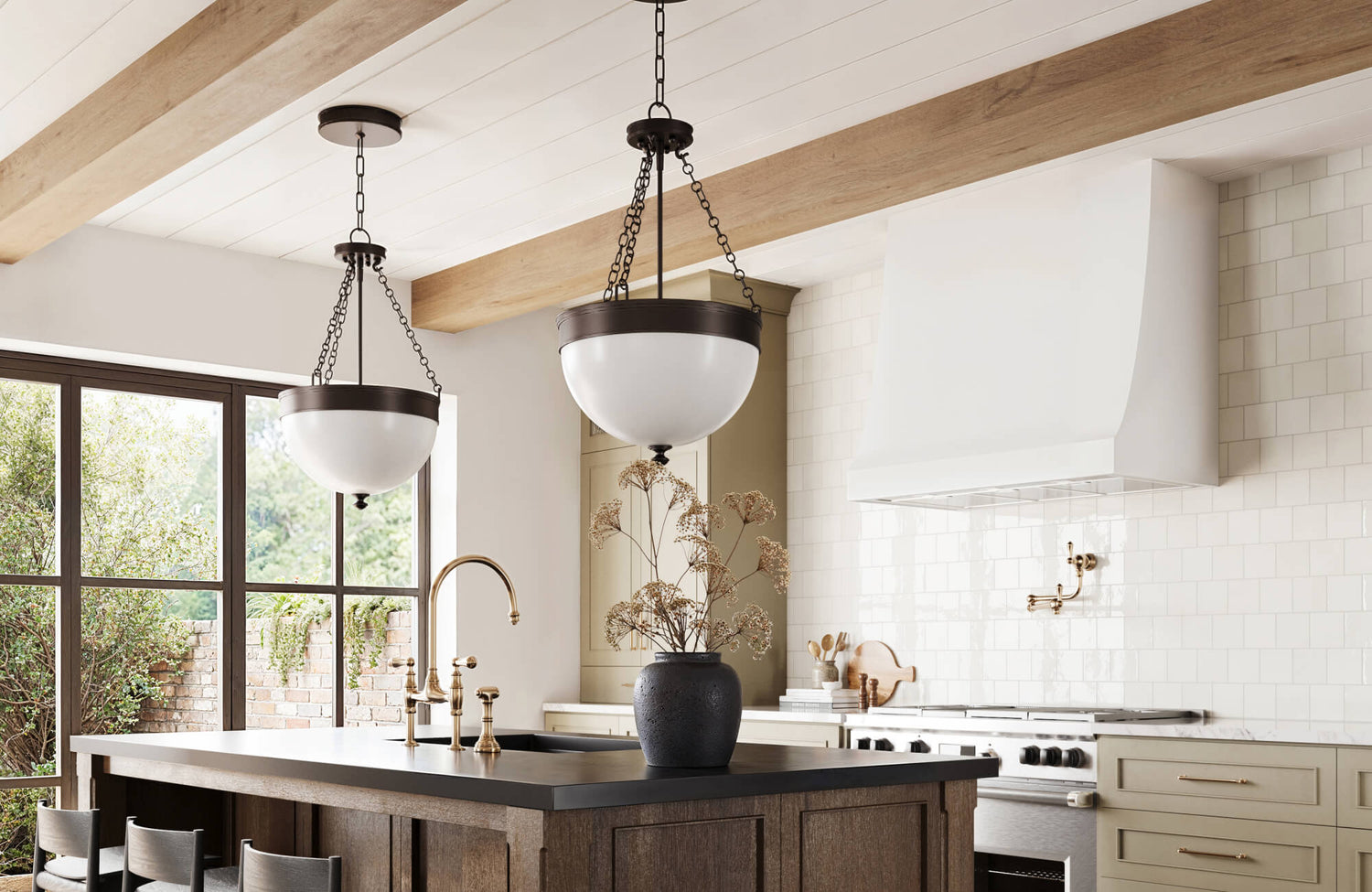
An excellent example of this approach is displayed in the picture above, featuring our Barnes 14" Pendant in Aged Antique Distressed Bronze. With its substantial form and warm bronze finish, it demonstrates how fewer, larger pendants can command presence without overwhelming the space. By anchoring the island visually, it creates balance and adds depth, proving that scale and quantity go hand in hand when establishing harmony in kitchen lighting.
Matching Pendant Size to Ceiling Height
Ceiling height plays a major role in how pendant size is perceived. In a room with standard eight-foot ceilings, a medium-sized pendant usually feels balanced. However, if your kitchen has tall or vaulted ceilings, a small pendant may look insignificant, almost floating without purpose in the space. This is where taller, more substantial designs come into play.
Choosing elongated or voluminous pendants in rooms with greater ceiling height also helps draw the eye downward and visually anchor the area. This keeps the space from feeling too vast or disconnected. By matching pendant size to ceiling height, you ensure that your fixtures not only light the room but bring a sense of proportion and grounding to the overall design as well.

Layering Light with Pendants in the Kitchen
Pendants bring focused illumination to key work areas, but they are never meant to stand alone. Relying solely on them often leaves parts of the kitchen too dim or creates uneven brightness that feels disjointed. To achieve a balanced effect, pendants should work in tandem with ambient lighting sources such as recessed ceiling fixtures or flush mounts. Adding under-cabinet lighting further enhances visibility by eliminating shadows on countertops, ensuring that every task area is fully lit. This layered approach creates a kitchen that is not only practical but also visually comfortable, with light evenly distributed throughout the room.
Another essential part of layering is control. Installing dimmers on separate circuits allows you to adjust the brightness of your pendants independently from other lights. This flexibility means you can maintain a bright, functional workspace during meal prep and then transition to a softer, more welcoming glow when it’s time to dine or entertain. Beyond convenience, dimmers also extend bulb life and improve energy efficiency, giving you long-term benefits while enhancing your day-to-day experience. Our Carly 22" Pendant in Vintage Brass, shown above, is a perfect example of a pendant that delivers task lighting while also contributing to the layered plan. Its vintage brass finish adds warmth and character, while its size ensures broad, even coverage across the island, proof that pendants can be both functional and atmospheric when thoughtfully integrated.

Styling and Design Rules for Pendant Choices
Pendant lighting is an opportunity to reinforce your kitchen’s style. Carefully selected shapes, finishes, and bulb tones complete the aesthetic while ensuring your space feels cohesive and inviting.
Material and Finish Coordination
The finish of your pendants sets the tone for how they interact with other design elements in the kitchen. Although it might be tempting to match everything perfectly, the most visually interesting spaces often blend finishes in a balanced way. For instance, bronze or matte black pendants can add depth when paired with stainless steel appliances, creating a layered, designer-quality look. Similarly, brushed brass pendants can stand out beautifully against cooler-toned cabinetry, adding warmth without clashing.
The key is to aim for finishes that share either a similar undertone or sheen level so that they harmonize without feeling repetitive. A glossy finish should pair with another reflective element, while matte pendants complement soft, brushed surfaces. When done well, this coordination creates a natural rhythm in the kitchen, each finish distinct, yet working together to form a unified design. Our Kaley 16" Pendant in Aged Brass, as seen above, illustrates this balance perfectly. Its soft brass tone ties in with warm wood cabinetry while also contrasting against cooler surfaces, proving how finish choice can unify the entire space without feeling one-dimensional.
Shape and Style Consistency
The shape of a pendant should feel like an extension of your kitchen’s architecture and style. Sleek, geometric pendants with clean lines tend to look right at home in modern kitchens, where minimalism and structure define the space. In contrast, curved or caged designs echo the softness of more traditional or farmhouse kitchens, blending seamlessly with ornate detailing or rustic finishes.
Introducing a pendant that contrasts with your kitchen’s dominant style can also inject unexpected character. For example, placing a minimalist globe pendant in a classic space can give it a contemporary lift, while a rustic lantern-style fixture in a streamlined kitchen adds warmth and texture. The key is to be intentional; when contrast is purposeful, it feels bold and sophisticated rather than out of place.
Color Temperature and Bulb Choice
The type of bulb you choose has as much influence on your kitchen’s atmosphere as the fixtures themselves. Warm light in the 2700K to 3000K range tends to flatter wood tones, cream finishes, and earthy palettes, creating a cozy and welcoming glow. On the other hand, neutral white light in the 3500K to 4000K range works better in kitchens with crisp white, gray, or cool-toned cabinetry, offering a clean look without veering into sterility.
What you want to avoid is overly blue light above 5000K, which can make your kitchen feel more like a laboratory than a living space. By matching the bulb’s temperature to your kitchen’s materials and colors, you also ensure that every detail, from the veining in your countertop to the hue of your cabinetry, appears at its best. This careful choice turns lighting from a functional element into a finishing touch that elevates the entire room.

Safety and Technical Guidelines for Pendants
Beyond aesthetics, pendant lights must meet safety codes and installation standards to ensure they function reliably for years to come. Because kitchens already demand a lot from their electrical systems, it’s important to confirm that your lighting does not overload a circuit. As a rule of thumb, you should keep the total wattage under 80 percent of the circuit’s rated capacity, which is roughly 1,440 watts on a 15-amp circuit and 1,920 watts on a 20-amp. Since pendants often share a circuit with recessed lights, under-cabinet fixtures, or even appliances, checking capacity before installation is critical. For the safest outcome, it is always best to have a licensed electrician handle the evaluation and installation so everything is done correctly and up to code.
Moreover, placement plays a major role in safety. Pendants should hang at least 30 to 36 inches above cooktops to avoid exposure to heat, grease, or open flames. Similarly, over sinks, fixtures should be positioned outside the splash zone to prevent contact with water. These clearances not only protect the fixtures but also reduce fire hazards and improve durability. Local building codes may set more specific requirements, so it’s always wise to verify guidelines in your area before finalizing placement.
Finally, the safety of pendants depends on selecting the right rating for the environment. Fixtures installed near sinks or other humid areas should carry a “damp location” UL rating, meaning they can withstand moisture and condensation without corroding. In drier areas, such as above an island, standard “dry-rated” pendants are usually sufficient. By choosing fixtures that match their environment, you maintain compliance while also protecting your investment. Paying attention to these technical details ensures your pendant lights don’t just look beautiful; they remain safe, durable, and reliable over time.
Designing With Intention
The rules for kitchen pendant lights exist not to confine you, but to guide you toward lighting that is both functional and inspiring. When you consider placement, proportion, layering, design, and safety together, pendants stop being simple fixtures and become defining features of your kitchen. They also highlight your work zones, set the tone for gatherings, and bring harmony to the entire space. By applying these principles with intention, you gain the freedom to create a kitchen that feels balanced, welcoming, and unmistakably your own. Ultimately, great lighting does more than brighten a room—it transforms how you experience it every day.
If you are ready to brighten your kitchen with pendant lights but need help refining the details, our team can guide you through the process. From choosing the right pendant proportions to selecting finishes and fixtures that complement your space, expert support ensures every decision is both practical and stylish. You can easily reach out through our contact page to connect with professionals who can turn these lighting rules into a tailored plan for your space.