Black subway tile occupies a specific position in a room that few other surface materials can replicate. The glaze reflects light while the color absorbs it, creating a surface that feels both present and composed depending on how the light falls and what surrounds it. That quality, combined with a format that has proven itself across residential and commercial interiors for generations, is what makes black subway tile a considered choice rather than simply a current one. In this blog, we'll cover the practical and visual case for black subway tile, from how it performs in demanding environments to where it works beyond the spaces it is most commonly associated with.

What Black Subway Tiles Bring To A Room's Character
Black subway tiles work across a wider range of interiors than most dark materials do, and that range comes from the tile's own restraint. The format is familiar, the color is decisive, and the result is a surface that holds its own without demanding that everything around it defer to it.
How The Depth Of A Black Tile Reads In Different Spaces
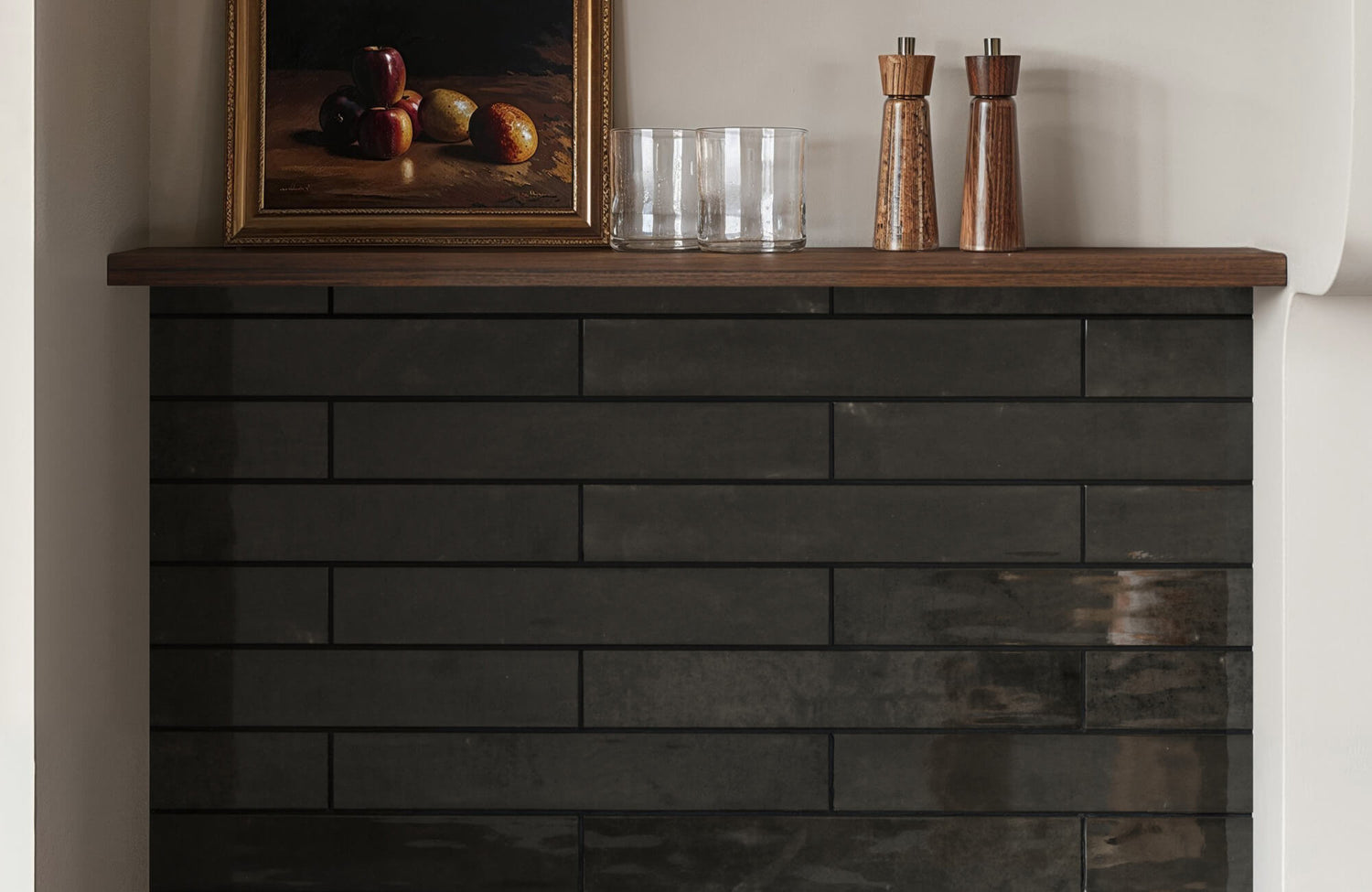
A black subway tile does not behave like other dark surfaces in a room. Where a painted wall or a dark stone absorbs light, a glazed black tile reflects it, which gives the surface a quiet presence that shifts throughout the day depending on where the light is coming from. That gloss catches the warm tone of brass, the grain of natural wood, and the cool surface of stone, drawing those materials into a visual relationship with the wall rather than sitting apart from them. The elongated format of our Jaden 2.5x16 Glossy Ceramic Tile in Ink, shown installed in the space above, works particularly well in this regard. Its length draws the eye along the wall surface and gives even a modest run of tile a sense of proportion that shorter formats do not deliver in the same way.
How Black Subway Tile Anchors An Architectural Feature
A black subway tile placed behind a fireplace, along a recessed wall, or across a surface that the room already directs attention toward does not need to work hard to hold its position. The depth of the color is enough to define the boundary between the feature wall and the surrounding space, giving the architectural element a clarity and weight it would not carry with a lighter surface treatment. What keeps this from feeling heavy is the tile's format and finish. The familiar subway proportion keeps the surface legible and ordered, and a glossy finish introduces enough light movement to prevent the depth from reading as flat or inert. Pairing black tile in these locations with lighter surroundings, whether that is a pale plaster wall, a white ceiling, or a natural stone hearth, gives the contrast the room needs to make the feature read as intentional rather than simply dark.
How Black Subway Tile Sits Across Different Interior Styles
The reason black subway tile appears across contemporary, traditional, and industrial interiors without looking out of place in any of them is that the format itself is neutral. The subway tile has no strong stylistic allegiance, which means the color does most of the interpretive work, and black reads differently depending on what surrounds it. Against stainless steel and flat-front cabinetry, it reads as sharp and current. Against warm wood tones and brass hardware, it reads as grounded and considered. Against exposed concrete or raw brick, it absorbs into the material palette rather than contrasting with it. The layout adds another layer of interpretation. A horizontal running bond reads as composed and familiar, a herringbone introduces movement and craft, and a vertical stack gives a wall more height than its dimensions suggest. Each of those choices changes the register of the tile without changing the tile itself.

Why Black Subway Tiles Hold Up As Well As They Look
The practical case for black subway tile is as strong as the visual one. Ceramic and porcelain are among the most durable surface materials available for residential and commercial use, and the dark glaze that gives black tile its depth also contributes to how well it resists the conditions a kitchen, bathroom, or wet area places on a wall surface over time.
How Ceramic And Porcelain Perform In Demanding Environments
Black subway tiles made from ceramic or porcelain resist scratches, stains, and moisture without requiring surface treatments or periodic sealing to maintain that resistance. The fired glaze that gives the tile its finish is what provides this protection, creating a hard, non-porous surface that does not absorb water, cleaning products, or the heat and humidity that kitchens and bathrooms generate consistently. That same surface holds its color without fading under UV exposure or artificial light, which matters in spaces where the tile is a defining element of the room's character rather than a background detail. In both residential and commercial applications, ceramic and porcelain subway tile maintains its appearance under conditions that would compromise softer or more porous materials over the same period of use.
What Black Tile Actually Requires To Stay Looking Its Best
The non-porous surface of a glazed black subway tile means that dirt, soap residue, and moisture sit on the surface rather than absorbing into it, which makes routine cleaning straightforward. A damp cloth handles most of what accumulates in daily use, and a mild detergent addresses anything that requires more attention without the need for harsh or abrasive products that could affect the glaze over time. In wet areas like showers, the tile's resistance to water spots and soap scum means the surface stays consistent between cleanings rather than requiring frequent intervention to maintain its appearance. Following the manufacturer's cleaning guidelines ensures the finish remains in the condition it was installed in, which, with proper care, is a long one.
The Longer Case For Choosing A Material That Lasts
A tile that does not need to be replaced is a tile that does not contribute to material waste, and ceramic and porcelain are among the most durable surface materials available in terms of lifespan. The production of porcelain in particular draws on responsibly sourced raw materials, and at the end of its life, a tile can be fully recycled rather than diverted to landfill. Choosing a surface material with this kind of longevity reduces the cumulative environmental cost of maintaining a home over time, because the interval between replacement cycles is measured in decades rather than years. For homeowners who want their material choices to reflect the same considered approach as their design choices, durability and sustainability are not separate considerations but the same one viewed from different angles.

How Black Subway Tile Interacts With Light In A Room
Black is not a color that disappears in a room, but a glazed black tile does something more nuanced than simply absorbing what surrounds it. The finish is what determines how the tile behaves in light, and a glossy black surface reflects rather than swallows, which changes how the room reads depending on the time of day and the quality of light falling on it.
How A Glossy Black Surface Moves Light Through A Space
A glossy black subway tile installed in a room with natural light does not darken the space the way a matte black wall would. The glaze reflects light back into the room, which means the surface contributes to the overall brightness rather than working against it, particularly in kitchens and bathrooms where light sources are often positioned to fall directly onto the tiled surface. In rooms where natural light is limited, the reflective quality of the glaze becomes even more useful because it distributes whatever light is present more broadly across the surface rather than concentrating it in a single point. Pairing black tile with lighter countertops, cabinetry, or wall surfaces in these conditions gives the reflection somewhere to land, which keeps the room feeling open rather than closed despite the depth of the tile's color.
How Black Tile Creates The Perception Of More Space
The contrast between a black tiled surface and the lighter elements surrounding it draws the eye toward the wall and holds it there, which paradoxically makes the room feel larger by giving it a clear sense of boundary and depth. A dark surface that recedes visually creates the impression that the wall is further away than it is, and a glossy finish amplifies this by adding movement and reflection to what would otherwise be a flat plane.
Our Mara 2x10 Glossy Ceramic Tile in Black Cardamom demonstrates this clearly in the kitchen above, where the vertical stack layout draws the eye upward along the length of each tile while the deep black glaze catches the warm brass fixtures and wood tones surrounding it, giving the wall a sense of depth and movement rather than a flat, absorptive surface. The combination of a reflective finish and a directional format gives the surface a spatial quality that shorter or matte alternatives do not carry in the same way, making it a considered choice for bathrooms, kitchens, and any room where the perception of depth is part of the design intent.

Where Black Subway Tile Works Beyond The Expected Spaces
The kitchen backsplash and the bathroom wall are the most familiar applications for black subway tile, but the format and color carry well into other parts of the home where a surface with presence and depth is needed. The same qualities that make it work in a wet area, its glaze, its proportion, and its ability to hold a room without overwhelming it, translate into less conventional settings with the same consistency.
Backsplash Layouts That Go Beyond The Standard Running Bond
The backsplash is where most homeowners first encounter black subway tile, and it remains one of the strongest applications because the wall surface is contained, well-lit, and seen at close range, where the quality of the glaze and the precision of the grout lines are most apparent. A classic horizontal running bond is the most resolved layout for a standard backsplash, but a herringbone introduces a level of craft and movement that changes the character of the surface considerably, and a vertical stack gives the wall more height than its dimensions suggest. The choice of grout color within any of these layouts has as much effect on the final result as the layout itself, with a dark grout creating a near-seamless surface and a lighter grout emphasizing the individual tile and the geometry of the pattern.
Using Black Subway Tile As A Backdrop In Living Spaces And Bedrooms
Black subway tile moves into living rooms, bedrooms, and other non-wet areas more naturally than most wall tile does because its format is familiar enough not to read as a clinical or utilitarian surface in those contexts. Behind a fireplace, it frames the opening and gives the chimney breast a material weight that painted plaster cannot deliver in the same way. As a headboard wall in a bedroom, it introduces texture and depth at the surface the room is oriented toward, which changes the quality of the space without requiring any structural intervention.
Black Subway Tile On The Floor
Porcelain black subway tile used as flooring brings the same depth and intention to a horizontal surface that it delivers on walls, and in bathrooms, mudrooms, and utility spaces, it performs practically as well as it reads visually. The material's density and moisture resistance make it suited to floors that see regular wet use, and its color absorbs minor surface variation in a way that lighter floors do not. The consideration worth accounting for in advance is that a dark floor will show dust, light debris, and water marks more readily than a mid-tone or textured surface, which means routine maintenance becomes a more visible requirement. In commercial settings like restaurants or retail environments, black subway tile flooring contributes a material seriousness to the space that other flooring options at a similar price point rarely match.
Seeing How Black Subway Tile Will Look In Your Space Before Committing
One of the most useful steps before committing to any tile decision is seeing how the material actually reads in your specific room, under your light conditions, against your existing surfaces. Edward Martin's augmented reality tool allows you to place black subway tile options directly into a view of your space, giving you a far more accurate sense of how the color, format, and finish will perform than a product image on a screen can provide. Ordering 4" x 4" samples alongside this process adds a physical reference point that confirms how the glaze, the color depth, and the surface texture read in person before any installation decisions are made.
Choosing Black Subway Tile With Confidence
Black subway tile earns its place in a room not because it is dramatic but because it is resolved. The color brings depth, the glaze brings light, and the format brings an order and proportion that holds across kitchens, bathrooms, living spaces, and everything in between. What makes it a considered choice rather than simply a popular one is that it asks relatively little of the room around it while contributing a surface quality that more neutral or lighter materials rarely match. The decisions that matter most, finish, format, layout, and grout color, are ones that can be tested and confirmed before any commitment is made, which removes much of the uncertainty that comes with choosing a darker material for a significant surface.
If you are comparing black subway tile options, finishes, or trying to determine how a particular format might work within your space, our Personalized Design Consultation can help bring clarity to the process. Our team can offer tailored guidance based on your room, your existing palette, and your design goals, helping you move forward with a choice that performs as well as it looks.