A mirror might seem like a simple household accessory, but choosing the right one is anything but superficial. The right mirror can completely transform how a room looks and feels, bringing in light, expanding space, and adding a distinct layer of personality to your interiors. At the same time, it needs to serve its function, whether that’s offering a clear, undistorted reflection for grooming or serving as a striking decorative piece that enhances your space’s design.
To make a mirror work for you, it’s important to go beyond surface appeal. From understanding where and how it will be used to evaluating shape, glass quality, and even environmental impact, each decision shapes how your mirror performs over time. This article guides you through six unique and essential considerations, giving you the clarity you need to make a confident, informed choice.

Understand the Purpose and Placement of the Mirror
Before selecting a mirror, take a moment to consider why you need it and where it will go. This first step helps streamline your decisions and ensures the mirror will not only serve its intended function but also enhance your space both visually and practically.
Identify Primary Function
Before anything else, consider what specific purpose the mirror needs to fulfill in your space. If your primary goal is functionality, such as grooming, shaving, or applying makeup, you’ll want a mirror that delivers high optical clarity and zero distortion. In these scenarios, details matter. You need a surface that accurately reflects color, texture, and fine lines, helping you carry out your routine with confidence.
This is exactly where our Esmeralda Wide Mirror in Polished Brass excels. As seen in the image above, it serves as a highly functional centerpiece in a bathroom setting, framing the sink and vanity with a generous reflective surface that supports daily grooming with clarity and ease. At the same time, its warm, golden brass finish adds a refined touch that elevates the space visually. In this way, the mirror delivers not only practical performance but also fulfills its aesthetic role, seamlessly balancing both aspects of its intended function.
On the other hand, if the mirror is meant to play a decorative or spatial role, your priorities shift. You might be looking for a piece that anchors a gallery wall, acts as a visual centerpiece, or enhances the sense of openness in a tight area. In these cases, things like frame design, shape, and overall size take precedence over perfect reflectivity. A large mirror in a narrow hallway, for instance, can create depth and brightness, while an ornately framed mirror in an entryway can add personality and drama. By identifying what you truly need from the mirror (utility, ambiance, or spatial enhancement), you set yourself up to choose a design that excels in exactly the way you need it to.
Evaluate the Room Dynamics
After defining your mirror’s purpose, the next essential step is to consider the flow and character of the room itself. Each space carries a unique layout, lighting condition, and emotional tone, and your mirror should reflect, not disrupt, that atmosphere. Pay close attention to how daylight travels through the room. Is there a window that bathes one wall in soft morning light? Placing a mirror on the opposite wall can extend that brightness further into the space. At night, consider how ceiling lights, sconces, or floor lamps interact with reflective surfaces. When positioned thoughtfully, a mirror can capture these light sources and distribute them in a way that adds warmth and depth to the room.
Beyond light, the mirror’s relationship with furniture and architectural features plays a pivotal role. A mirror above a console, fireplace mantel, or headboard needs to be proportionate, not too dominant, but not too timid either. It should complement rather than compete with the objects around it. You might also use a mirror to visually balance a room, such as filling the negative space between two windows or softening a wall that feels overly solid or static. When you account for these spatial dynamics, you give the mirror a clear purpose within the overall composition. The result is a room that feels complete, cohesive, and effortlessly inviting.
Decide on Mounting Style
Once you’ve established the mirror’s role and how it relates to your space, it’s time to decide how it should be mounted; a choice that impacts both form and function. Wall-mounted mirrors are an excellent fit for areas where space efficiency and a streamlined look are priorities. In bathrooms, hallways, or above mantels, they offer a stable, permanent solution that visually anchors the room without taking up valuable floor space. This style works particularly well when you have a clearly defined layout and don’t anticipate moving things around often. The result is a mirror that feels built-in and intentional, enhancing the room’s design while keeping things neat and unobtrusive.
On the other hand, if you prefer adaptability or enjoy changing up your space from time to time, leaning or freestanding mirrors provide much-needed flexibility. A leaning mirror, often tall and dramatic, rests casually against the wall and brings a relaxed, contemporary vibe to bedrooms, closets, or entryways. Its scale and angle can add depth and height to a room with minimal effort. Freestanding mirrors go one step further by allowing complete mobility; they can be moved from one room to another or repositioned to catch more natural light or change your backdrop. Whether you're redecorating or just adjusting your view, this type of mirror supports spontaneity without compromising style. Ultimately, choosing the right mounting approach ensures the mirror adapts to your daily needs while complementing the flow and energy of your space.

Choose the Right Mirror Type and Glass Quality
Mirror quality isn't just about how clearly you can see your reflection. It’s also shaped by the mirror’s behavior under light, its material strength, and how well it withstands environmental wear. Choosing the right mirror means understanding both its optical role and structural composition.
Types of Mirrors and Their Best Uses
Not all mirrors are created equal, and the type you choose can significantly influence how well it meets your needs.
Flat Mirrors
Flat mirrors, or plane mirrors, are by far the most common and versatile. They reflect images with accurate proportions and minimal distortion, making them ideal for everyday tasks like dressing, grooming, or simply checking your appearance before heading out the door. Because they provide a one-to-one reflection, they’re perfect for spaces where clarity and realism matter, such as bathroom vanities, hallway check-ins, or bedroom wardrobes. Their straightforward function and clean reflection also make them a staple in nearly every space.
In the image above, our Clancy Small Mirror in Antique Brass demonstrates how a flat mirror can be both highly functional and visually striking. It's a clear, accurate reflection that supports daily routines, while the antique brass frame adds a warm, timeless character that complements the surrounding fixtures and tiles.
Concave Mirrors
Concave mirrors, in contrast, have a different role to play. With their inward curvature, they magnify objects brought close to them, offering a zoomed-in perspective that’s particularly useful for detailed grooming. You might use a concave mirror when you need to apply eyeliner with precision, inspect your skin, or shave with exactness. However, their curvature means they can distort your reflection if viewed from a distance, bending the image and creating a funhouse effect, so they’re best used for targeted purposes rather than general reflection.
Convex Mirrors
Convex mirrors, which bulge outward, work in the opposite way. Although they don’t provide an accurate image, they offer a wider field of view, making them excellent for safety and surveillance. Though you won’t typically use them for personal grooming, they’re highly effective in garages, driveways, or even large interiors where keeping an eye on multiple angles matters.
Assess the Glass Quality and Backing
A good mirror starts with good glass. High-quality mirrors are made with float glass, a material that’s flawlessly smooth and consistent in thickness, ensuring that the image it reflects isn’t warped or stretched. If you’ve ever looked into a cheap mirror and felt something seemed slightly “off,” it was likely due to imperfections in the glass itself.
Backing materials also play a critical role in durability. While aluminum backing is common and cost-effective, silver-backed mirrors offer superior reflectivity and depth. For areas like bathrooms, where humidity levels are high, a copper-free silver backing is even better. This innovation resists the oxidation that typically causes mirrors to discolor or peel around the edges over time. If you want your mirror to stay pristine longer, especially in damp environments, prioritizing these material qualities can make all the difference.
Consider Safety Glass Options
Safety should never be an afterthought, especially in spaces where accidents are more likely. If you’re placing a mirror in a home with active children or in a region prone to earthquakes, investing in safety glass becomes essential. For instance, tempered glass is heat-treated to shatter into small, blunt pieces rather than dangerous shards, significantly minimizing the risk of injury in case of breakage. Similarly, laminated glass, composed of multiple layers bonded together, offers another level of protection, as it holds together even when cracked, reducing hazards while maintaining structural integrity.
These types of mirrors may not look any different from regular ones, but they’re engineered for protection. You might not notice their benefits day-to-day, but in the event of an accident or impact, you’ll be glad you chose a mirror that puts safety first. For spaces like gyms, schools, or busy family areas, this extra peace of mind is well worth the investment.

Factor in Mirror Size and Shape for Functional Harmony
Dimensions and contours determine how a mirror fits into its surroundings and enhances its practicality. When selected with intention, the right size and shape can subtly transform a room’s spatial perception and visual rhythm.
Selecting the Right Size
Choosing the appropriate mirror size isn’t just about what fits on a wall; it’s about how that mirror interacts with its environment. A good rule of thumb is to keep your mirror around two-thirds the width of the furniture it’s mounted above, such as a console table, dresser, or sofa. This proportion creates a balanced and cohesive look, ensuring the mirror feels naturally integrated rather than out of scale. If it’s too small, the mirror gets lost in the composition; too large, and it overpowers the surrounding elements.
For full-body mirrors, size also directly impacts usability. You’ll want a mirror that’s at least 60 to 70 inches tall if you plan to stand a few feet away and still see your entire reflection from head to toe. This is particularly important in dressing areas or bedrooms, where utility meets visual flow. A properly sized mirror contributes to the comfort of the space, making it feel thoughtful and intentional rather than improvised.
Shape Implications
The shape of a mirror plays a quiet but influential role in how a space feels.
Rectangular Mirrors
Rectangular mirrors are classics for a reason. They bring a sense of structure and order. Their straight lines also mirror architectural elements like windows and doors, making them ideal for formal or minimalist interiors. If your room already features a lot of angles or grid patterns, a rectangular mirror will reinforce that consistency and keep the aesthetic grounded.
Round Mirrors
Round mirrors soften a room's energy and introduce a more relaxed, organic vibe. They work beautifully in spaces that might feel too rigid or boxy, helping to break up straight lines and add a sense of movement.
Organic Mirrors
For those looking to push boundaries, irregular or organic mirrors can function almost like art pieces. Their unexpected forms draw the eye and inject personality into the room, often serving as focal points without overwhelming the overall design.
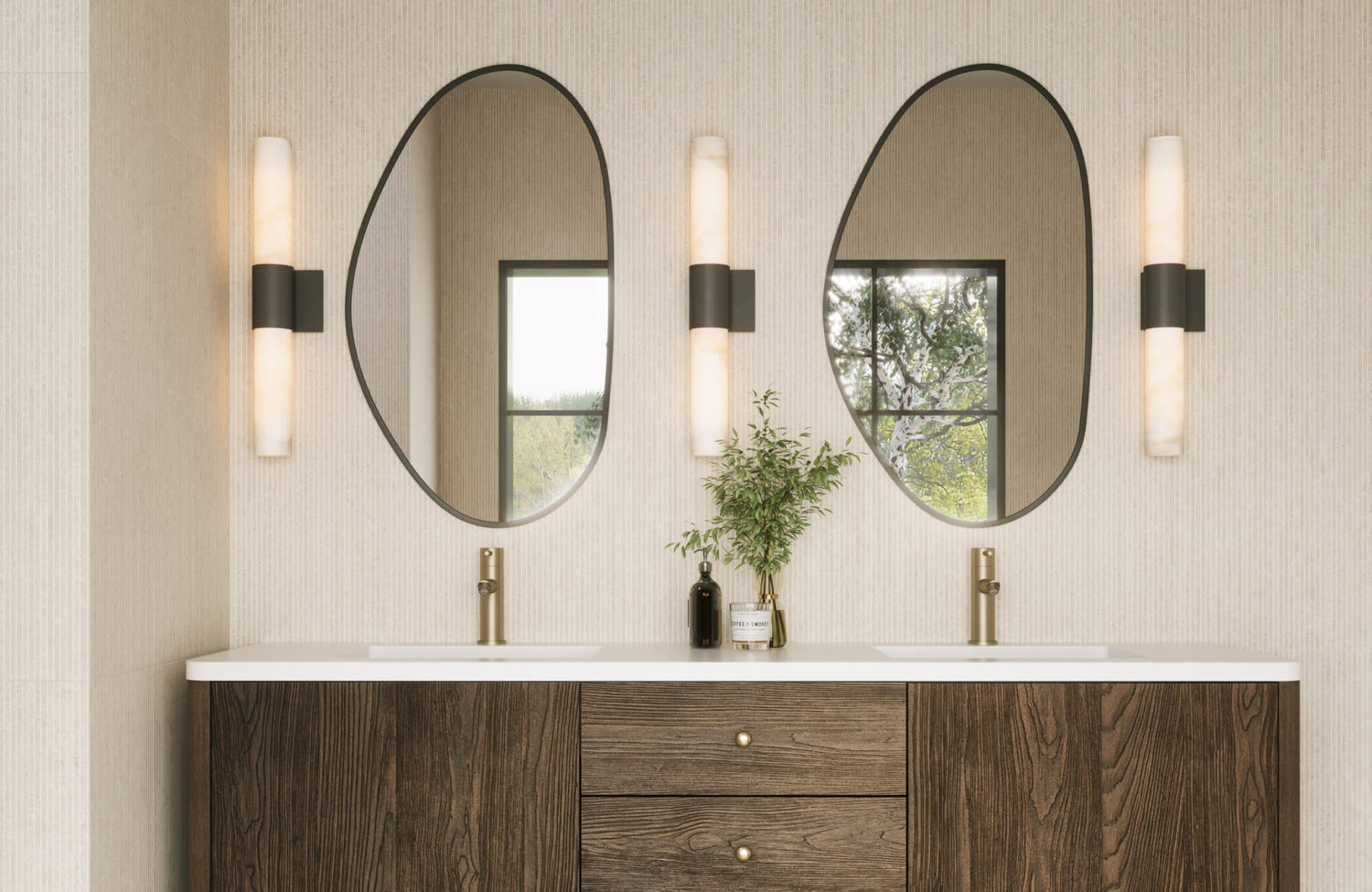
Featured in the space above, our Rory Mirror in Antique Brass Iron brings this artistic approach to life. With its fluid, asymmetrical silhouette, it softens the geometry of the surrounding finishes while adding a refined layer of warmth through its antique brass frame. Positioned between vertical sconces, it becomes the centerpiece of the vanity wall, offering both visual intrigue and everyday practicality in one sculptural statement.
Vertical vs Horizontal Orientation
The direction in which you orient your mirror affects not only how it functions but also how it alters your perception of the room’s dimensions. A vertically oriented mirror naturally draws the eye upward, adding a sense of height. This effect is especially useful in rooms with low ceilings or where you want to emphasize vertical lines, like hallways, narrow bathrooms, or between tall bookshelves.
On the flip side, a horizontal mirror emphasizes width. It stretches the visual field side to side, making walls appear longer and spaces feel broader. This is a smart choice for above sofas, mantels, or long buffets where lateral balance is important. The choice between vertical and horizontal should not be random. It should also reflect how you want the space to feel. With the right orientation, your mirror becomes more than a decorative object; it becomes a subtle architectural tool.

Match the Frame Design with Interior Aesthetics
Frames shape how a mirror interacts with your surroundings, anchoring it visually and tying it into the larger design narrative of your room. The right frame adds cohesion, contrast, or character, depending on how you use it.
Material and Finish
Choosing the right material and finish for your mirror frame is just as important as selecting its shape or size. The frame not only defines the mirror’s overall character but also influences how it interacts with the rest of your space. From organic warmth to industrial edge, each material creates a distinct visual and emotional tone that anchors the mirror within your decor.
Wood Frame
If you’re aiming for a cozy, inviting atmosphere, a wood frame brings natural warmth and a sense of tradition. It pairs effortlessly with earthy tones, textured fabrics, and classic interior themes. The grain and finish of the wood can further refine the mood, from polished cherry to weathered oak; each variation adds distinct personality.
Metal Frames
Metal frames deliver a crisp, contemporary feel. Brushed aluminum or matte black creates a clean, streamlined look that’s ideal for industrial, urban, or minimalist spaces. Metal frames often read as bold and intentional, giving your mirror an edge without overwhelming the room.
For instance, our Fitz Mirror in Antiqued Iron exemplifies this aesthetic. As shown in the photo above, its slender iron frame, finished in a muted black patina, brings a modern sensibility to the classic round form. The suspended loop detail and decorative rectangular mount also add a nod to early industrial designs, making it a striking addition to any contemporary space.
Resin
Resin opens the door to detailed, decorative forms. If you love ornate baroque scrolls, floral motifs, or playful silhouettes, resin allows for that expressiveness without the weight or cost of carved wood or cast metal.
Whatever material you choose, pay close attention to its finish. A distressed wood may evoke a rustic charm, while a glossy lacquer can feel sleek and modern. Matching the finish to your room’s mood helps the mirror feel like it belongs.
Color Coordination
When it comes to color, your mirror frame can either blend in or boldly stand out. A frame that echoes the tones already present in your room, be it the wall color, furniture, or accessories, will create a sense of harmony. This approach works especially well if your goal is subtlety and cohesion. For example, a beige or white frame in a light-toned room feels serene and seamless.
Alternatively, using a contrasting frame can bring excitement and focus. A gold frame against dark walls or a black frame in a pastel room draws the eye immediately and makes the mirror a focal point. In minimalist spaces, monochrome or frameless mirrors keep the visual field uncluttered and allow the architecture or furnishings to speak louder. But if your space leans eclectic with mixed patterns, colors, and textures, a brightly painted or carved frame can add a layer of personality and charm. The key is intentionality: let the color support the story your room is telling, whether that’s refined elegance or creative vibrance.
Proportion and Visual Balance
Beyond material and color, the scale of the frame in relation to its setting is crucial. A thick, elaborate frame in a small or narrow space, for example, can feel oppressive, while a delicate, minimal frame in a grand room might disappear altogether. When a mirror serves as a statement piece, such as above a fireplace or at the end of a hallway, a bolder frame makes sense. It grounds the mirror and asserts its presence with confidence.
In tighter areas or rooms where the mirror isn’t the main event, slimmer frames or even frameless options maintain openness and avoid visual clutter. This is particularly effective in modern or Scandinavian-inspired interiors, where simplicity is prized. You want the mirror to feel balanced in its environment, not like an afterthought or an overpowering element. By matching proportion with context, you allow the frame to complement the space without competing with it.

Assess Lighting Compatibility and Integration
Proper lighting can elevate a mirror from a simple reflective surface to a transformative design element. When carefully considered, lighting enhances visibility, mood, and spatial depth, all while ensuring the mirror performs its role effectively.
Backlit and Integrated Lighting
Incorporating backlit or edge-lit mirrors into your space is a game-changer, particularly in areas where precision and clarity matter most. These mirrors are designed with built-in LED strips that cast an even, ambient glow around the perimeter or from behind the mirror itself. This diffused lighting also eliminates harsh shadows that traditional overhead lights often create, offering a clean and flattering reflection. Whether you're applying makeup, shaving, or completing your skincare routine, the consistent light allows you to see details clearly without straining your eyes or adjusting your angle repeatedly.
Beyond functionality, the quality of light plays a significant role in the mirror’s overall effect. Daylight-balanced LEDs, which emit around 5000K, are ideal when you need true-to-life color rendering and sharp visibility, making them a practical choice for bathrooms and vanity stations. However, if your goal leans more toward setting a calming tone, especially in bedrooms or hallways, warm white light in the 2700K–3000K range offers a gentler, more inviting atmosphere. What makes integrated lighting so appealing is its adaptability: you can find mirrors that balance both moods, giving you brightness when you need it and ambiance when you don’t. This blend of performance and style ensures your mirror not only looks great but functions effortlessly in your daily life.
Position Relative to Natural and Artificial Light
Although integrated lighting offers control, the strategic placement of your mirror in relation to natural and artificial light sources can transform how a room feels throughout the day. A well-placed mirror can function as a light multiplier, bouncing sunlight deeper into your space and brightening areas that might otherwise remain dim. Positioning a mirror across from a window, for example, not only doubles the natural light but also creates the illusion of a more expansive interior. This trick works wonders in small or narrow rooms, where every ray of daylight counts and visual openness makes a significant difference.
However, achieving this effect requires a careful balance. Placing a mirror where it catches direct sunlight or strong lamp beams at full intensity can result in harsh glares and unwanted reflections that strain the eyes. The goal is to work with the light, not against it. You might find that tilting the mirror slightly or raising it a few inches changes the way it interacts with both day and night lighting. Also, consider how your lighting changes throughout the day and position the mirror to complement those shifts. In doing so, your mirror becomes a subtle lighting assistant, enhancing both visibility and mood without adding extra fixtures or expense.
Smart Lighting Options
Smart technology has seamlessly made its way into mirror design, offering more than just reflection; it offers interaction. With dimmable LEDs, motion sensors, and app or voice-controlled features, smart mirrors allow you to tailor lighting to your exact needs at any time of day. Whether you're easing into your morning routine or winding down for the night, you can adjust brightness levels or shift from cool daylight tones to warm ambient hues with a tap or voice prompt. Some mirrors can even be programmed to adapt automatically, simulating the natural progression of sunlight to help keep your internal clock balanced and your mood steady.
But the appeal of smart mirrors extends beyond convenience—they’re also a thoughtful choice for energy-conscious living. Motion-activated lighting ensures that LEDs only illuminate when someone is present, helping to prevent unnecessary electricity use. At the same time, the use of energy-efficient LED technology reduces overall consumption without compromising light quality. If you’re designing a space that aims to be both technologically advanced and environmentally aware, a smart mirror fits beautifully into that vision. It enhances your space with modern ease while reinforcing sustainable habits, proving that cutting-edge innovation can coexist with everyday practicality.

Consider Budget, Sustainability, and Maintenance
A truly good mirror does more than reflect your image. It reflects thoughtful choices that align with your values, budget, and lifestyle. By weighing cost, environmental impact, and maintenance needs, you ensure your investment pays off in both performance and peace of mind.
Cost vs Longevity
When shopping for a mirror, it's easy to gravitate toward the least expensive option, especially when faced with a wide range of choices. However, what might seem like a budget-friendly deal can quickly turn into a costly cycle of repairs or replacements. Mirrors with premium features like copper-free backing that resists corrosion, reinforced construction to prevent edge damage, and anti-fog technology that maintains clarity in steamy conditions, offer much more than just aesthetics. These enhancements are designed to also endure daily wear and environmental stressors, ultimately giving you more value for your money over time.
This is especially important in high-moisture or busy areas, such as bathrooms, kitchens, or entryways, where lesser-quality mirrors are more likely to show signs of wear. A mirror that begins to peel, warp, or cloud after just a short period can be frustrating, not to mention a hassle to replace. By evaluating your mirror purchase with longevity in mind, you avoid those pitfalls. It’s not about choosing the most expensive piece on the shelf; it’s about aligning your investment with your specific needs.
Eco-friendly and Ethical Choices
Beauty and responsibility can and should go hand in hand. Choosing a mirror with eco-friendly materials is a simple yet meaningful way to reduce your environmental impact without sacrificing style. Mirrors made from recycled or upcycled glass not only minimize waste but also reduce the energy needed in the manufacturing process. This small decision supports larger sustainability efforts, especially when you factor in the scale at which mirrors are produced and replaced. If your mirror includes a wooden frame, selecting one made from FSC-certified wood ensures the material comes from responsibly managed forests that prioritize biodiversity and long-term ecological health.
Equally important is what you don’t see: the components hidden behind the reflective surface. Some traditional mirrors are manufactured using lead-based backings or adhesives high in volatile organic compounds (VOCs), which can release harmful emissions into your indoor air. These invisible pollutants not only harm the environment but can also compromise the quality of the air you breathe daily. By choosing mirrors labeled as lead-free and low-VOC, you actively protect your space’s health while reducing exposure to toxins. Furthermore, supporting brands that value ethical sourcing and transparency means your purchase is part of a larger chain of conscious consumerism.
Cleaning and Care Requirements
Although it’s easy to get caught up in choosing the perfect mirror design, cleaning and care are what truly determine whether your mirror continues to look good long after it’s mounted. Daily life introduces splatters, fingerprints, and humidity, all of which can dull a mirror’s appearance or even cause long-term damage if left unchecked. Because ot that, selecting a mirror with built-in resistance features, like anti-smudge or anti-fog coatings, can make a noticeable difference in upkeep. These coatings reduce how often you need to clean and prevent common issues like fogging after hot showers, allowing your mirror to stay functional and clear with minimal effort.
Additionally, the design of your mirror influences how easily it stays clean. Frameless mirrors, for example, are not just a modern design choice; they’re also practical. Without the nooks and edges of traditional frames, there are fewer places for dust and grime to gather. This is especially useful in high-moisture environments like bathrooms, where mold and mildew can sneak into crevices. Even framed mirrors can be low-maintenance if the frame material is non-porous and sealed well, but they do demand a bit more diligence to keep every edge spotless.
When it’s time to clean, the right tools make all the difference. A soft microfiber cloth lifts dust and oils gently without scratching the glass, and using a streak-free, ammonia-free cleaner helps preserve any protective coatings your mirror may have. Natural solutions, like a diluted vinegar spray, are also effective and safe for most surfaces. It’s important to avoid excessive moisture or harsh chemicals, as these can seep into the backing and cause dark spots, warping, or peeling. Before using any cleaner, especially on specialty or coated mirrors, it’s always best to consult the manufacturer’s care instructions to avoid voiding any warranties or damaging unique finishes.
Making the Final Decision with Confidence
Choosing a good mirror means aligning functionality, aesthetics, and sustainability in a way that suits your space and lifestyle. By taking the time to define its purpose, consider room dynamics, evaluate materials, and think long-term, you ensure that your mirror does more than reflect your image—it reflects thoughtful design. Let your final choice be one that enhances your space with intention, elegance, and everyday usefulness.
If you’re still unsure which mirror is the right fit for your needs or would like expert guidance tailored to your space, our team is here to help. Whether you’re looking for advice on materials, sizing, or custom options, feel free to reach out to us directly. We’re happy to provide personalized recommendations that bring your vision to life and ensure your next mirror is as functional as it is beautiful.