Floral wallpaper has a rare ability to change the emotional tone of a room before a single piece of furniture is moved. Unlike paint, which shifts atmosphere largely through color, floral wallpaper introduces imagery, rhythm, scale, contrast, and a sense of movement across the wall. A room can become softer, brighter, more romantic, more dramatic, or more collected simply through the way flowers are drawn, spaced, colored, and placed.
The effect is not one-dimensional. A pale watercolor floral can make a bedroom feel quiet and restorative, while an oversized dark floral can turn a powder room into a jewel-box space. A small vintage print may feel nostalgic and cozy, while a large botanical mural can read as modern and architectural. Understanding how floral wallpaper changes the mood of a room allows you to choose with greater intention, especially when coordinating it with tile, rugs, vanities, lighting, mirrors, furniture, and decor.

Esme 15" Wall Sconce in Polished Nickel frames the mirror with warm light, while Janelle 30" Single Vanity in Walnut Whisper with 3 cm White Zeus Silestone Top grounds the botanical wallpaper with a tailored wood finish.
Why Floral Wallpaper Has Such A Strong Emotional Effect
Floral wallpaper influences a room before individual details are consciously noticed. Because it covers a broad visual plane, it becomes part of the room’s atmosphere rather than a single decorative accent. Its flowers, stems, colors, and rhythms shape how the architecture feels, softening hard lines, adding movement, and giving the space an emotional register that plain walls rarely achieve.
Floral Patterns Bring Nature Into Interior Spaces
Floral wallpaper carries an immediate association with nature. Even when the print is stylized, abstract, or highly decorative, the presence of petals, vines, stems, leaves, and botanical movement softens the room’s architecture. Straight walls become less rigid. Corners feel less severe. Large surfaces begin to feel layered rather than blank.
This is one reason floral wallpaper often feels warmer than a purely geometric or solid wall treatment. Flowers suggest growth, seasonality, delicacy, abundance, and familiarity. A trailing vine can make a hallway feel more relaxed. A field-like floral can bring freshness to a bedroom. A painterly bloom can make a dining room feel expressive without relying on excessive ornament.
Edward Martin's Botanique Wallpaper in Winter, 52" x 132" illustrates this naturalizing effect through a restrained botanical pattern rather than a vivid floral display. Its fine stems, small leaves, and neutral palette create a quiet sense of movement across the wall, softening the tailored lines of a bathroom vanity, oval mirror, paired sconces, and painted trim. The design feels organic without becoming visually loose, which is especially useful in rooms where structure and softness need to be held in balance.
The natural quality of floral wallpaper is especially valuable in rooms with hard or polished materials. Tile, stone, metal, glass, and lacquered finishes can feel elegant but visually firm. A floral wallcovering can offset that structure with softness and movement. When balanced with a textured rug, warm wood furniture, sculptural lighting, or a well-placed mirror, the wallpaper becomes part of a layered interior rather than a decorative surface applied in isolation.
Wallpaper Changes More Than The Wall Color
Color is often the first feature people notice, but wallpaper changes a room through more than hue. Floral wallpaper introduces pattern repeat, motif size, background space, contrast, direction, texture, and finish. These details affect whether the room feels restful, lively, formal, intimate, nostalgic, or dramatic.
A floral pattern with a loose repeat and open spacing allows the eye to pause, which can make a room feel calmer. A dense print with high contrast creates more visual movement, making the space feel energetic or immersive. A matte finish may appear softer and quieter, while a subtle texture can add depth, especially in rooms with layered lighting.
This is why two floral wallpapers in similar colors can create completely different moods. A pale blue floral with fine branches and generous negative space may feel airy and serene. A pale blue floral with tightly packed blooms and strong outlines may feel more traditional, detailed, and decorative. The emotional result comes from the full composition, not the color alone.
Mood Is Shaped By The Whole Room, Not The Pattern Alone
Floral wallpaper does not determine a room’s mood by itself. It works in conversation with light, flooring, tile, furniture, rugs, mirrors, window treatments, and the room’s purpose. A print that feels calm in a bedroom may feel theatrical in a powder room because the scale, lighting, and amount of time spent in the space are different.
Natural light can make floral wallpaper feel fresh and open, especially when the background is pale or the pattern has botanical greens. Low light can deepen the mood, making the same type of floral feel more intimate. Mirrors can reflect the pattern and increase its presence, which may be useful in a compact room but overwhelming if the print is already dense. Rugs and upholstery also matter: a quiet rug can ground a busy floral, while another strong pattern nearby may make the room feel unresolved.
It is important to treat mood as subjective. Color and pattern can influence how a space is perceived, but emotional response varies by personal preference, cultural associations, lighting conditions, ceiling height, furnishings, and surrounding materials. The most successful floral wallpaper choices come from studying the room as a whole, not judging the pattern from a small image alone.

Mirai Wallpaper in Blue gives the wall a soft floral rhythm, pairing its pale blue ground and white botanical lines with the ribbed console’s warm, structured texture.
How Color In Floral Wallpaper Changes Room Mood
Once the emotional presence of floral wallpaper is understood, color becomes the most immediate way to refine that feeling. A floral pattern may be delicate, dramatic, cheerful, or restrained, but its palette determines the first impression. The same motif can feel restful in muted tones, expressive in saturated hues, or intimate against a dark ground, making color one of the clearest guides for choosing the right mood.
Soft And Muted Florals Create Calm, Gentle Rooms
Soft floral wallpaper is often chosen for rooms where comfort and quiet are the priority. Muted pinks, dusty blues, sage greens, creams, warm whites, taupes, and faded lilacs tend to lower the visual temperature of a room. They do not demand attention in the same way saturated colors do, which makes them well suited to bedrooms, nurseries, guest rooms, dressing spaces, and reading corners.
The calming effect comes from restraint. A low-contrast floral print allows the wall to feel decorated without becoming visually loud. Watercolor florals, faded botanical sketches, and tonal prints can create a sense of softness that pairs naturally with upholstered beds, woven rugs, linen drapery, warm lighting, and simple mirrors.
Edward Martin's Mirai Wallpaper in Blue is a useful example of this quieter approach. Its pale blue field and white line-drawn blooms create movement without strong contrast, while the fine linear texture keeps the larger flowers from feeling heavy. Against the warm vertical rhythm of a ribbed console, the wallpaper reads as calm and airy, showing how muted florals can support a room’s atmosphere without overwhelming its furnishings.
Muted florals also work well in transitional interiors because they can bridge traditional and contemporary elements. A soft botanical wallpaper can sit comfortably beside a clean-lined vanity, a tailored sofa, or a quietly patterned rug. The result feels considered rather than overly themed.
Bright Florals Add Energy, Warmth, And Optimism
Bright floral wallpaper creates a more expressive mood. Yellows, corals, saturated pinks, lively greens, clear blues, and warm reds can make a room feel cheerful, social, and energized. These colorways are often effective in entryways, breakfast nooks, powder rooms, creative workspaces, and children’s rooms, where a sense of movement and personality is welcome.
The key is balance. A bright floral can quickly become overwhelming if every surrounding element competes with it. Neutral flooring, quieter tile, solid rugs, streamlined furniture, or simple lighting can give the wallpaper enough space to feel intentional. In a compact entry, for example, a vivid floral may create a memorable first impression when paired with a restrained console, a sculptural mirror, and a clean floor finish.
Bright florals are also useful when a room lacks architectural detail. Rather than adding molding or additional decor, the wallpaper itself can bring rhythm and character. Still, the more saturated the color, the more important it becomes to test the wallpaper in the room’s actual light. A coral that feels warm in daylight may appear much stronger under evening bulbs.
Dark Florals Create Drama, Intimacy, And Sophistication
Dark floral wallpaper can change a room more dramatically than almost any other floral style. Black, navy, charcoal, oxblood, espresso, and deep green backgrounds make flowers appear more dimensional and often more painterly. Instead of feeling sweet or delicate, the floral motif becomes atmospheric, intimate, and refined.
This approach is especially effective in dining rooms, powder rooms, bedrooms, lounge spaces, and feature walls. In a dining room, dark florals can create a sense of occasion. In a powder room, they can make a small space feel jewel-like rather than merely compact. In a bedroom, they can feel cocooning when balanced with soft bedding, warm lamps, and restrained furniture.
Because dark florals absorb more light, surrounding materials need careful consideration. Mirrors, metallic fixtures, layered lighting, pale stone, lighter flooring, or reflective vanity finishes can keep the room from feeling heavy. The goal is to create contrast and relief so the wallpaper feels atmospheric rather than visually dense.

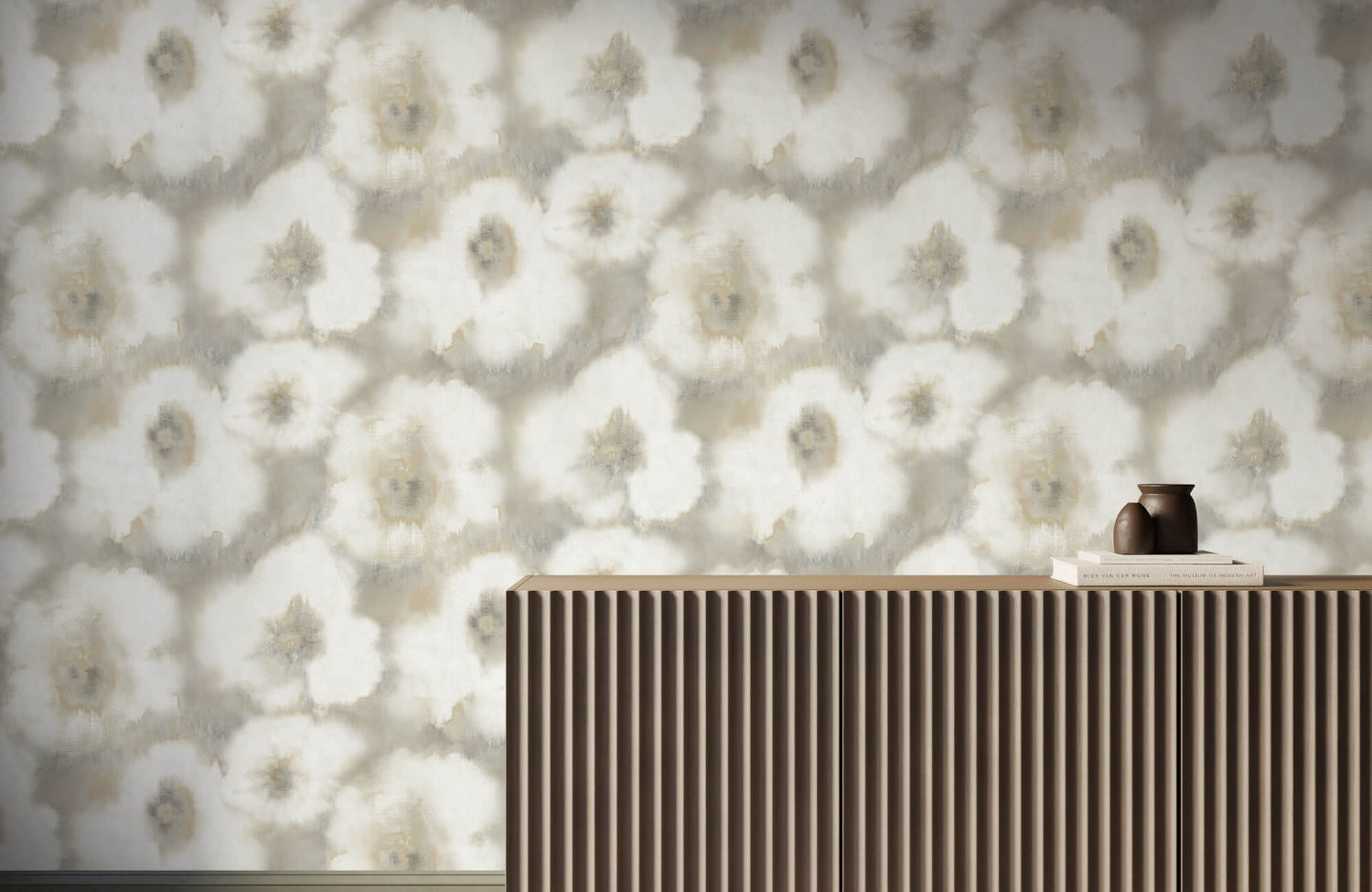
Amarise Wallpaper in White/Gold brings a muted floral pattern to the wall, balancing pale texture, soft gold accents, and the clean vertical lines of the console below.
How Pattern Scale And Density Affect The Feeling Of A Room
Color sets the emotional temperature, but scale and density determine how strongly the pattern occupies the room. A floral design can whisper in the background, create a tailored layer of detail, or become the dominant visual gesture. Understanding the difference between large and small motifs, open spacing and dense repeats, helps explain why some floral wallpapers feel airy while others feel enveloping.
Large-Scale Florals Feel Bold, Modern, And Immersive
Large-scale floral wallpaper often feels more modern and artistic than a small repeating print. Oversized blooms, mural-style compositions, and sweeping botanical forms create a sense of immersion, especially when the pattern has enough open space around the motifs. Instead of reading as a decorative background, the wallpaper becomes a central design gesture.
A common concern is whether large floral wallpaper will make a room look smaller. The answer depends less on size alone and more on contrast, spacing, placement, and light. A large floral with a pale ground and airy composition may make a wall feel expansive. A large floral with dark colors and strong contrast may feel more enclosing, which can be desirable in a dining room or bedroom but less suitable for a narrow hallway.
Large florals usually need some viewing distance. They are often strongest on a bedroom wall behind the bed, a living room feature wall, a dining room backdrop, or a powder room wall where the pattern can be appreciated as a composition. When used thoughtfully, large floral wallpaper can feel confident without feeling cluttered.
Small-Scale Florals Feel Cozy, Detailed, And Traditional
Small-scale florals create a different kind of intimacy. They often feel cozy, detailed, nostalgic, and collected, particularly when the pattern references vintage textiles, cottage interiors, or classic wallcoverings. In bedrooms, reading rooms, powder rooms, and smaller private spaces, a small floral can bring charm and softness without requiring a large architectural gesture.
Edward Martin's Amarise Wallpaper in White/Gold shows how a smaller floral repeat can feel layered rather than crowded. Its pale ground, fine gray botanical detailing, and soft gold flower heads create a gentle rhythm across the wall, while the vertical texture of the console below gives the composition structure. The wallpaper’s delicacy allows the room to feel decorated and warm without losing visual clarity.
The mood depends heavily on contrast and spacing. A small floral in muted colors may feel delicate and restful. A dense small print with strong outlines can feel busier and more decorative. Neither effect is inherently better. The right choice depends on whether the room is meant to feel quiet, layered, traditional, or expressive.
Small-scale florals are most successful when nearby elements are edited. A simple rug, clean-lined furniture, solid bedding, or restrained window treatment helps the print feel intentional. If several small patterns appear in the same room, they should vary in scale so the eye can distinguish one surface from another.
Dense Patterns Feel Expressive, While Open Patterns Feel Airier
Pattern density determines how much visual activity appears across the wall. A dense floral pattern places motifs close together, creating a rich and immersive surface. This can feel dramatic, maximalist, enveloping, or old-world depending on the palette and drawing style. Dense florals often work well in powder rooms, dining rooms, and spaces where a more decorative mood is desired.
Open floral patterns leave more background visible. They feel calmer, lighter, and easier to live with over time, especially in bedrooms, small rooms, and interiors with minimal furnishings. Open spacing gives the eye moments of rest, which can make the room feel more spacious.
Perceived room size is not determined by wallpaper alone. Ceiling height, natural light, furniture placement, mirror location, flooring color, and wall coverage all affect whether a room feels open or compressed. Professional installation is also worth considering for intricate repeats, murals, and high-contrast patterns, since alignment issues are more visible when the design has strong movement.

Celia 5 x 10 Glossy Ceramic Tile in Deep White adds vertical texture beneath the floral wallpaper, while Cavendry Travertine Vase Set echoes the room’s warm natural tones.
How Floral Wallpaper Shapes The Mood Of Different Rooms
The effect of floral wallpaper changes as soon as it enters a specific room. A print that feels serene behind a bed may feel theatrical in a powder room or sociable in a dining space. Room function, lighting, surface materials, and the amount of time spent in the space all influence how the pattern is experienced.
Bedrooms, Nurseries, And Restful Private Spaces
In bedrooms and nurseries, floral wallpaper is usually most successful when it supports rest. Soft colorways, gentle contrast, and open or medium-scale motifs can make the room feel calm without stripping it of character. A muted botanical print behind a bed can frame the sleeping area, while a delicate floral throughout the room can create a cocoon-like effect.
Edward Martin's Petaline Wallpaper in Taupe I, 52" x 132" demonstrates how a floral motif can add intimacy without making a private room feel overly patterned. Its small taupe blooms and warm neutral ground create a steady, quiet rhythm, while the bedroom setting shows how that rhythm can sit comfortably above glossy vertical tile, layered pillows, natural vessels, and warm lighting. The pattern brings softness to the wall, but its restrained scale allows the bed and surrounding textures to remain visually grounded.
For a calming bedroom, look for low-contrast patterns, softened outlines, and colors that sit comfortably with bedding, rugs, lamps, and furniture finishes. Sage, dusty blue, warm ivory, blush, taupe, and faded green often work well because they feel atmospheric without becoming visually sharp. Dark florals can also suit bedrooms when the desired mood is intimate and hotel-like, especially with layered lighting and tactile textiles.
Nurseries benefit from the same restraint. A floral wallpaper does not need to be overtly playful to feel appropriate. A gentle botanical design can age gracefully as the room evolves, particularly when paired with adaptable furniture and soft, durable rugs.
Living Rooms, Dining Rooms, And Social Spaces
In social spaces, floral wallpaper can add hospitality, personality, and visual richness. A living room may call for a more balanced approach because it is used often and viewed from multiple angles. Large-scale florals can work beautifully as a feature wall, especially when furniture silhouettes remain clean and the rug does not compete for attention.
Dining rooms can accept more drama. A deeper floral palette, painterly motif, or enveloping wall treatment can make meals feel more intimate and ceremonial. The wallpaper becomes part of the atmosphere, working with the dining table, chairs, lighting, mirror placement, and floor finish to create a room that feels complete.
This is where whole-room coordination becomes essential. Rugs, lighting, mirrors, and furniture should support the mood established by the wallpaper rather than echo it too literally. A floral wallcovering feels more refined when the surrounding pieces vary in texture, scale, and visual weight, allowing the pattern to anchor the room without overwhelming it.
Bathrooms, Powder Rooms, And Transitional Spaces
Bathrooms, powder rooms, hallways, and other transitional spaces often allow for bolder floral wallpaper choices because they are experienced in shorter intervals. A powder room can handle a dark floral that might feel too intense in a large living area. A hallway can feel more finished with a restrained botanical pattern, provided the scale and contrast do not visually narrow the passage.
In bathrooms, floral wallpaper can shift the mood toward spa-like, romantic, vintage, or dramatic depending on how it interacts with tile, vanity finishes, mirrors, and lighting. A green botanical print with pale tile can feel fresh and clean. A dark floral with a refined vanity and warm sconces can feel intimate and tailored. A cheerful floral near a guest bath can bring personality to a functional space.
Moisture conditions require practical judgment. Wallpaper suitability in bathrooms depends on ventilation, splash exposure, product specifications, adhesive type, and installer guidance. Always follow manufacturer recommendations for maintenance and placement, particularly in humid areas. For project-specific questions involving bathroom surfaces, finishes, or placement constraints, Edward Martin’s contact page offers a practical point of support.

Priya 14" 1 Light Flush Mount in Matte Black/Opal Matte Glass punctuates the floral ceiling pattern, while Mara 2 x 10 Glossy Ceramic Tile in Nettle Green reinforces the room’s deep green palette below.
How To Choose Floral Wallpaper For The Mood You Want
After considering color, scale, density, and room function, the strongest choices begin with a clear emotional intention. Floral wallpaper works best when it supports the way a room should feel, not merely the style it should display. By starting with mood, each design decision becomes more precise, from palette and pattern size to placement, lighting, and surrounding materials.
Start With The Feeling Before Choosing The Pattern
The strongest floral wallpaper choices begin with mood, not pattern. Before comparing colorways or motifs, define what the room should feel like when someone enters it. Calm, romantic, cheerful, dramatic, fresh, and sophisticated each point toward different design decisions.
A calm room often benefits from muted colors, low contrast, and open spacing. A romantic room may call for soft florals, warm neutrals, blush, cream, or faded tones. Cheerful rooms can carry brighter colors and livelier motifs, while dramatic rooms often rely on dark grounds, high contrast, and oversized blooms. A fresh mood may come from botanical greens and airy white backgrounds. A sophisticated mood usually depends on a restrained palette, painterly details, and carefully balanced contrast.
This approach prevents the common mistake of choosing a wallpaper because it is beautiful on its own, only to find that it does not suit the room’s function or emotional purpose. The right floral wallpaper should not simply be attractive. It should make the space feel more resolved.
Match Wallpaper Intensity To Room Function
Every room has a different tolerance for patterns. Bedrooms usually benefit from quieter florals because rest is the priority. Dining rooms can support stronger color, deeper contrast, and more enveloping patterns. Powder rooms can take bold designs because the smaller scale and shorter use time make intensity feel intentional rather than exhausting.
Kitchens, breakfast areas, and other active rooms can also support more expressive wallpaper when the application is thoughtfully controlled. Edward Martin's Botanique Wallpaper in Fall, 52" x 132" offers a clear example: its warm orange and green botanical details bring movement and character, while the light ground keeps the pattern from feeling heavy. Used across a ceiling, the design draws the eye upward and gives the room a more finished architectural presence, especially against dark green cabinetry, glossy vertical tile, and softly rounded lighting.
Living rooms require particular care. Since they are used frequently and often connect to other spaces, the wallpaper should coordinate with views, furniture groupings, rugs, and lighting. Hallways need similar restraint because strong patterns can visually compress narrow walls if the contrast is too sharp.
The guide below can help connect desired mood with practical wallpaper choices.
| Desired mood | Best color palette | Best pattern style | Best room placement |
|---|---|---|---|
| Calm | Sage, cream, dusty blue, warm white | Open florals, watercolor botanicals, low contrast prints | Bedrooms, nurseries, reading rooms |
| Romantic | Blush, ivory, faded rose, soft taupe | Vintage florals, trailing vines, delicate blooms | Bedrooms, dressing areas, guest rooms |
| Cheerful | Yellow, coral, lively green, clear pink | Bright florals, playful repeats, medium-scale prints | Entryways, breakfast nooks, children’s rooms |
| Dramatic | Black, navy, charcoal, deep green, oxblood | Dark florals, oversized blooms, painterly motifs | Dining rooms, powder rooms, feature walls |
| Fresh | Green, white, pale blue, natural neutrals | Botanical prints, airy layouts, leafy florals | Bathrooms, kitchens, sunlit rooms |
| Sophisticated | Muted neutrals, deep tones, restrained palettes | Tonal florals, abstract botanicals, balanced contrast | Living rooms, dining rooms, primary bedrooms |
A table can guide the first decision, but the final choice should still be tested in context. A wallpaper that appears subtle online may feel more assertive at full scale, while a bold print may become surprisingly elegant when paired with quiet materials.
Test The Wallpaper Against Real Materials And Lighting
Samples are essential because floral wallpaper changes throughout the day. Morning light may reveal undertones that are not visible at night. Warm bulbs can make creams and pinks appear richer, while cooler light can sharpen blues and greens. The pattern should be viewed both close up and from across the room, since scale often changes dramatically with distance.
Testing should include the materials that will sit near the wallpaper. Compare it with flooring, rugs, upholstery, furniture finishes, mirrors, vanity materials, and lighting temperature. A floral with a beige background may look refined beside warm stone but dull beside a cooler gray surface. A green botanical print may feel fresh with pale oak and linen but heavier beside dark flooring.
For rooms centered on furniture, rugs, decor, vanities, lighting, or mirrors, Edward Martin’s design services can help clarify how pattern, scale, finish, and material choices work together. The purpose is not to make every element match, but to ensure the room’s mood feels deliberate from surface to furnishing.
Bringing The Room’s Mood Into Focus With Floral Wallpaper
Floral wallpaper is most successful when it is chosen as an atmospheric decision, not just a decorative one. Its mood comes from the combined effect of color, pattern scale, density, placement, light, and the materials around it. A soft floral can make a bedroom feel composed and restful. A dark floral can give a powder room depth and intimacy. A bright botanical print can make a transitional space feel more welcoming. The difference lies in how the wallpaper supports the room’s purpose.
The best floral designs do not overwhelm the architecture or disappear into the background. They establish a point of view and allow the rest of the room to respond. When wallpaper is tested alongside tile, rugs, lighting, mirrors, furniture, and finishes, the result feels less like a single pattern choice and more like a complete design direction. That is where floral wallpaper becomes especially powerful: it gives the room an emotional center while leaving room for the surrounding materials to refine, balance, and complete the mood.