Pendant lights are essential design tools that shape the atmosphere, functionality, and flow of a space. But their full potential is only realized when they’re placed with purpose. Too close together, and they overwhelm the room. Too far apart, and they leave visual gaps and dim zones that disrupt the design. This article takes you beyond simple measurements to explore how proportion, rhythm, and room context all influence pendant placement. Whether you're styling a kitchen island, dining nook, or entryway, understanding how to space your pendants ensures they feel intentional, not arbitrary.

Understanding Visual Balance and Spatial Proportion
Getting the spacing right for your pendant lights begins with understanding visual balance. It’s not just about exact measurements. It’s about how the fixtures relate to one another, to the room’s architecture, and to the furniture below. Your eyes naturally seek symmetry and order, so even a slight misalignment in pendant spacing can make a room feel off. When pendants are spaced evenly and thoughtfully, they also create a sense of harmony that instantly elevates the space. This balance goes hand in hand with scale. The height of your ceiling and the size of your fixtures play a major role in determining how high the pendants should hang and how large they should be. A useful guideline is to multiply the ceiling height in feet by 2.5 to find a suitable drop in inches, but this should always be adjusted to the room’s proportions and the look you’re trying to achieve.
Along with balance and scale, repetition brings rhythm into your design. Just like music has a beat, your lighting layout should have a visual tempo. When pendants are placed at consistent intervals, typically between 24 to 30 inches apart, they guide the eye across the room and help define key areas like kitchen islands or dining zones. This rhythm isn’t just visually pleasing; it also improves functionality by ensuring even illumination. Each pendant becomes part of a pattern that supports the flow of the space, giving your design both structure and movement. With the right balance, scale, and spacing, your pendant lighting becomes an integral part of its visual identity.
A perfect example of how scale and balance come together can be seen in the image above featuring our Barnes 14" Pendant in Aged Antique Distressed Bronze. Its rich, timeless hue that blends warmth and depth anchors the space with understated sophistication. When hung evenly over a kitchen island, the pendant’s proportion and color create visual harmony while maintaining an inviting glow. It perfectly illustrates how thoughtful fixture selection enhances not just illumination but also the rhythm and balance of a well-designed interior.

Functional Considerations for Task and Ambient Lighting
Although pendant lights can be visually striking, their primary purpose is to illuminate. The effectiveness of your layout depends on more than just style; it’s about creating the right light for the right task. That means adjusting spacing based on how and where the light will be used.
Avoiding Light Overlap and Shadowing
When pendants are spaced incorrectly, the lighting can quickly become either too harsh or too dim. If your fixtures are hung too close together, their beams may overlap too much, creating hotspots that result in glare or uncomfortable brightness. These intense zones not only diminish the room’s visual comfort but can also make surfaces appear uneven in tone. This is especially noticeable on shiny countertops or reflective surfaces where light intensity is magnified.
To counter this, choosing pendants that diffuse light softly can make a noticeable difference. Designs with warm metallic finishes, such as our Fionn 14" Pendant in Vintage Brass, balance illumination with subtle glow. The classic golden hue with gentle luster helps scatter light evenly, preventing harsh reflections while enriching the room with warmth. When paired with proper spacing, pendants like this enhance both visual comfort and atmosphere, allowing the light to feel layered and natural rather than overpowering.
On the other hand, spacing pendants too far apart can leave you with uneven illumination. Dark patches or scalloped shadows form between the beams, breaking up the flow of light and leaving key areas underlit. To avoid these extremes, pay close attention to each fixture’s light spread. If your pendant casts a circle of light that's about three feet wide, the next fixture should be placed roughly three feet away to ensure an even wash of light. By aligning your spacing with the actual reach of the illumination, you create a balanced, consistent lighting experience throughout the room.
Matching Pendant Spacing with Purpose
Every space serves a different function, and your pendant lighting should reflect that. When you're working with task-oriented zones like kitchen islands, counters, or worktables, you need focused, bright lighting that eliminates shadows. This means hanging your pendants closer together to ensure the surface is well lit from edge to edge. Spacing them between 24 to 30 inches apart on center typically gives you the best coverage without overloading the space visually.
In contrast, ambient lighting works to set the mood or provide overall brightness rather than targeting specific tasks. In areas like dining rooms or open living spaces, the goal shifts from precision to atmosphere. In these spaces, you can afford to spread pendants further apart, often at 36 inches or more, depending on the fixture size and desired brightness. This wider spacing also allows the light to diffuse more gently, creating a softer, more inviting glow. A fixture like our Santos Pendant in Vintage Gold Leaf, shown in the photo above, perfectly embodies this approach. Its vintage gold finish, a warm, refined tone with a subtle sheen, casts a soft radiance that enhances ambient lighting. When arranged at balanced intervals, these pendants bring both elegance and comfort to the space, proving that thoughtful spacing can elevate mood as much as it enhances function.
Coordinating with Other Light Sources
Pendants are rarely the only source of light in a room. To get the most out of your design, you need to think about how they interact with other light sources, whether that's recessed ceiling lights, sconces, under-cabinet strips, or natural daylight streaming through windows. If you treat pendants as stand-alone elements, they may either feel disconnected or compete with nearby lighting, throwing off the room’s overall balance.
Instead, think of pendant lighting as one layer in a broader lighting plan. When placed correctly, pendants can enhance ambient light from above or complement the task lighting provided by another source. For example, in a kitchen, you might align pendants with recessed cans to form a uniform grid, or intentionally offset them to add dimension and depth. The goal is to achieve a seamless blend of function and aesthetics. When your pendant placement supports the surrounding lighting, not just fills a gap, you create a layered, well-integrated environment where every light works together.

Applying Measurement Rules to Specific Areas
Although general spacing formulas offer a great starting point, pendant placement should always respond to the specific needs and layout of each room. Whether you’re lighting a kitchen island or an entryway, the way a space functions plays a major role in determining how and where pendants should hang.
Kitchen Islands and Counters
In the kitchen, pendant lights do more than just brighten your workspace. They also serve as visual markers that anchor the island within the larger room. To get the height right, pendants are typically hung about 30 to 36 inches above the countertop. This allows them to provide ample light for chopping, prepping, and cooking, while also keeping sightlines clear for conversation and openness.
For horizontal spacing, most pendants perform best when placed 24 to 30 inches apart, center to center. This gives you enough light coverage without crowding the space visually. The number of pendants you need also depends on the length of your island. Start by dividing the total length by your target spacing, then adjust slightly to ensure the layout looks symmetrical from end to end. Our Azalea 36" Pendant in Vintage Gold Leaf and Soft Black can enhance this balance beautifully. Its vintage gold leaf interior paired with a soft black exterior creates striking contrast and warmth, helping define each pendant’s presence while maintaining cohesion across the island. Finally, keep a comfortable buffer of about six to twelve inches between the edge of each pendant and the edge of the island. This helps prevent the lights from feeling cramped or too close to where you stand, while still framing the surface effectively.
Dining Areas and Breakfast Nooks
When it comes to dining areas, pendants shift from pure task lighting to something more atmospheric. Over a round table, a single pendant often works best, positioned directly in the center and suspended about 30 to 36 inches above the tabletop. This height brings the fixture close enough to define the space and cast a warm, inviting glow, without interfering with sightlines during meals.
If your table is rectangular, a linear arrangement creates a more balanced effect. You can either go with two or three evenly spaced pendants, or opt for one longer, linear fixture that spans most of the table’s length. To keep the design looking intentional, place the outermost pendants approximately six to twelve inches in from the table’s ends. This framing ensures the entire surface is well lit without making the fixture feel oversized or awkwardly positioned. One standout fixture is our Dorian Pendant in Aged Brass. Its softly burnished aged brass finish, work beautifully in this setup offering a warm, refined glow that enhances the mood while tying together metallic accents and natural textures throughout the dining space. It also helps center the lighting visually, so it feels like a natural extension of the dining setup.
Hallways, Entryways, and Bathrooms
Smaller or transitional spaces like hallways, entryways, and bathrooms benefit greatly from the personality and function that pendant lights offer. In entryways, pendants or chandeliers often become focal points, especially when you have the ceiling height to accommodate something bold. As a rule, keep at least seven feet of clearance from the floor to the bottom of the fixture to maintain safe and comfortable movement through the space.
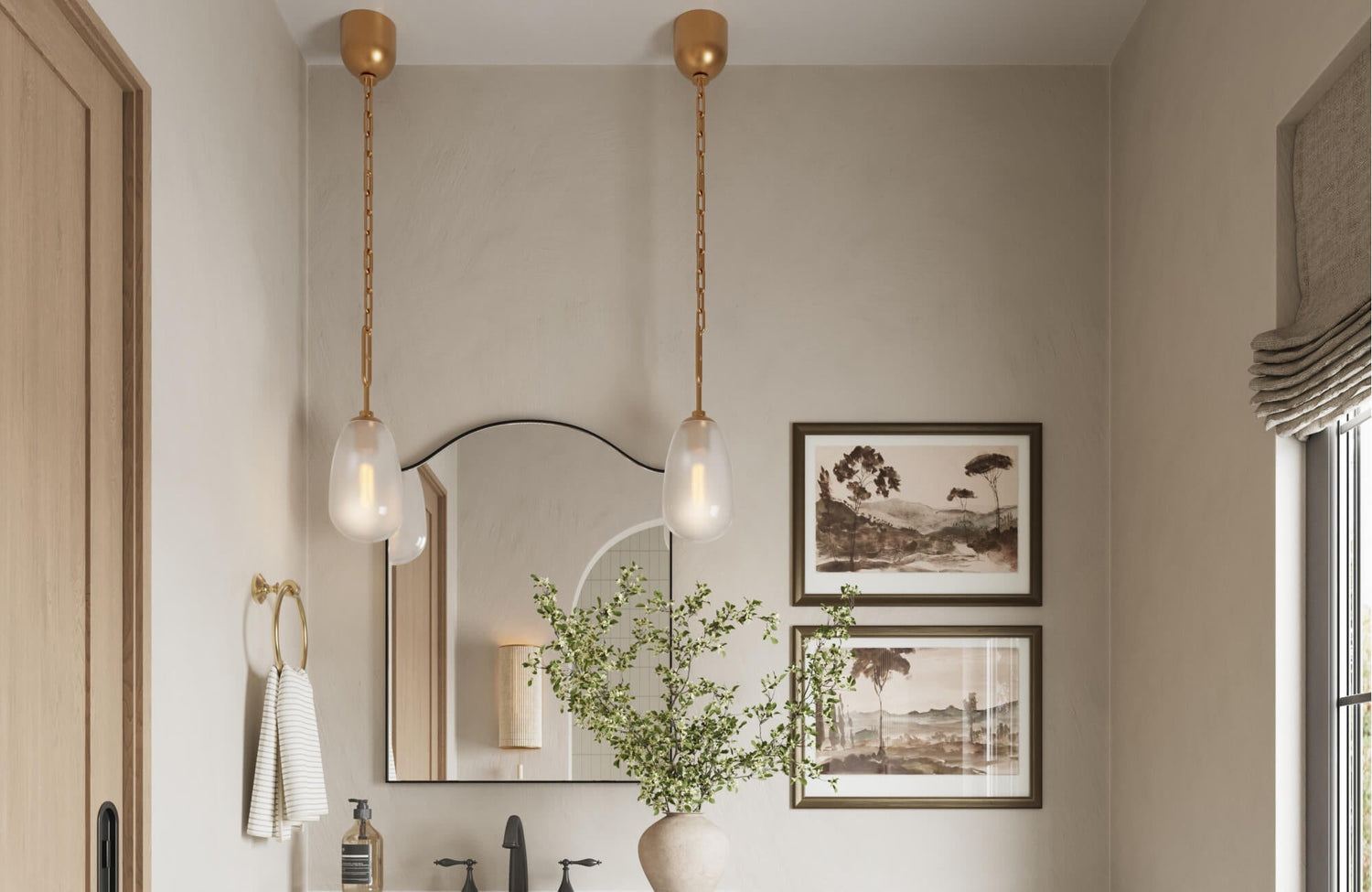
In hallways, pendants are best used in a series to lead the eye along the length of the corridor. The key is to space them evenly, both to maintain rhythm and to avoid visual gaps or overlit patches. Because hallways are typically narrower, fixtures should be compact and not hang too low. In bathrooms, pendants often shine when flanking a mirror rather than hanging overhead. When placed at eye level, they minimize shadows on the face, which is especially helpful during grooming tasks. These rooms may be smaller, but with careful placement, your pendants can make a strong visual impact without sacrificing practicality.
For areas like these, minimalist designs often make the greatest impression. Fixtures with clean lines and subtle finishes blend seamlessly into compact spaces without overwhelming them. Our Hemingway Pendant in Matte Black, featured in the image above, exemplifies this idea beautifully. Its matte black finish creates a grounding effect that pairs well with both light and textured interiors. Hung in a stairwell or entryway, it delivers soft, diffused light that accentuates architectural curves and natural materials, proving that simplicity can be just as captivating as grandeur.

Adapting to Style, Fixture Type, and Room Design
Pendant spacing isn’t just about getting the measurements right. The design, shape, finish, and overall style of the fixtures play a big role in how they look and feel once installed.
Fixture Shape and Light Spread
Not all pendants light a space in the same way, which is why fixture shape should always influence your spacing decisions. A drum-shaped pendant, for example, typically casts light both upward and downward, creating a soft pool of light that’s concentrated directly beneath it. Because of this focused beam, you may need to leave a little more space between fixtures to avoid overly intense overlaps or visual heaviness.
In contrast, clear glass pendants tend to emit a more diffused, ambient glow that spreads in every direction. These types of fixtures are ideal when you want a softer atmosphere or when your layout allows for closer groupings without creating visual clutter. Cone-shaped pendants, on the other hand, offer a narrow, directed light, making them great for precision task lighting. A design like our Sable Pendant in Aged Brass Ceramic Moss Crackle, displayed the photo above, beautifully bridges these characteristics. Its aged brass detailing provides warmth and elegance, while the moss crackle ceramic shade diffuses light softly, adding texture and dimension. This balance makes it perfect for bathrooms, dining areas, or vanities where layered lighting and gentle contrast create a refined, cohesive effect.
Architectural Elements
The placement of pendant lights can be a powerful way to highlight the natural flow of a space. Rather than floating independently, they can echo and reinforce architectural details like beams, ceiling vaults, or furniture layouts. If you’re working with exposed trusses or decorative beams, aligning your pendants beneath them draws the eye upward and strengthens the room’s structure visually. This kind of alignment gives your lighting a built-in, intentional feel that blends seamlessly with the design.
In asymmetrical or open-concept spaces, a rigid grid may not always work. That’s when pendants can help define distinct zones, such as separating the kitchen island from a nearby dining space, without relying on walls or dividers. Even in spaces with uneven ceiling heights, you can adjust the spacing and hanging lengths to preserve harmony. When your pendant layout responds to the architectural context around it, the entire room feels more considered and connected.
Finishes and Visual Weight
The color, texture, and material of your pendant lights can change how much space they appear to take up, even if their actual size is the same. A pendant in a dark finish like matte black or aged bronze will naturally feel heavier and more prominent. In these cases, giving each fixture a bit more breathing room can help the layout feel open rather than crowded. Heavier-looking materials like concrete or thick metal also demand visual space to remain comfortable within the room’s design. Our Bernard 10" Lantern in Aged Brass is a great example. Its aged brass frame, rich with depth and character, adds a sense of timeless weight while still maintaining elegance through its open lantern design. Pairing such fixtures with deliberate spacing ensures they enhance the room’s presence without overwhelming it.
Meanwhile, lighter materials such as frosted glass, woven fabric, or translucent acrylic have a much softer visual impact. These pendants can be grouped closer together without overwhelming the eye or making the space feel cluttered. When you balance visual weight with spatial rhythm, you also create a lighting scheme that feels intentional and well-scaled. By taking both style and spacing into account, your pendant lighting becomes an integral part of the room’s overall aesthetic, rather than just a practical afterthought.
Creating Cohesion Through Thoughtful Placement
Pendant lighting achieves its greatest impact when it blends visual elegance with practical precision. Proper spacing is not just about following numbers. It is about creating rhythm, honoring scale, and responding to the function and layout of each room. When pendants are positioned with careful attention to balance, proportion, and purpose, they elevate the entire space and become visual anchors that enhance your design and make your rooms feel unified, welcoming, and complete. With the right strategy, every pendant you hang will contribute to a lighting plan that is both timeless and tailored to how you live.
If you're ready to take your lighting design to the next level or have questions about choosing the right pendant fixtures, our team is here to help. Our experts can guide you through fixture selection and layout planning to ensure every detail is thoughtfully executed. Whether you're refreshing a single room or designing an entire space, reaching out for personalized support can make all the difference in achieving lighting that not only looks beautiful but feels effortlessly cohesive.