Subway tiles carry a deceptively simple quality — a clean rectangular form, a surface that responds well to light, a proportion that has proven itself across more than a century of interiors. That simplicity is precisely what makes them such effective tools for creating focal points. They provide enough structure to anchor a space without overwhelming it, and enough flexibility to work within almost any design language.
Whether the goal is a backsplash that defines a kitchen, a shower wall that gives a bathroom its character, a fireplace surround that grounds a living room, or an accent wall that shifts the entire mood of a room, subway tiles can hold that kind of visual weight. The key is understanding how color, finish, size, layout direction, and grout all work together and choosing each element with the space in mind.

Aurelia 2.5 x 11 Glossy Porcelain Subway Tile in Seafoam shows how subway tiles can become a focal point, wrapping the arched shower in blue-green color and reflective texture
Understanding and Exploring Subway Tiles
Subway tiles first appeared in the early 1900s, lining the walls of New York City’s subway stations. Their practical origins, defined by a clean, rectangular form with an easy-to-maintain finish, quickly proved to have broader appeal, and over the following decades, they moved from public infrastructure into residential interiors, adapting to each design era with remarkable ease.
What has kept subway tiles relevant is not nostalgia but genuine versatility. They can work within minimalist, traditional, eclectic, and organic interiors without feeling forced. Their evolution from a utilitarian solution in public spaces into a considered design element in private homes also reflects how a well-resolved form rarely loses its relevance.
Types of Subway Tiles
Subway tiles are made in several materials, each suited to different applications and atmospheres. Ceramic subway tiles, the most widely available, offer a broad range of colors and finishes at an accessible price point, making them well-suited to walls and backsplashes in lower-moisture environments. Porcelain subway tiles are denser and more water-resistant, making them the more practical choice for bathrooms, kitchens, and high-moisture settings where durability matters as much as appearance. Natural stone subway tiles introduce texture, warmth, and mineral variation that manufactured materials cannot replicate, best suited to spaces where an organic, handcrafted quality is part of the design intention.
Choosing the Right Size and Shape
The size of a subway tile shapes how the finished surface reads in the room. Larger formats reduce the number of grout lines, creating a cleaner, more expansive effect that can help smaller spaces feel less crowded. Smaller tiles introduce more detail and visual rhythm, which is useful when the surface itself needs to carry more interest. The choice should relate to the proportions of the room and the character of the installation, with each format offering a different balance between simplicity and texture.
Less conventional sizes such as longer formats, wider proportions, or non-standard dimensions can also bring a more considered, bespoke quality to a space. When the tile size feels genuinely chosen for the room rather than defaulted to, the entire installation reads as more intentional.
Selecting Color and Finish
Color and finish determine the atmosphere of a subway tile installation more than any other single decision. Glossy finishes reflect light and bring a cleaner, more luminous quality to surfaces, effective in kitchens and bathrooms where light is limited, or where the goal is a crisper, more refined look. Matte finishes absorb light rather than reflecting it, lending surfaces a quieter, more textural quality that suits organic, rustic, and transitional interiors particularly well. The color should also support the room's existing palette; neutral tones for compositions that rely on material and texture, deeper or more saturated hues when the tile itself is meant to carry the visual weight.
Considering Grout Color
Grout is a design decision, not an afterthought. A contrasting grout color, like darker grout against a light tile, or lighter grout against a darker surface, draws the individual tile shapes into focus, giving the pattern more visible rhythm and definition. A grout color that closely matches the tile creates a more seamless, unified surface where the overall plane reads before the individual tiles do. Neither approach is inherently superior; the right choice depends on whether the design calls for pattern and texture to come forward, or for a quieter, more resolved surface.
Why Subway Tiles Work for Focal Points
Subway tiles create focal points effectively because their restraint gives them range. They can be installed in horizontal, vertical, stacked, herringbone, and chevron orientations, each creating a different sense of movement and visual emphasis. Their material quality, whether ceramic, porcelain, or stone, also adds tactile depth to any surface they cover. And because they have never belonged exclusively to one design era or style, they carry a timeless character that allows a well-executed installation to feel considered rather than trend-dependent.

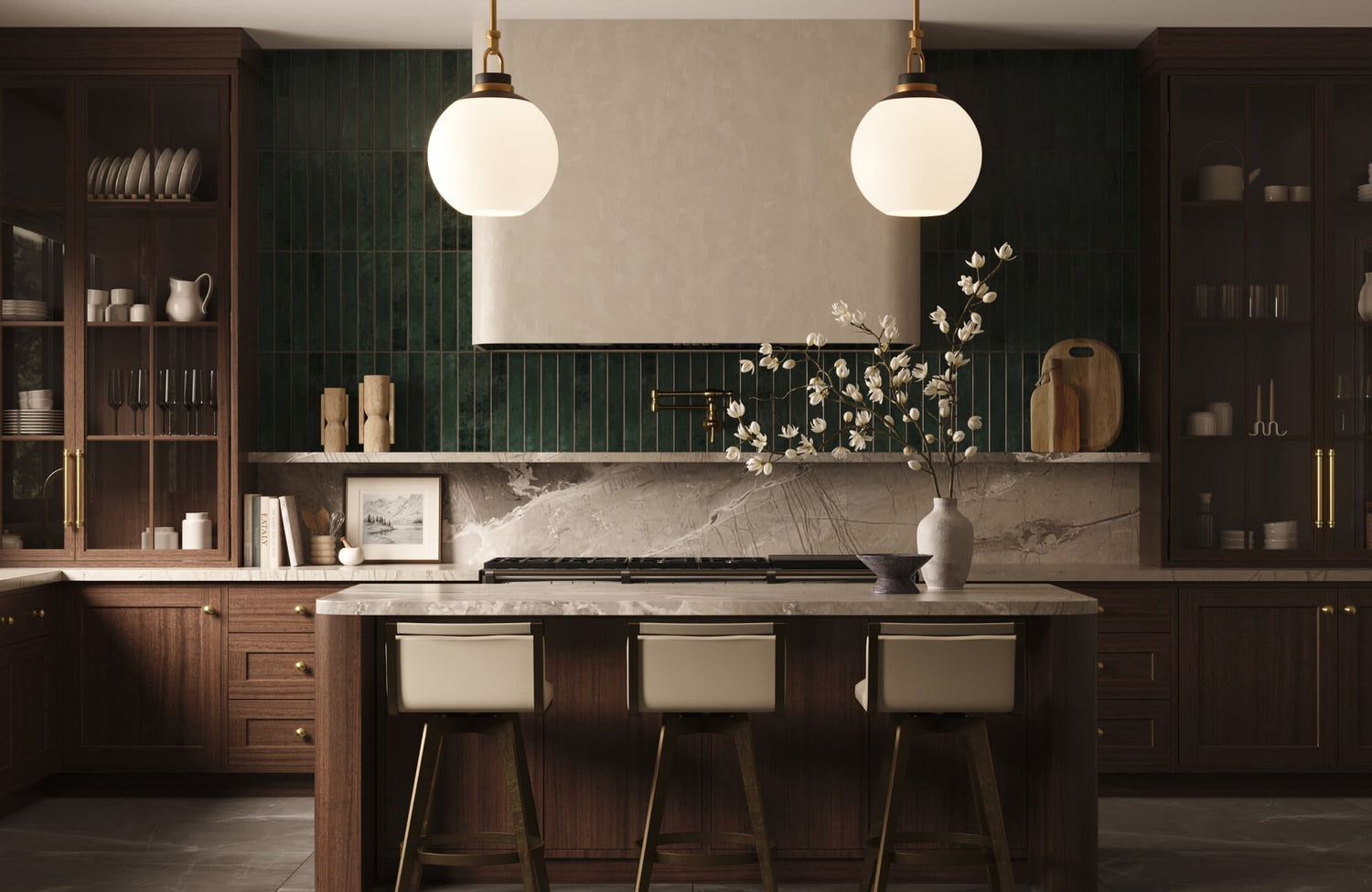
Jaden 2.5 x 16 Glossy Ceramic Tile in Ink gives the kitchen a moody, refined backdrop, showing how a black subway tile can suit a more dramatic aesthetic
Styling Subway Tiles for Different Aesthetics
Subway tiles take on a different character depending on how they are used, and understanding that range is part of using them well. The same basic form can feel crisp and architectural in a modern minimalist interior, warm and tactile in a rustic one, or layered and expressive in an eclectic space.
Modern and Minimalist
In modern and minimalist interiors, subway tiles work best when they reinforce the room's commitment to clarity and restraint. Neutral colors such as white, soft gray, and warm black keep the palette controlled. Larger format tiles also reduce visible grout lines and allow the surface to read as a clean plane rather than a composition of individual units. When grout color closely matches the tile, the wall or backsplash becomes a quietly unified backdrop rather than a pattern in its own right. Pairing subway tiles with streamlined fixtures like frameless mirrors, minimal hardware, and simple faucets further keeps the overall design language consistent.
Rustic and Farmhouse
In a rustic and farmhouse-inspired aesthetic, subway tiles gain warmth from color, material, and grout choice. Warm, earthy tones — beige, taupe, cream, soft stone — feel more in keeping with the relaxed, natural character these spaces tend to have. Natural stone subway tiles add texture and mineral variation that manufactured tiles cannot replicate in quite the same way. Darker grout colors also bring individual tile shapes into relief, adding handmade rhythm to a surface that might otherwise feel too clean. Pairing subway tiles with reclaimed wood, stone countertops, and exposed architectural elements allows the tiles to become part of a broader material story rather than the sole design statement.
Bohemian and Eclectic
In eclectic interiors, subway tiles benefit from combination and contrast. Mixing subway tiles with patterned field tiles, such as Moroccan, geometric, or handmade varieties, allows the two surfaces to create visual dialogue rather than uniform coverage. Deeper, more saturated colors such as teal, mustard, forest green, or matte black give subway tiles more personality and presence in spaces that are already layered with color, pattern, and collected objects. Natural materials, botanical elements, and mixed-period furniture complete this kind of composition, where each element contributes to a room that feels assembled with intention rather than matched to a single aesthetic.
For an even more interactive experience, take advantage of Edward Martin’s augmented reality (AR) tool , which allows you to visualize tile options within your actual space before committing. This is a useful step when working with bolder colors, mixed patterns, or less conventional layouts.

The earthy hues of Everett 2 x 10 Matte Ceramic Tile in Almond turn the fireplace into a warm, textured focal point that anchors the entire living room
Creating a Focal Point with Subway Tiles
Subway tiles become focal points through placement, proportion, and material choices that draw attention to the surfaces that matter most in a room.
Using Subway Tiles as a Backsplash
The backsplash is one of the most natural focal points in a kitchen or bathroom, and subway tiles are well-suited to it precisely because they can be configured in ways that range from quiet and classic to bold and expressive. A horizontal grid layout creates a timeless, grounded effect that suits both traditional and contemporary kitchens without competing with cabinetry or countertops. A herringbone arrangement introduces movement and visual complexity, while the zigzag pattern creates a surface that earns its role as the room's focal point. Edward Martin’s Chantel 3x12 Matte Porcelain Tile in Alaska Grey, for instance, brings a cool, considered tone and a refined matte finish to a herringbone installation, adding sophistication without visual noise.
Subway Tiles in Kitchens
Beyond the backsplash, subway tiles can define other surfaces within the kitchen that benefit from visual emphasis. Tiling the wall behind the stove draws attention to the cooking area as the natural center of the room, a deliberate choice that gives the kitchen a stronger sense of composition. Tiles around the base of a kitchen island can ground and define that element within the broader space. Combining matte and glossy finishes within the same kitchen also creates layered contrast, giving the room depth and material variety. Pairing subway tiles with quartz countertops, brushed brass hardware, or stone elements extends their quality into the surrounding design.
Creating a Subway Tile Accent Wall
A full accent wall in subway tile is most effective when the chosen surface is naturally visible from multiple positions in the room, like an entry wall, a bedroom wall behind the bed, or a living room wall that anchors a seating arrangement. Tiling the entire surface gives it a unified, architectural quality that a partial treatment rarely achieves. A deeper color or a three-dimensional tile surface adds tactile richness that makes the wall feel more considered. Framed artwork, mirrors, or directional lighting positioned against a tiled accent wall also draws additional attention to the surface and helps it read as an intentional design choice rather than a decorative experiment.
Incorporating Subway Tiles into Flooring
On floors, subway tiles bring the same material quality and design flexibility they offer on walls, with the added consideration of durability. In bathrooms, mudrooms, and entryways, porcelain subway tiles are the more practical choice. Edward Martin’s Juliet 2.5 x 10 Matte Porcelain Tile in Charcoal, for example, adds depth and a grounded, matte quality to a floor surface while offering the durability these areas require. A simple grid layout reads clean and easy to maintain. A herringbone or chevron arrangement on the floor introduces more movement and makes the floor itself a design feature worth noticing. A border or accent strip in a contrasting color or material can define the space further, giving the floor a more resolved, finished quality.
Subway Tiles in Bathrooms
Bathrooms are among the strongest settings for subway tile focal points because the enclosed scale of the room allows a single tiled surface to shape the entire atmosphere. On shower walls, a vertical stacked layout draws the eye upward and gives the space a taller, more architectural quality. A herringbone arrangement brings pattern and movement to a surface that might otherwise feel purely functional. A good example is the Harper 3 x 12 Glossy Ceramic Tile in Vermilion, used around a bathtub surround, introduces warm color and a reflective finish that transforms the bathing area into a genuine visual centerpiece. Paired with brass or matte black fixtures, the installation reads as a complete, composed choice rather than a tile selection made in isolation from the rest of the room.

Natasha 2 x 6 Matte Porcelain Tile in Blush uses a clean horizontal layout to guide the eye across the shower while softly emphasizing the arched opening
Using Subway Tile Layout to Guide the Eye
Where subway tiles create the focal point matters. How they are oriented determines what the eye does when it arrives there. A horizontal layout makes a surface feel wider and more expansive, which is useful on a backsplash, fireplace surround, or shower wall where breadth is the quality worth emphasizing. A vertical layout draws the eye upward, which can make ceilings feel taller and give compact spaces a more open, airy quality. In narrow bathrooms, low-ceilinged kitchens, and intimate shower enclosures, orientation is not simply a pattern preference; it is a spatial tool.
More directional layouts like herringbone, chevron, diagonal offset, vertical stack create stronger movement across a surface and guide attention toward specific design features: a range hood, a shower niche, a vanity wall, a bathtub surround, or a tiled alcove. A vertical stack behind a bathroom vanity creates a clean architectural backdrop that frames the mirror without competing with it. A herringbone backsplash behind a stove makes the cooking wall feel considered and complete.
Layout direction should ultimately support the room's overall design language rather than introduce visual noise. In modern interiors, stacked subway tiles create a crisp, linear quality. Offset or herringbone patterns bring a more classic or transitional character. Pairing the right orientation with considered grout contrast, an appropriate finish, and surrounding materials that support rather than fight the tile also allows the focal point to feel purposeful and naturally connected to the rest of the space.
Subway Tiles Create Focal Points Through Intention, Not Accident
Subway tiles offer something that more decorative materials cannot always provide: the ability to create a focal point through restraint. Their form is resolved enough to anchor a surface, their material range is broad enough to suit almost any room, and their layout flexibility allows the same basic tile to feel entirely different depending on how it is installed.
A backsplash that defines a kitchen. A shower wall that gives a bathroom its atmosphere. A fireplace surround that grounds a living room. An accent wall that shifts how a room feels from every angle. Each of these moments is made possible not by the tile alone, but by the combination of color, finish, grout, orientation, and placement chosen with the specific room in mind.
For help selecting subway tiles, requesting samples, or getting guidance on layout and finish for a specific space, contact us. We're glad to help you compose an installation that feels both considered and complete.