The kitchen has evolved far beyond a place to cook. For today’s homeowners, it is a workspace, gathering hub, and design centerpiece all at once. Yet even the most beautifully designed kitchen can fall short if the lighting does not support how the space is actually used. Food preparation demands precision, safety, and visual clarity, and that starts with getting brightness right.
Too dim, and you strain your eyes while chopping or misjudge doneness. Too bright, and the space feels harsh, clinical, and uncomfortable. Understanding how bright kitchen lighting should be for food preparation allows you to balance performance with aesthetics, ensuring your kitchen works as beautifully as it looks.

Understanding the Metrics of Brightness
Before choosing fixtures or bulbs, it is essential to understand how brightness is measured. Many lighting mistakes happen because homeowners rely on outdated or misleading metrics. Modern kitchen lighting design focuses on how light behaves in the space, not just how much energy a bulb consumes.
Why You Must Stop Buying Based on Watts
Watts were once a reliable shorthand for brightness because incandescent bulbs followed predictable patterns. Today, with LEDs dominating kitchen lighting, wattage only tells you how much energy a fixture uses, not how much light it produces. An LED consuming 10 watts can outperform a 60-watt incandescent bulb, making wattage a poor indicator of actual brightness. Designing kitchen lighting based on watts often leads to under-lit prep surfaces or excessive glare. Instead, brightness should be evaluated using lumens and foot candles, which reflect the real-world performance of light in your kitchen.
The Magic Number for Kitchen Task Areas
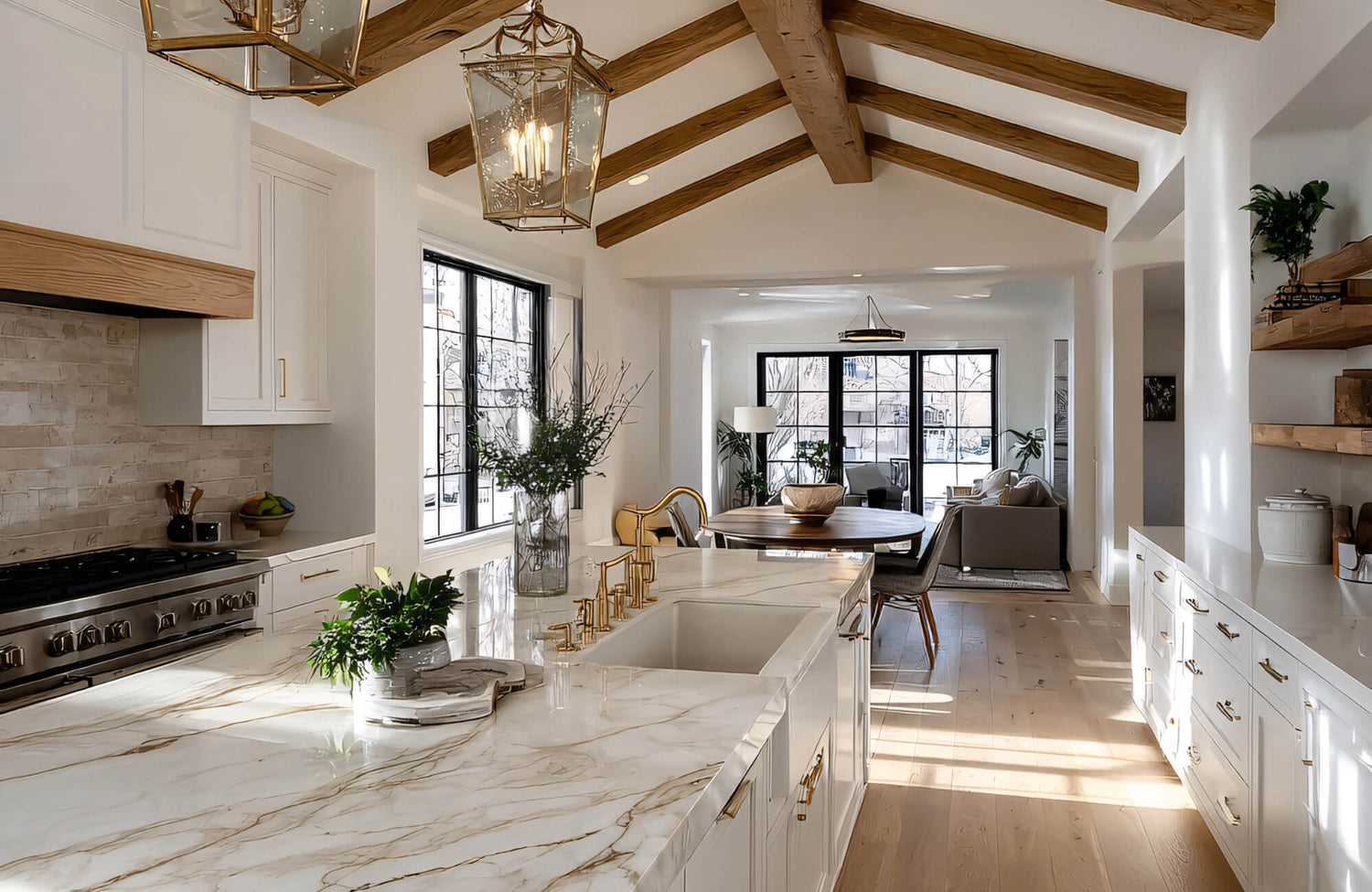
For food preparation, brightness must be high enough to clearly see textures, colors, and fine details. Professional lighting designers consistently recommend that kitchen task areas receive between 70 and 100 foot candles of illumination, a range that supports precision without overwhelming the space. In kitchens where islands double as prep zones, pendants like Edward Martin’s Reynold 18" 1 Light Pendant in Aged Gold/White Linen, shown in the image above, help deliver focused, evenly distributed light while maintaining a refined visual presence. Prep-heavy kitchens benefit from staying closer to the upper end of this range, while casual or secondary work areas may function well with slightly less illumination, provided shadows and eye strain are avoided.
Calculating Foot Candles for Professional Results
Foot candles measure how much light actually reaches a surface, not how much light a fixture emits. To calculate them, the total lumens illuminating a surface are divided by the surface area in square feet. For example, a ten-square-foot countertop receiving 800 lumens delivers 80 foot candles, which sits squarely in the ideal range for food prep. While homeowners do not need to calculate this for every surface, understanding the relationship between lumens, distance, and surface area helps you choose fixtures that perform effectively once installed.

Selecting the Right Color Temperature for Food
Brightness alone does not guarantee good visibility. The color of the light is just as critical in how food appears and how comfortable the kitchen feels. Color temperature is measured in Kelvin and influences everything from mood to accuracy when preparing ingredients.
The Problem with Warm Ambient Light
Warm light, typically below 3000K, creates a cozy and inviting atmosphere, but it is poorly suited for food preparation. Yellow-toned lighting can distort the natural colors of ingredients, making greens appear muted and proteins harder to judge accurately. Fixtures such as Edward Martin’s Matthew 18" 1 Light Pendant in Aged Gold/White Linen, paired with accent lighting like the Freeman Wall Sconce in Old Bronze seen in the image above, demonstrate how warm ambient layers are best reserved for perimeter or dining-adjacent zones rather than primary prep surfaces. When relied on too heavily in work areas, warm lighting sacrifices clarity in favor of mood, often at the expense of functionality.
The Sweet Spot of 3000K to 4000K
For food preparation, lighting in the range of 3000K to 4000K strikes the ideal balance. At 3000K, light remains warm enough to feel residential while offering improved clarity over traditional warm bulbs. Moving closer to 3500K or 4000K introduces a cleaner, whiter light that enhances contrast and detail without feeling sterile. This range allows you to maintain a refined aesthetic while ensuring countertops are properly illuminated for daily cooking tasks.
The Importance of High CRI for Food Safety
Color Rendering Index, or CRI, measures how accurately a light source reveals colors compared to natural daylight. In kitchens, a CRI of 90 or higher is critical for food preparation. High CRI lighting ensures that produce looks fresh, meats show true coloration, and subtle changes in food appearance are easy to detect. This is not just an aesthetic concern but a safety one, as accurate color perception helps prevent undercooking or spoilage-related mistakes. Investing in high CRI LEDs is one of the simplest ways to elevate both the function and quality of kitchen lighting.

Strategic Placement to Eliminate Shadows
Even the brightest, best-colored light fails if it is poorly positioned. Shadows are one of the most common complaints in kitchen lighting, often caused by fixtures placed without considering how people stand and move while preparing food.
Why Recessed Lights Belong Over the Counter Edge
Recessed ceiling lights are most effective when positioned near the front edge of countertops rather than directly overhead. When lights are centered over walkways instead of work surfaces, the cook’s body blocks the light, casting shadows across the counter. Placing recessed fixtures closer to the cabinet face ensures light falls in front of the user, illuminating the entire prep area evenly. This subtle adjustment dramatically improves visibility without increasing brightness or adding fixtures.
The Non Negotiable Need for Under Cabinet Lighting
Under cabinet lighting is essential for professional-level kitchen illumination. It delivers direct, shadow-free light exactly where food preparation happens. Without it, even well-planned ceiling lighting struggles to provide adequate coverage. LED strips or linear fixtures installed beneath cabinets create consistent illumination across countertops while minimizing glare. They also allow you to achieve recommended foot candle levels without overpowering the rest of the kitchen, making them one of the most effective lighting investments available.
Positioning Pendants for Shadow Free Island Prep
Kitchen islands frequently serve as major prep zones, yet pendants are often installed without enough consideration for spacing or height, leading to uneven illumination. Properly positioned pendants should be evenly spaced and mounted high enough to distribute light across the entire island surface. Designs with diffused output, such as Edward Martin’s Oswald Pendant in Dusty Iron, featured in the image above, help minimize harsh shadows while still providing strong task lighting. When thoughtfully placed, pendants become both a functional solution for food preparation and a defining design element within the kitchen.

Control and Flexibility with Dimmers
A well-lit kitchen should adapt effortlessly to different activities throughout the day. The lighting needs for chopping vegetables differ significantly from those for entertaining guests or enjoying a late-night snack. Control systems allow you to tailor brightness without compromising performance.
Transitioning from Prep Mode to Dining Mode
Dimmers make it possible to maintain high brightness during food preparation and soften the lighting once cooking is complete, allowing the kitchen to shift seamlessly between tasks and gathering. Linear fixtures like Edward Martin’s Hailey 48" 4 Lights Linear Pendant in Aged Gold/Opal Matte Glass, along with sculptural options such as the Lumira 18" LED Pendant in Vintage Brass/Glossy Opal shown in the image above, illustrate how layered lighting can adapt to changing needs throughout the day. With the right controls, the same fixtures can support focused prep work and then transition into a warmer, more relaxed dining atmosphere without compromising the overall design.
Zoning Your Switches for Specific Tasks
Separating lighting into zones gives you precise control over how the kitchen functions. Task lighting, ambient lighting, and accent lighting should operate independently so each can be adjusted based on use. Zoning ensures that prep areas receive sufficient brightness without forcing the entire kitchen to remain fully illuminated. This approach not only improves usability but also enhances energy efficiency and visual comfort.
Selecting Dimmable LEDs to Avoid Flicker
Not all LEDs dim well, and poor compatibility can lead to flickering, buzzing, or uneven light output. Selecting high-quality, dimmable LEDs designed for use with modern dimmer switches is essential. Smooth dimming preserves visual comfort and prevents eye strain, particularly during extended cooking sessions. Investing in compatible components ensures lighting remains stable and reliable across all brightness levels.
Illuminating the Heart of the Home
Kitchen lighting for food preparation is not about chasing the brightest possible setup. It is about delivering the right amount of light, in the right color, placed where it works best. By focusing on foot candles instead of watts, selecting color temperatures that enhance clarity, prioritizing high CRI lighting, and positioning fixtures to eliminate shadows, you can create kitchens that function at a professional level while remaining warm and inviting—especially when supported by Edward Martin’s design consultation, which helps homeowners make confident, style-aligned decisions through personalized recommendations tailored to their space.
Thoughtful control systems further ensure the kitchen adapts seamlessly from task-driven mornings to relaxed evenings. For added clarity at any stage of your project, you can contact Edward Martin for expert guidance on product questions or assistance with lighting, tile, rug, or furniture selections, ensuring every detail works together to support both everyday meals and memorable moments with equal brilliance.