Arched mirrors have surged in popularity across residential and commercial interiors, but their visual impact extends far beyond aesthetics. Because of their curvature, extended vertical line, and ability to manipulate light, arched mirrors interact with spatial perception in highly specific ways that can make a room feel larger, taller, and more open.
This article examines the technical design principles behind those effects, including optical depth, visual expansion, and architectural alignment. It also evaluates placement strategies, proportion theories, and material considerations that influence how effectively an arched mirror enhances perceived square footage. By the end, you’ll understand not only whether arched mirrors make a room look bigger, but why—backed by principles used in interior architecture, lighting design, and visual ergonomics.

Optical Depth and Spatial Perception
Arched mirrors influence how the eye interprets interior boundaries by creating visual depth that stretches beyond the room’s actual footprint. Their curved silhouette gently redirects sightlines, allowing spatial cues to unfold in a way that makes compact environments feel naturally expanded.
Vertical Elongation and Visual Lift
The arch’s rising curve guides the eye upward, creating a feeling of added ceiling height that subtly reshapes how the room’s proportions are perceived. This upward lift reduces the visual weight that often gathers around the mid-wall area, helping the space feel more open. The softened transition at the top also allows the gaze to continue moving instead of stopping abruptly at a corner. As the curve draws the eye along its arc, the surrounding walls appear taller and more graceful. This quiet elevation effect helps stabilize the room’s proportions, especially in tight or low-ceilinged layouts.
Reflected Depth as a Spatial Multiplier
A reflection introduces a second layer of visual information, and that layered scene immediately broadens the perceived depth of the room. This extended view replaces hard visual endpoints with a continuation of space, allowing small interiors to feel more breathable. The reflected architecture also forms a cohesive relationship with the actual structure, giving the impression of an expanded footprint. As the eye navigates between real space and mirrored space, the boundaries soften and feel less confining. This continuous visual exchange generates a sense of dimensional layering that enriches spatial clarity.
Curvature and Gaze Continuity
The absence of sharp upper corners allows the eye to travel in a gentle sweep rather than shifting direction abruptly. This uninterrupted flow reduces the visual friction that often compresses smaller spaces. The arch’s natural curvature also acts like a visual guide, carrying the gaze from one plane to another with ease. As the eye glides across the silhouette, reflections feel integrated rather than isolated. This cohesive movement reinforces a sense of openness that reads as calm and spacious. By sustaining this fluid visual rhythm, the mirror helps unify the room’s architectural lines, strengthening the perception of continuity throughout the space.

Architectural Proportion Form and Scale
The power of an arched mirror becomes most evident when its form complements the room’s architectural rhythm, allowing it to function almost like an added structural feature. When proportion and scale align with the space, the mirror naturally strengthens spatial cohesion while amplifying visual volume.
Borrowed Architecture Through Arched Forms
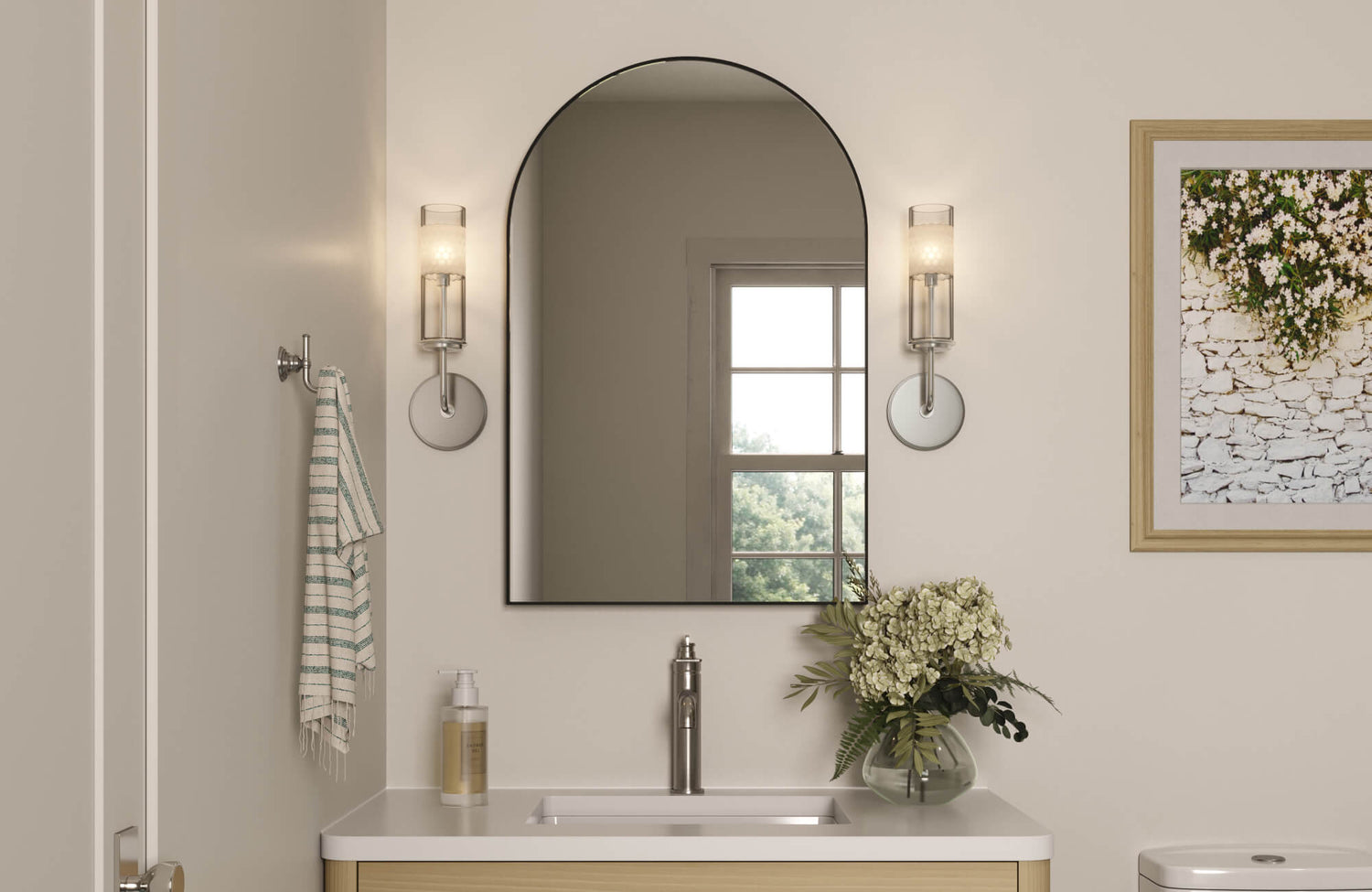
Arched silhouettes echo the familiar language of classical architecture, immediately lending an air of openness to the space. When mirrored, this architectural cue feels like a continuation of the room’s structure rather than a separate object. The reflection reinforces this effect, appearing almost like an extra doorway or window. As the viewer processes this visual extension, the room also takes on a more expansive identity. This borrowed sense of architecture allows small rooms to feel more balanced and expressive. A perfect example is Edward Martin’s Clancy Small Arch Mirror in Antique Brass, as displayed in the photo above, whose graceful arched form visually opens the bathroom and enhances the room’s architectural presence.
Scale and the Rule of Thirds
Mirrors that satisfy the rule of thirds, occupying at least one-third of the wall height, shift from decorative accent to impactful architectural presence. This proportion ensures the mirror participates in shaping the vertical plane rather than merely dressing it. The increased scale also helps draw the eye upward, rebalancing rooms that might otherwise feel compressed. As wall space becomes visually engaged, the surrounding area feels more dynamic and open. This balanced scale strengthens the mirror’s ability to modify spatial perception.
Visual Weight and Structural Balance
Frame thickness determines whether the mirror feels integrated or imposing within the room. Thin frames minimize visual weight, allowing the reflection to dominate and act like an architectural opening. This lighter presence helps the mirror blend seamlessly into both modern and traditional spaces. As the frame recedes, the reflected scene becomes the focal point, leading the eye further into the composition. This balance helps maintain spatial harmony without overwhelming the layout.

Light Enhancement and Luminance Control
Arched mirrors intensify the feeling of spaciousness by redistributing light in ways that elevate clarity and balance. Their curved form works harmoniously with natural and artificial illumination, reducing the visual heaviness caused by shadows and uneven brightness.
Amplification of Natural Light
Positioning an arched mirror opposite a window allows the reflection to act like a secondary light source, broadening the reach of daylight. This expanded illumination creates a more vibrant and open visual field, especially in narrow rooms. The enhanced brightness also diminishes the contrast between lit and shaded areas, making boundaries appear further away. As light spreads across multiple planes, the room gains a sense of openness that feels natural rather than forced. In addition, the interplay of reflection and daylight establishes a stable luminance pattern. By strengthening this balanced light distribution, the arched mirror helps maintain a consistent sense of spaciousness throughout the room.
Shadow Reduction and Softened Gradients
The curved silhouette helps soften shadow transitions, preventing the harsh edges that often shrink a room visually. As shadows blend more smoothly, the space appears continuous rather than compartmentalized. This gentle gradient also contributes to a calmer and more open spatial experience. With fewer abrupt shifts in brightness, the room feels unified and expansive. Moreover, shadows subtly lift away from boundaries, allowing walls to read as broader surfaces. This softened interplay between light and shadow reinforces the room’s visual harmony, strengthening the impression of uninterrupted spaciousness.
Specular Reflection and Ambient Glow
High-clarity mirror surfaces distribute light in multiple directions, creating a soft ambient glow that enriches the room’s atmosphere. This layered illumination counteracts dark pockets that typically compress space. As reflected light blends with existing fixtures, the interior gains a more multidimensional quality. In addition, smooth lighting transitions create a visual depth that feels both refined and expansive. The effect enhances not only brightness but also overall spatial perception. A perfect example of this is the Raelynn Mantel Mirror in Polished Brass as shown in the photo above, where its polished brass frame and organic silhouette help spread warm, natural light across the fireplace wall to elevate the room’s ambient glow.

Strategic Placement and Spatial Alignment
The location of an arched mirror determines whether it transforms the room or simply adds decorative reflection. When thoughtfully aligned with architectural sightlines, the mirror extends the room’s rhythm and creates a more continuous spatial flow.
The Reflective Axis Method
Placing the mirror along a strategic axis, such as facing a doorway or window, extends the room’s architectural movement. The reflection forms an intentional continuation of that axis, giving the space a sense of elongation. This alignment also allows the eye to move through the room with greater fluidity, maintaining a clear directional path. As sightlines stretch, boundaries feel less restrictive and more open, allowing the room to visually “breathe.” The overall composition gains a sense of depth rooted in structural logic and refined visual balance. The photo above illustrates this through our Esmeralda Wide Mirror in Polished Brass, whose expansive arched profile captures the window and hanging pendant perfectly, extending the dining area’s sightline and enhancing spatial continuity through skillful reflective-axis placement.
Enhancing Spatial Continuity in Compact Layouts
Small rooms benefit significantly when arched mirrors reflect open areas instead of dense furnishings. The reflected openness replaces visual stagnation with a sense of forward movement. This added circulation also creates a more navigable atmosphere, even when the footprint is limited. As the eye perceives extended pathways, the room feels more connected and expressive. The mirror becomes part of the architectural rhythm rather than a passive surface. By reinforcing this sense of directional flow, the mirror helps compact layouts feel intentionally designed rather than constrained by size.
Height Placement and Visual Boundaries
Mounting the mirror at a height aligned with natural sightlines helps the reflection feel cohesive rather than distorted. This alignment prevents breaks in visual continuity that can disrupt the sense of openness. As the reflected architecture connects seamlessly with the surrounding walls, the room feels more unified. The mirror also helps anchor the vertical plane in a balanced way. This coordinated height placement reinforces spatial harmony and clarity. With the eye naturally meeting the reflection at a comfortable level, the room’s proportions feel both intuitive and visually expansive.

Material Quality, Surface Clarity, and Frame Design
The physical composition of an arched mirror plays a crucial role in how effectively it expands spatial perception. High-quality materials ensure clear, undistorted reflections that reinforce architectural lines and visual depth.
Low-Iron Glass and High-Clarity Reflection
Low-iron glass eliminates the green tint typically found in standard mirrors, allowing reflections to appear cleaner and more accurate. This clarity enhances the authenticity of the reflected space, making the room feel genuinely larger. True-to-color reflections also support architectural integrity and spatial continuity. As visual information remains faithful, the eye processes depth with greater ease. This precision allows the mirror to function as a convincing extension of real space. By preserving the integrity of every reflected detail, low-iron glass strengthens the mirror’s ability to deliver a crisp, uninterrupted spatial narrative.
Frame Profiles and Perimeter Dominance
Slim frames reduce the dominance of the mirror’s perimeter, allowing the reflection itself to take precedence. This lighter boundary helps the mirror blend organically into the wall plane. The minimized frame also prevents visual interruption, ensuring smooth transitions from wall to reflection. As the eye focuses on the expanded scene, the room gains a broader visual reach. This balance suits both modern and traditional interiors. Through this restrained framing approach, the mirror becomes an integral architectural surface rather than a visually heavy decorative object.
Anti-Distortion Backing and Structural Integrity
High-grade backing materials prevent warping that can alter reflected lines and distort architectural details. Clear, stable reflections preserve the visual geometry that creates the illusion of added space. The structural integrity also ensures long-term accuracy, preventing subtle shifts that could disrupt spatial perception. As reflected lines remain straight and consistent, the viewer experiences reliable visual depth. This consistency strengthens the mirror’s role as a spatial enhancer. Such structural reliability allows the mirror to maintain its spatial impact over time, ensuring the room’s proportions are always perceived with clarity and precision.
Expanding Space Through Design Precision
Arched mirrors amplify spatial perception by blending optical depth, architectural proportion, and luminance control into a single functional design element. Their curved silhouettes guide sightlines with a natural ease that instantly broadens the perceived dimensions of a room. When paired with thoughtful placement and high-quality materials, these mirrors become architectural extensions that reshape the visual boundaries of any interior. The reflective layering they introduce also creates a dynamic interplay between real and mirrored space, enriching both depth and clarity. These combined effects make arched mirrors one of the most powerful tools for achieving spacious, light-filled, and visually balanced rooms.
Edward Martin’s design services build on this same spatial intelligence, offering expert mirror curation and layout planning tailored to enhance scale, harmony, and architectural flow. To bring these design strategies into your home, contact us for personalized guidance and refined solutions crafted around your space!