What makes a wall truly luxurious in 2026: flawless symmetry or expressive artistry? As high-end interiors evolve beyond minimalist perfection, people are beginning to favor spaces that feel emotional, immersive, and deeply personal rather than rigidly styled. This shift has sparked a growing debate in luxury home decor circles over which aesthetic holds greater influence today: painterly murals or geometric patterns.
From boutique-inspired master suites to statement dining rooms and sophisticated home offices, wall design is becoming one of the most powerful tools for shaping atmosphere and identity within a space. As both aesthetics compete for dominance in contemporary interiors, understanding their impact, longevity, and functionality reveals far more than a simple design preference—it highlights where luxury interior trends are heading for the next decade.

The Charlie Sideboard in Taupe grounds the airy artistry of the Skyveil Mural in Mistfall VI while layered ceramic decor softens the contemporary palette.
The Rise of the Artisanal Aesthetic in Modern Home Decor
Before diving into specific design styles, it is important to understand why interiors are moving toward more expressive and emotionally driven aesthetics overall. Homeowners are increasingly seeking spaces that feel curated, tactile, and deeply personal rather than overly polished or formulaic. This broader shift toward authenticity has created the perfect foundation for the rise of artisanal-inspired wall treatments and painterly finishes.
Moving Away from Machine-Made Perfection
For years, ultra-clean lines and digitally precise finishes dominated modern interiors. While minimalism remains influential, many now find hyper-perfect surfaces emotionally cold and visually repetitive. The contemporary luxury market is embracing imperfection as a marker of sophistication, valuing handcrafted aesthetics that reveal depth, texture, and individuality.
Painterly murals align naturally with this transition because they introduce visual movement that feels organic rather than manufactured. Brushstroke-inspired finishes, layered pigments, and watercolor diffusion techniques create walls that appear alive and evolving throughout the day as lighting conditions change. These qualities allow interiors to feel curated rather than assembled.
This artisanal direction also reflects broader lifestyle preferences. Globally, people are seeking environments that provide comfort, emotional warmth, and sensory richness. Spaces designed with painterly wall treatments often achieve this through subtle tonal blending and atmospheric composition, transforming rooms into immersive experiences rather than simply decorated environments.
Why Hand-Brushed Textures Define 2026 Luxury
Luxury design in 2026 increasingly favors tactile storytelling over rigid perfection. Hand-brushed textures communicate craftsmanship in a way that resonates strongly with quality-conscious audiences investing in premium home solutions. Unlike flat printed patterns that prioritize repetition, painterly murals offer variation and nuance that resemble fine art installations. Edward Martin’s Skyveil Mural in Mistfall VI, 312" x 132", shown in the image above, reflects this shift through its layered brushwork and softly weathered tonal movement.
Designers are particularly drawn to murals because they soften architectural harshness. Large contemporary homes often feature expansive walls, high ceilings, and sharp structural geometry. Painterly surfaces counterbalance these elements by introducing fluidity and warmth. This creates a more emotionally balanced environment without sacrificing sophistication.
Another defining advantage lies in exclusivity. Many high-end murals are customized or adapted to individual spaces, ensuring that no two installations feel identical. In luxury interiors where uniqueness matters, this artistic individuality becomes a major selling point.

Warm earth tones in the Hillrise Mural Wallpaper pair effortlessly with the Charlie Sideboard in Taupe to create a serene landscape-inspired focal point.
Defining the Painterly Mural and Its Artistic Impact
As artisanal design continues gaining momentum, painterly murals have emerged as one of the most influential expressions of this movement. Their ability to combine large-scale artistry with emotional softness allows walls to function as immersive architectural features rather than simple decorative surfaces. Understanding what defines these murals helps explain why they are becoming such a dominant force in luxury interiors.
The Watercolor Effect and Soft Room Transitions
One of the most influential characteristics of painterly murals is the watercolor effect. Diffused pigments and soft tonal gradients create seamless visual transitions that make interiors feel expansive and calming. Unlike sharp-edged designs that clearly define boundaries, watercolor-inspired murals blur edges gently, allowing walls to recede visually.
This effect is especially effective in open-plan homes where continuity between spaces is essential. Soft mural compositions can guide movement naturally from one zone to another without abrupt visual interruption. Bedrooms, lounge areas, and wellness spaces particularly benefit from these transitions because they foster relaxation and serenity.
Muted earth tones, dusty blues, mineral greens, and cloud-like neutrals are frequently used within painterly designs because they complement natural materials such as limestone, oak, travertine, boucle upholstery, and textured rugs. The result is a layered luxury aesthetic that feels timeless rather than trend-driven.
Impressionist and Abstract Expressionist Inspirations
Many contemporary mural collections draw inspiration from Impressionist painting and Abstract Expressionism. These artistic references introduce emotional depth that traditional wallpaper patterns often lack. Impressionist-inspired murals may feature blurred landscapes, atmospheric horizons, or botanical abstractions that feel dreamlike and immersive, much like Edward Martin’s Hillrise Mural Wallpaper, 312" x 132", featured in the image above.
Abstract Expressionist influences bring spontaneity and movement through oversized gestures, layered pigment applications, and asymmetrical composition. These murals transform walls into focal points without overwhelming the room because their artistic irregularity feels sophisticated rather than chaotic.
The appeal of these influences lies in their interpretive nature. Geometric patterns communicate immediately through repetition and order, while painterly murals encourage emotional engagement and personal interpretation. This creates a stronger sensory connection between the homeowner and the environment.
Scaling Art to Fit the Architectural Canvas
Large-scale murals excel because they adapt to architecture instead of competing with it. In luxury interiors, walls are often expansive enough to function as canvases themselves. Painterly murals leverage this scale by flowing continuously across entire elevations, creating dramatic visual cohesion.
Designers frequently use murals to emphasize ceiling height, elongate narrow rooms, or anchor oversized furniture arrangements. In homes with curved walls, recessed lighting, or custom millwork, painterly designs integrate more naturally because their fluid compositions accommodate architectural irregularities.
This flexibility allows murals to feel bespoke. Rather than appearing like applied decoration, they become integrated components of the interior architecture itself. For those seeking a more cohesive approach, Edward Martin design services can help coordinate murals with complementary furnishings, lighting, mirrors, and decor selections to ensure every element feels intentionally layered within the space.

The Julian Sideboard in Black adds bold contrast beneath the sculptural Seraphin Mirror in Charcoal and refined Rowland Wall Sconce in Aged Brass.
The Timeless Appeal of Geometric Patterns and Structured Design
While painterly murals emphasize fluidity and artistic expression, geometric patterns continue to hold a powerful position within contemporary interior design. Their structured repetition and mathematical precision offer a completely different interpretation of sophistication that remains highly relevant in modern homes. Exploring the enduring appeal of geometrics reveals why they continue to compete so strongly with more organic artistic styles.
Creating Rhythm with Mathematical Symmetry
Geometric patterns rely on repetition, proportion, and symmetry to establish visual rhythm. This predictability creates interiors that feel organized and intellectually composed. Clean lines, tessellated motifs, hexagonal structures, and angular compositions introduce clarity that complements modern architecture exceptionally well. The subtle checker-inspired detailing of Edward Martin’s Essex Wallpaper in Taupe II, 52" x 132", seen in the image above, demonstrates how restrained geometry can still create strong visual cadence within a refined interior.
In spaces where order and precision are priorities, geometric patterns provide structure without requiring elaborate decoration. Their visual consistency also allows designers to integrate bold materials such as marble, polished metals, smoked glass, or sculptural lighting without creating visual conflict. Because geometric patterns emphasize alignment and repetition, proper wall preparation and careful installation are especially important for maintaining visual consistency across larger surfaces.
Symmetry plays a particularly important psychological role in luxury interiors. Balanced compositions naturally communicate stability and refinement, which explains why geometric motifs remain prominent in premium hospitality environments and formal residential settings. Installation results and overall appearance may vary depending on wall condition, surface preparation, and installation methods. Professional installation is recommended for specialty wallcoverings and large-scale applications.
The Role of Geometrics in Formal Dining and Workspaces
Geometric patterns perform especially well in rooms designed for focus, interaction, or formality. Dining rooms benefit from structured wall treatments because they reinforce architectural alignment and create a polished atmosphere suited to entertaining.
In home offices, geometric designs can subtly improve concentration by reducing visual ambiguity. Structured repetition introduces cognitive order that supports productivity while maintaining visual sophistication. This makes geometrics particularly effective for executives, creatives, and remote professionals designing elevated work environments within their homes.
Luxury offices frequently combine geometric wallpaper with dark wood finishes, statement lighting, and streamlined furniture to create spaces that feel authoritative yet contemporary.
How Bold Angles Define Transitional Style
Transitional interiors blend traditional elegance with modern simplicity, and geometric patterns are especially effective within this design category. Angular motifs bridge classical symmetry with contemporary minimalism, allowing spaces to feel current without becoming overly trend-sensitive.
Chevron patterns, linear grids, and softened Art Deco references remain highly relevant because they introduce visual energy while maintaining sophistication. When paired with neutral palettes and premium materials, bold geometric walls can feel dramatic without appearing excessive.
This adaptability helps explain why geometric patterns continue to endure even as softer artistic aesthetics gain momentum.

Berkshire Wallpaper in Terracotta I introduces structured rhythm beside the expressive Skyveil Mural in Mistfall II, while the Charlie Sideboard in Taupe unifies both aesthetics.
Comparing Visual Longevity and Trend Cycles
Both aesthetics bring distinct advantages to luxury interiors, but their long-term appeal depends on more than immediate visual impact. To better illustrate the differences between these two aesthetics, the following comparison highlights how each style performs across key design considerations. Understanding these contrasts makes it easier to evaluate style leadership beyond simple trend popularity. The contrast shown in the image above between Edward Martin’s Berkshire Wallpaper in Terracotta I, 52" x 132", and Skyveil Mural in Mistfall II, 312" x 132", further emphasizes how structured geometrics and expressive painterly surfaces each create a distinct interpretation of luxury.
|
Design Aspect |
Painterly Murals |
Geometric Patterns |
|
Emotional impact |
Soft, immersive, artistic |
Structured, disciplined, modern |
|
Visual Flexibility |
Highly adaptable to organic interiors |
Best suited to defined architectural styles |
|
Trend Perception |
Emerging luxury direction |
Established contemporary classic |
|
Best Color Approach |
Muted gradients and layered tones |
High-contrast or monochromatic palettes |
|
Architectural Compatibility |
Works well with curves and open layouts |
Ideal for linear and symmetrical spaces |
|
Maintenance of Relevance |
Evolves through artistic interpretation |
Maintains consistency through timeless repetition |
|
Spatial Effect |
Expands and softens rooms |
Sharpens and organizes interiors |
Painterly murals currently represent the more progressive direction in luxury design because they align with broader lifestyle trends emphasizing wellness, individuality, and emotional comfort. However, geometric patterns possess remarkable staying power because their structured nature resists stylistic volatility. Long-term performance and visual aging can also differ depending on environmental exposure, maintenance routines, and material composition.
Rather than replacing geometrics entirely, painterly murals are expanding the definition of sophistication. They offer an alternative form of luxury that feels expressive rather than controlled. Care and maintenance recommendations may vary by material and finish, so it is important to follow the product-specific guidance provided for each wallcovering.

The Drayton Marble Sculpture Set and Stanton Tray style the workspace beautifully, while the Foster Dining Chair in Onyx Leather adds sophisticated contrast.
Choosing Based on Room Function and Mood
Beyond aesthetics alone, the most successful interiors are designed around how each room is meant to feel and function. Certain spaces benefit from softness and emotional calm, while others require structure and visual clarity to support focus or formality. Choosing between painterly murals and geometric patterns often becomes less about preference and more about creating the right atmosphere for daily living.
Why Murals Transform Master Suites into Sanctuaries
Bedrooms are increasingly being designed as restorative environments rather than purely functional sleeping spaces. Painterly murals support this transformation exceptionally well because they soften visual stimulation and create immersive calm.
Layered mural compositions can mimic clouds, mist, landscapes, or abstract organic movement, encouraging relaxation through subtle visual depth. This approach works particularly well behind upholstered beds, integrated lighting systems, and textured natural materials.
Luxury master suites often incorporate oversized murals alongside linen drapery, plush rugs, sculptural lighting, and warm wood finishes to create hotel-inspired sanctuaries that feel deeply personal.
The emotional softness of painterly walls also complements wellness-centered design philosophies that prioritize mental comfort, tranquility, and sensory harmony.
Using Geometric Patterns to Increase Focus in Home Offices
Home offices require a different psychological environment. Productivity-oriented spaces benefit from visual structure that promotes concentration and decisiveness. Geometric patterns naturally reinforce these qualities through repetition and spatial order.
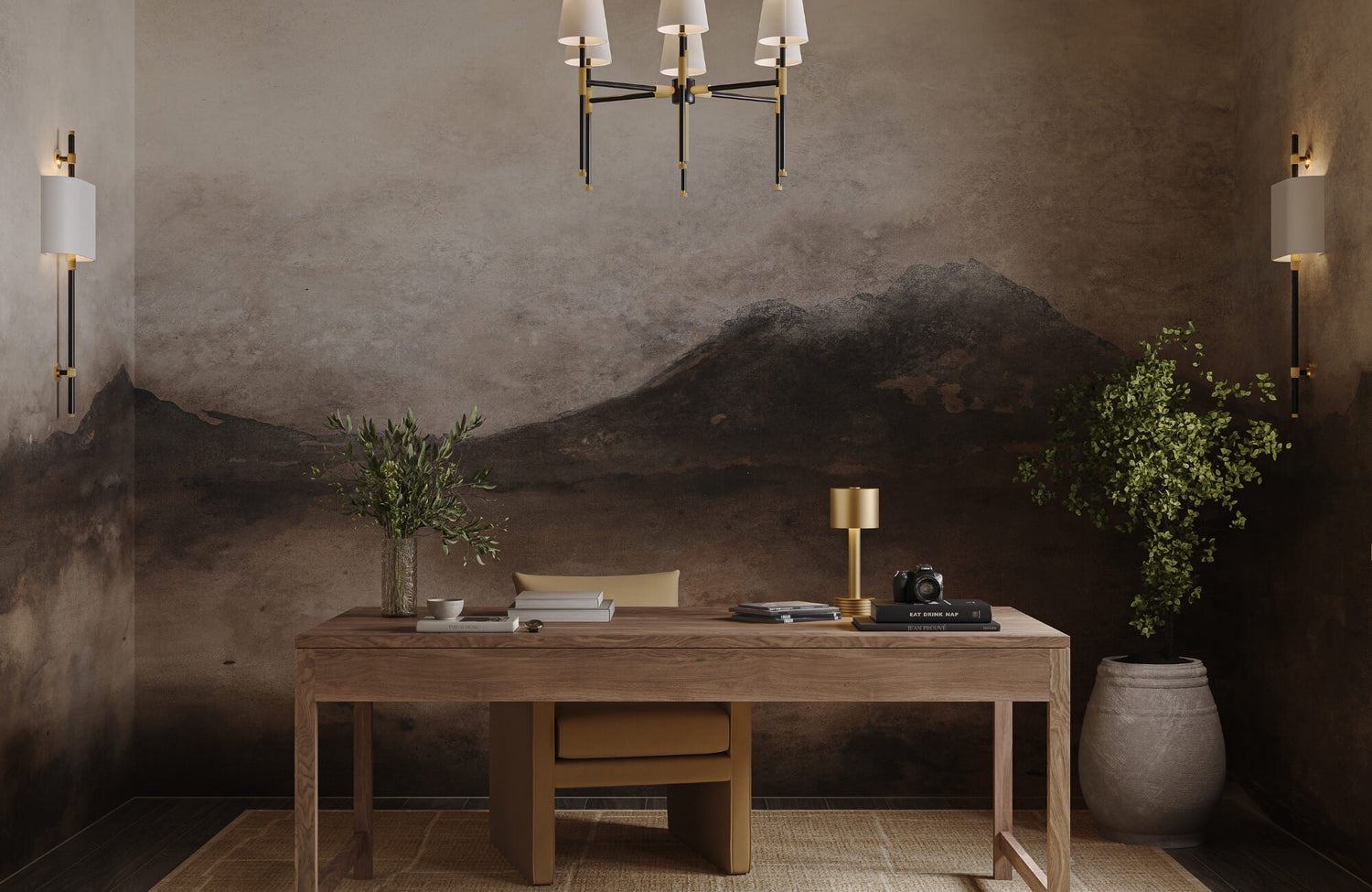
Linear motifs and symmetrical compositions help define work zones clearly, especially in multifunctional homes where office areas coexist with living spaces. Structured wall patterns can also enhance professionalism during virtual meetings by creating polished architectural backdrops. While more organic in composition, Edward Martin’s Plateau Wallpaper in Taupe II, 52" x 132", featured in the image above, offers a similarly grounded visual rhythm that works beautifully in study spaces seeking warmth without sacrificing refinement.
Designers often pair geometric wallpaper with streamlined furniture, integrated shelving, statement mirrors, and layered lighting to create offices that feel efficient yet luxurious. For those refining a workspace or planning a full interior update, Edward Martin’s contact page provides access to personalized guidance for selecting wall treatments and coordinating premium design elements throughout the home.

Installation Considerations for Large Scale Art versus Pattern Repeats
In addition to style and mood, practical installation factors also have a significant influence on selecting the right wall treatment. Large-scale murals and repeating geometric patterns each involve different technical demands that can affect labor, alignment, material usage, and long-term maintenance. Understanding these installation considerations helps ensure that the final design achieves both visual impact and lasting quality.
The Complexity of Seam Alignment in Panoramic Scenes
Painterly murals often involve panoramic compositions that require meticulous alignment during installation. Because the artwork flows continuously across multiple panels, even slight inconsistencies can disrupt the visual integrity of the design.
Professional installation becomes especially important for large-scale murals featuring watercolor gradients, horizon lines, or intricate artistic detailing. Walls must be carefully prepared, measurements must be exact, and panel sequencing must follow the intended composition precisely.
Lighting placement also significantly affects mural presentation. Integrated sconces, recessed lighting, and natural daylight can either enhance or distort painterly textures depending on positioning. Designers therefore consider illumination strategies early in the planning process.
Although installation may be more complex, the resulting visual impact often justifies the investment in premium interiors.
Calculating Waste and Pattern Repeats for Geometrics
Geometric wallpaper introduces different technical challenges centered around pattern matching and repeat calculations. Intricate motifs require careful alignment to preserve continuity across seams, corners, and ceiling transitions.
Large repeats can increase material waste substantially because installers must trim sections precisely to maintain symmetrical alignment. Complex geometric designs may also reveal wall imperfections more easily due to their structured nature.
However, geometric installations are often easier to repair selectively if damage occurs. Since patterns repeat consistently, replacing isolated sections can be more manageable than restoring panoramic mural compositions. For those prioritizing precision and long-term practicality, this can be an important consideration.
The Verdict on Style Leadership for the Coming Decade
Painterly murals and geometric patterns represent two distinct visions of luxury interior design. Geometric patterns continue to embody structure, precision, and timeless architectural discipline, making them ideal for formal spaces, professional environments, and interiors grounded in modern symmetry.
Painterly murals, however, are increasingly defining the emotional future of luxury living. Their fluid artistry, layered textures, and immersive softness align closely with contemporary desires for comfort, authenticity, and individuality. That does not mean geometric patterns are disappearing. Instead, the industry is moving toward greater balance, where structured designs coexist with expressive artistry depending on the purpose and mood of the space. Ultimately, the most stylish choice is not determined solely by trend cycles but by how successfully the design enhances the experience of living within the home itself.