The round mirror is a timeless design element that blends sculptural beauty with profound symbolic meaning. Celebrated across cultures and centuries, its perfect circular form evokes harmony, continuity, and inner reflection. As both a functional object and a visual focal point, the round mirror adds elegance and spatial balance to interiors. Whether enhancing natural light, creating visual flow, or serving as a metaphor for unity and self-awareness, it remains an essential feature in refined interior design.
This article explores the rich symbolism of round mirrors through cultural, spiritual, psychological, aesthetic, and contemporary lenses, inviting a deeper appreciation for their enduring presence in thoughtfully curated spaces.

Cultural Significance Across Civilizations
Across ancient civilizations, round mirrors were revered not merely as functional objects but as sacred symbols of cosmic balance and divine presence. Their shape echoed celestial bodies like the sun and moon, aligning them with cyclical time, eternal order, and spiritual protection. Whether adorning temples or homes, they reflected both physical appearance and cultural beliefs about beauty, truth, and metaphysical power.
Ancient Eastern Traditions
In the context of classical Chinese Feng Shui, round mirrors were placed with precise intent to redirect negative Qi and restore energetic harmony within domestic or sacred environments. These mirrors, often crafted from polished bronze or metal, embodied the balance of yin and yang, reflecting the interplay of opposing but complementary forces.
Similarly, Japanese Shinto tradition holds the Yata no Kagami as a sacred round mirror representing wisdom, honesty, and clarity—one of the three Imperial Regalia of Japan. In this role, the mirror transcended reflection, functioning as a divine emblem of truth and purity. The mirror's unbroken circumference also symbolized spiritual completeness, resonating with broader cosmological themes. In both traditions, the mirror’s roundness conveyed not just aesthetic preference but deep spiritual and energetic significance.
Greco-Roman and European Use
In Greco-Roman culture, handheld round mirrors frequently appeared in the iconography of goddesses such as Aphrodite and Venus, symbolizing beauty, self-awareness, and the divine feminine. These mirrors were often elaborately adorned, suggesting that their function extended beyond vanity to include symbolic representation of personal and spiritual identity.
Romans believed that mirrors could capture aspects of the soul, a belief that later evolved into superstitions about the consequences of breaking one. In medieval Europe, spherical convex mirrors, commonly referred to as "witch balls", were suspended near entrances and windows to repel malevolent spirits and protect the household. Their curved, all-seeing shape was thought to ward off harmful energies by dispersing them outward. Through these roles, the round mirror became not only a household object but also a mystical tool imbued with protective and symbolic power.

Spiritual and Metaphysical Interpretations
Round mirrors are central to many spiritual practices, where their shape symbolizes infinity, wholeness, and sacred symmetry. Often seen as portals or energetic amplifiers, they reflect not just light but intention and consciousness. Integrated into rituals or meditative environments, they create harmonious fields that support spiritual focus and transcendence.
Sacred Geometry and Symbolic Form
Within sacred geometry, the circle is a foundational form that expresses timelessness, unity, and the absence of fragmentation. A round mirror, by its perfect curve and central symmetry, mirrors this archetype with precision. It also embodies an aesthetic and energetic balance that supports spiritual alignment and inner peace. Often placed in meditative environments, altars, or sacred architecture, these mirrors serve as grounding visual anchors that center attention and intention. Their shape allows energy to flow in a continuous, harmonious loop, encouraging a stable spiritual atmosphere. In this way, the geometry of the mirror transcends decoration and becomes a conduit for metaphysical coherence.
Energy Amplification and Spiritual Portals
In esoteric traditions and energy work, round mirrors are used to intensify and redirect not only light but also vibrational fields, emotional intent, and psychic focus. Their reflective quality is considered dynamic, capable of modulating the energetic character of the space they occupy. When strategically placed, they are believed to magnify intention, disperse energetic stagnation, and serve as psychic mirrors that reflect the deeper, often hidden aspects of the soul.
During practices such as scrying, the mirror acts as a meditative gateway, enabling practitioners to access inner vision or spiritual insight. Its circular form is thought to create a protective and amplifying field, containing the experience within a safe and coherent boundary. This combination of reflection, containment, and amplification reinforces the mirror’s role as a sacred portal.

Psychological Symbolism and Inner Reflection
In psychology, round mirrors symbolize self-integration, personal wholeness, and emotional balance. Their smooth, edge-free form contrasts sharply with angular shapes, offering a gentler reflection of the self. This visual softness encourages introspection without judgment, reinforcing themes of acceptance and inner clarity.
The Mirror as a Psychological Device
Within the framework of psychoanalytic theory, particularly Jacques Lacan’s concept of the mirror stage, the mirror is central to how the ego begins to form through self-recognition. A round mirror, with its absence of angles or edges, offers a softer, more unified reflection that aligns with the idea of a stable, integrated self. Rather than highlighting fragmentation, it provides a visual space where coherence and balance can be perceived, even if unconsciously.
This quality makes it particularly valuable in therapeutic environments, where the goal is often to foster emotional clarity and psychological wholeness. Its form reduces visual harshness and encourages an open, less confrontational gaze. Over time, repeated interaction with such a reflective surface may subtly reinforce a sense of inner equilibrium and self-acceptance.
Jungian Mandala and Personal Integration
Carl Jung’s concept of the mandala, a circular symbol representing the self and the process of individuation, finds a compelling parallel in the round mirror. Like the mandala, the mirror draws the eye inward and organizes the visual field around a central point, suggesting psychological centering. Used intentionally, it can evoke feelings of introspection and depth, helping the individual explore unconscious material in a safe and structured way.
This makes it a valuable tool in therapeutic rituals or self-reflection practices that aim to integrate disparate parts of the psyche. The symmetry and containment provided by the mirror’s circular shape foster a sense of completion and inner alignment. Thus, it functions as a psychological symbol of the self in transformation.

Functional Meaning in Spatial and Interior Design
Round mirrors are strategic design elements used to soften lines, reflect light, and introduce spatial harmony. Their circular form visually balances architectural rigidity, promoting calm and organic flow. In both modern and traditional interiors, they serve as both focal points and energy enhancers.
Spatial Dynamics and Light Distribution
Round mirrors excel at dispersing light evenly across a space, a property rooted in their symmetrical curvature and edge-free design. When placed opposite windows or sources of natural light, they capture and scatter illumination in a soft, diffused pattern. This creates an enhanced perception of depth and airiness, making small or dim rooms appear larger and brighter. Their radial symmetry also avoids visual clutter, maintaining clean sightlines and reducing angular competition in a room. Designers often use them in entryways, hallways, or transitional zones to open up visual fields and create smoother spatial progression. The result is a more welcoming, balanced interior that feels cohesive and serene.
Form-Driven Balance and Emotional Impact
The use of round mirrors introduces a sense of calm and softness to interiors, offsetting the dominance of hard materials and sharp angles common in architectural construction. From a neuroaesthetic perspective, the human brain responds positively to circular shapes, associating them with safety, continuity, and approachability. This emotional resonance makes round mirrors ideal for settings where relaxation and comfort are prioritized, such as bedrooms, spas, or wellness centers. Their presence subtly guides mood and perception, reinforcing a sense of ease and spatial harmony. They also provide a non-linear counterbalance in modern, minimalistic layouts, serving as organic focal points. Through both emotional and visual impact, round mirrors contribute meaningfully to the atmosphere of a space.
Versatility in Design Styles and Applications
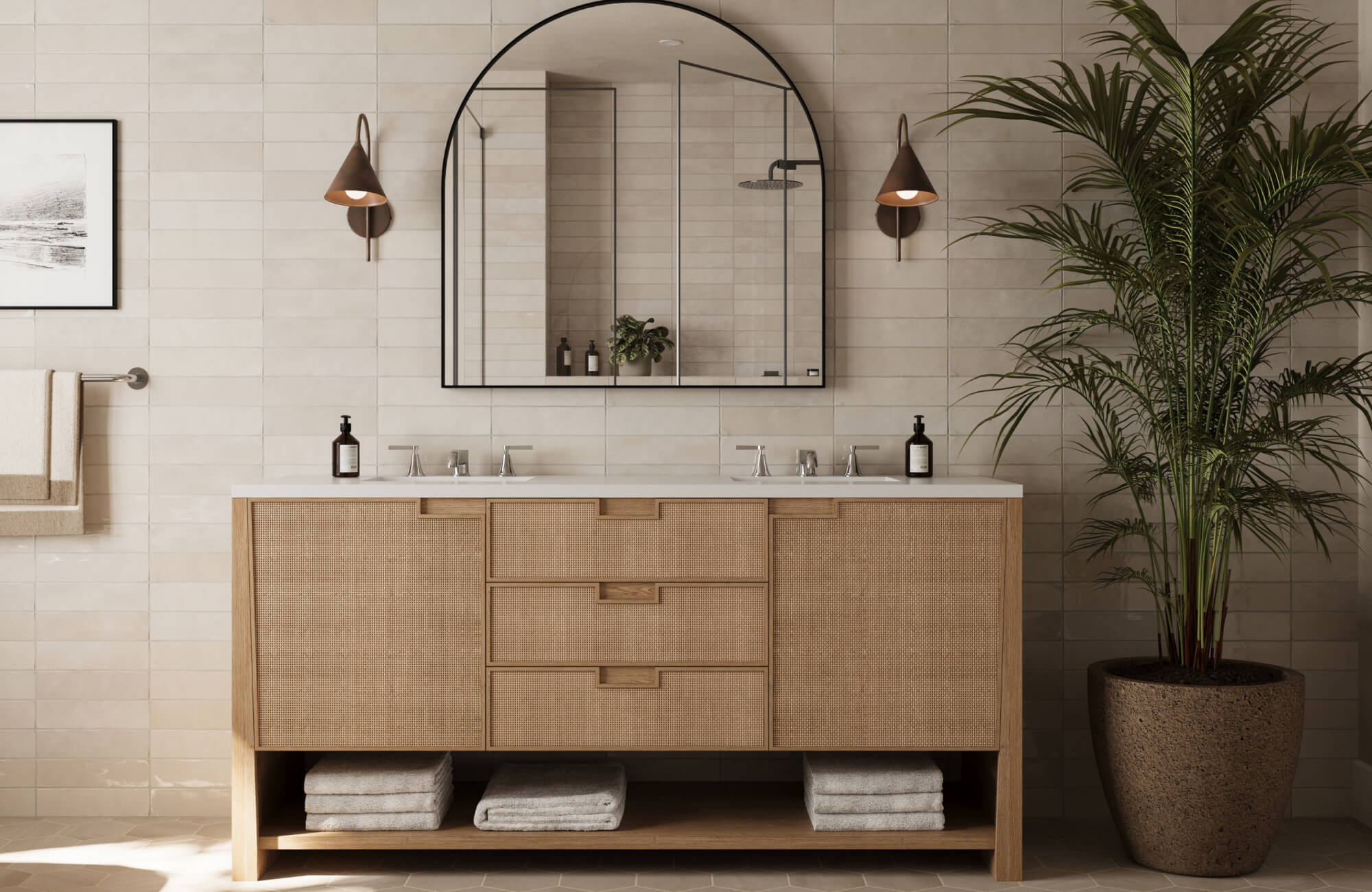
Round mirrors possess an exceptional adaptability that allows them to complement a wide range of interior design styles, from modern minimalism and Scandinavian warmth to bohemian eclecticism and classical elegance. Their sculptural silhouette introduces visual interest without overwhelming a room, making them an ideal accent for both subdued palettes and richly layered aesthetics. Whether framed in metal, wood, or rattan, their timeless form bridges diverse materials and design languages with graceful cohesion.
They can also be scaled for bold, statement-making installations or used in repetition for subtle rhythm across a wall or corridor. This versatility ensures that round mirrors serve not only as focal points but as integrative elements that enhance spatial narrative and stylistic harmony. A prime example is Edward Martin’s Tristan Round Mirror in Polished Brass, as displayed in the picture above. It pairs clean geometry with a refined metallic finish, effortlessly elevating both contemporary and traditional interiors.

Contemporary Symbolism in Art and Branding
In contemporary art and branding, the round mirror symbolizes inclusivity, innovation, and introspective engagement. Artists use it to challenge perception, while brands adopt it to convey transparency and holistic identity. Its timeless shape continues to resonate in modern storytelling and experiential design.
Visual Art and Experiential Reflection
In contemporary installation art, round mirrors are frequently used to manipulate perception and reframe spatial understanding, immersing viewers in reflective environments that challenge visual norms. Artists like Anish Kapoor utilize concave or convex surfaces to create optical illusions that distort depth, space, and self-perception. These works also invite viewers into active dialogue with the art, encouraging them to reconsider their own visual and physical presence. The mirror becomes not just a surface but a medium for introspection and sensory disruption. Its circular form reinforces themes of continuity and infinite possibility, amplifying the philosophical and emotional impact. As a result, the mirror transforms into a conceptual lens through which deeper truths about perception and existence are explored.
Brand Identity and Holistic Representation
In branding, the circular form is increasingly used to represent continuity, trust, and interconnectedness—qualities that resonate with modern consumers seeking meaning and authenticity. Round mirrors or circular logos also suggest inclusivity and a 360-degree perspective, aligning with values such as transparency, customer-centricity, and innovation. Retail environments often incorporate round mirrors to create immersive spaces where customers can see themselves as part of a lifestyle or experience. The mirror becomes a symbolic device that reinforces brand narratives of empowerment, transformation, and personal engagement.
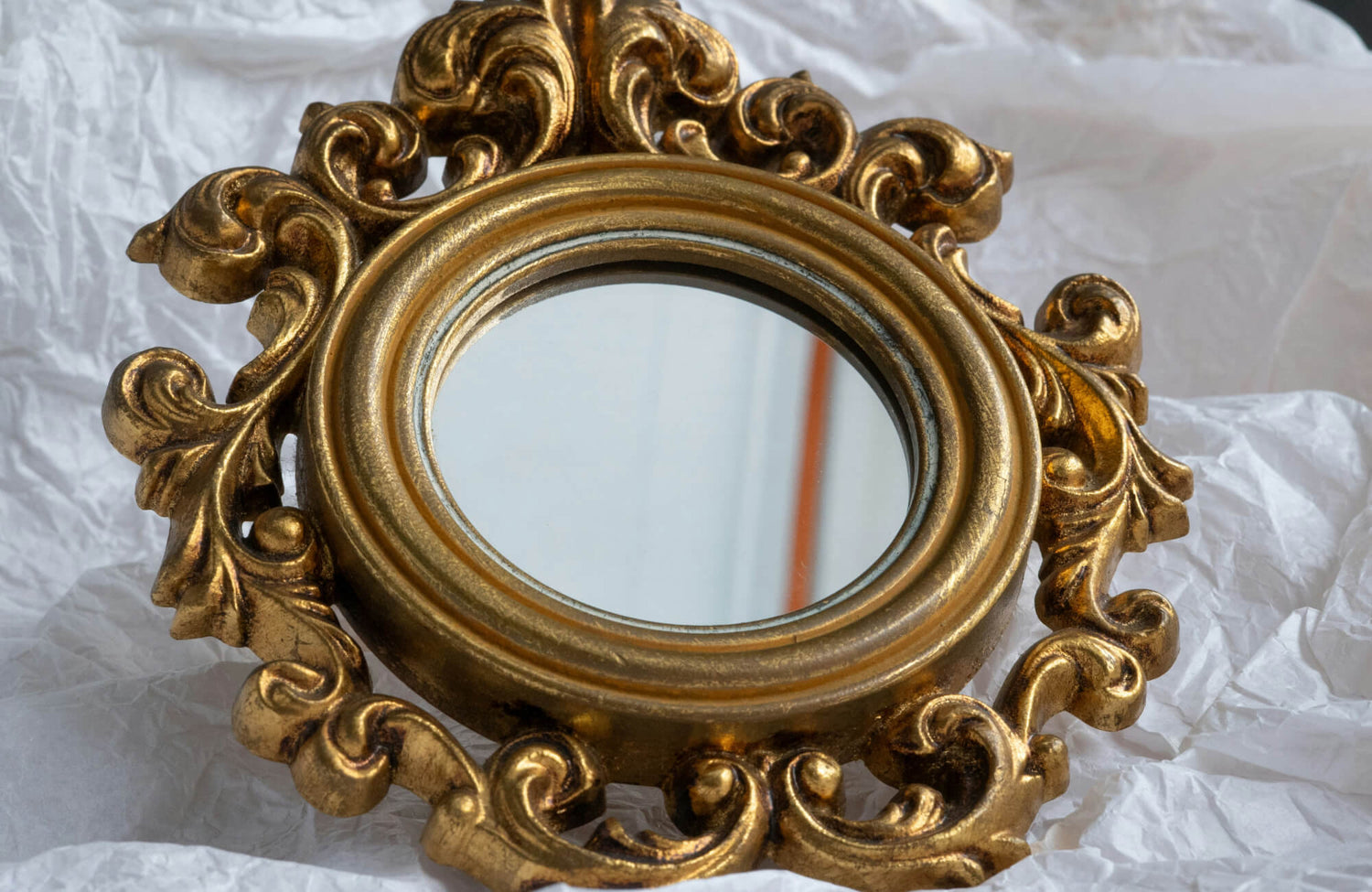
A refined example is the Fitz Mirror in Antique Silver, as shown in the photo above, whose timeless form and subtly distressed finish lend an air of heritage and sophistication, ideal for boutiques or branded environments aiming to evoke trust, elegance, and timeless identity. Its form serves both a visual and conceptual purpose, enhancing cohesion between product, space, and identity. As branding becomes more experiential, the round mirror offers a potent tool for storytelling and connection.
Symbolism in Digital and Experiential Design
In digital and experiential design, the round mirror has emerged as a subtle yet intentional symbol of personalized space and modern self-perception. Designers incorporate circular motifs into social content styling, user interfaces, and branded environments to evoke unity, emotional intimacy, and reflection. This trend mirrors the rounded profile icons, camera frames, and storytelling formats that dominate social media and mobile platforms.
In experiential retail or digital branding, round mirrors often serve as interactive design features that invite users to see themselves within a curated visual narrative. Their circular form also reinforces ideas of completeness and personalization, shaping how users emotionally connect with spaces and stories. As such, the round mirror functions as both a literal and conceptual device in contemporary design, reflecting the evolving relationship between form, identity, and user engagement.
Final Reflections on the Symbolism of Round Mirrors
The round mirror embodies a timeless convergence of form and meaning, symbolizing unity, introspection, and continuity across cultural, spiritual, and psychological domains. Its circular shape and reflective surface invite both outward perception and inward contemplation, making it a powerful tool for transformation and awareness. Far beyond ornamentation, it serves as a symbol of wholeness and coherence in both physical and conceptual spaces. As design, thought, and ritual evolve, the round mirror remains a compelling emblem of clarity and connection.
At Edward Martin, we thoughtfully integrate symbolic design elements, such as round mirrors, to elevate spatial harmony, emotional resonance, and visual storytelling in every interior we create. Discover our design services to elevate your space with expert guidance, or contact us to begin your personalized project consultation today!