Choosing a mirror goes far beyond filling an empty wall. It shapes how light moves through a room, how spacious it feels, and even how the space evolves over time. A single mirror can quietly reinforce a space’s history or sharpen it with contemporary clarity, which is why the decision often feels more meaningful than expected.
As design preferences continue to balance nostalgia with innovation, the choice between antique and modern mirrors becomes increasingly relevant. By exploring how each option differs in reflection quality, value, structure, sustainability, and functionality, this article helps you understand what each mirror brings into your space, and more importantly, which one aligns with how you live and what you want your space to express.

Reflection and Visual Texture
What makes an antique mirror feel soulful, and a modern mirror feel razor-sharp comes down to chemistry. Once you understand how each reflective surface is made, you can predict not only how it will look on your wall, but how it will shape the mood and light of the entire room.
Desilvering and Foxing
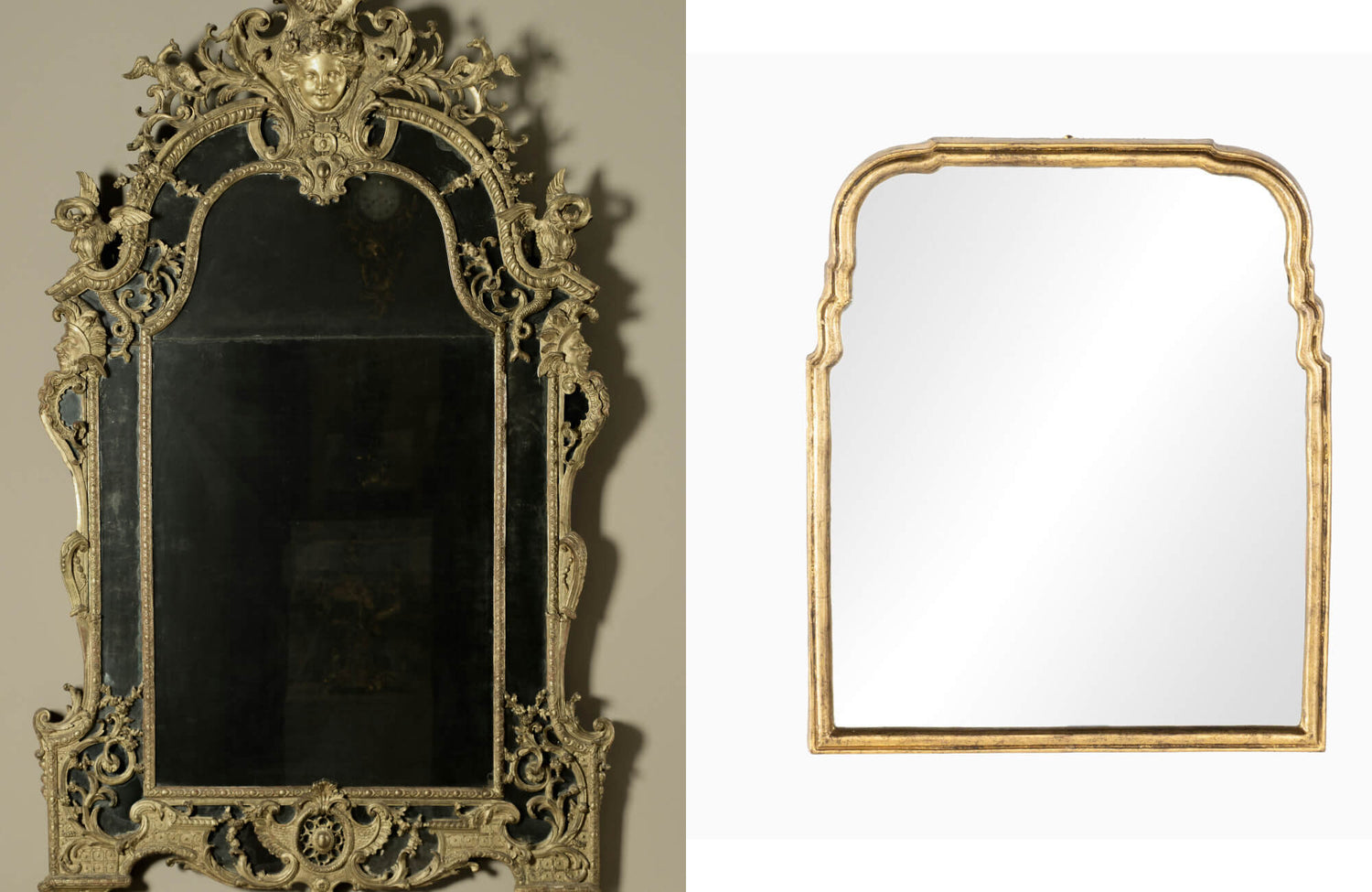
An antique mirror earns its character the slow way through time, air, and imperfect protection. In many pieces made before the mid-19th century, the reflective layer was created using a mercury–tin amalgam, and even later, silvered mirrors were sealed with backings that weren’t as chemically resilient as today’s coatings. As years pass, humidity and airborne pollutants slip into microscopic gaps, causing the reflective layer to break down unevenly. That’s when you see desilvering at the edges and foxing across the surface; those smoky blooms, peppered shadows, and darkened freckles that make the reflection feel gently weathered instead of pristine.
Because the degradation is organic and irregular, the mirror starts to behave like a filter rather than a flat reflector. The image softens, highlights glow instead of glare, and the room feels slightly more cinematic, as if the mirror is holding onto its own atmosphere. If you’re drawn to interiors that feel layered and lived-in, this “imperfect chemistry” becomes the point. It also adds narrative weight and visual texture that a manufactured antique finish can imitate, but rarely captures with the same depth or randomness.
Clarity and High-Definition Silvering in Modern Glass
Modern mirrors are built for consistency and control. Instead of relying on older, more vulnerable reflective backings, contemporary production uses refined wet-silvering with silver nitrate or vacuum deposition to lay down an extremely uniform reflective layer. Pair that with low-iron float glass, chosen specifically to reduce the greenish cast you see in standard glass and you get a reflection that reads clean, bright, and color-true. Protective copper-free backings and lead-free paints then seal the mirror against moisture, so the surface stays stable even in humid spaces.
That precision changes the way the mirror performs in your room. Rather than absorbing light the way aged glass often does, modern glass throws it back with clarity, turning the mirror into a quiet powerhouse for brightness and spatial expansion. This is why a modern mirror can make a tight entry feel larger, a dim bathroom feel more polished, or a bedroom corner feel more intentional, especially when you want your reflection to be honest, your lighting to be efficient, and your overall look to feel crisp instead of romantic.
A piece like our Elvynne Mirror in Antique Brass, shown in the image above, bridges that gap between modern performance and timeless character beautifully. Although its warm brass frame nods to classic detailing, the mirror itself benefits from modern glass construction, delivering clarity, brightness, and color accuracy. This balance makes it especially effective in spaces that want the visual richness of an antique-inspired finish without sacrificing the clean reflection and light-enhancing qualities of contemporary mirrors—perfect for bathrooms, entryways, or bedrooms where both style and function matter.

Investment Value and Long-Term Market Relevance
Beyond how a mirror looks, its value is shaped by how it holds or loses worth over time. Whether a mirror becomes an appreciating object or a practical fixture depends on rarity, documentation, and what you expect it to represent in your space.
Provenance and the Antique Resale Market
When you choose an antique mirror, you are stepping into a market driven by scarcity and history rather than trends. Mirrors from established periods such as Louis XV, Regency, Art Deco, or Mid-Century Modern exist in finite numbers, which is why well-preserved examples often gain value rather than depreciate. Provenance also plays a central role here; documented origins, workshop attribution, estate records, or even period-appropriate construction details can dramatically influence how a mirror performs at auction or in private resale.
Just as important is material authenticity. Collectors place a premium on mirrors that retain their original glass, even when that glass shows foxing, waviness, or edge desilvering. Those visual irregularities are read as proof of age, not flaws. Although replacing the glass may make the mirror more reflective for everyday use, it often weakens its investment credibility by severing the chemical and historical link that defines the piece. If long-term value matters to you, restraint and preservation usually outperform restoration aimed solely at visual perfection.
The Cost Efficiency of Contemporary Units
Modern mirrors operate under a completely different value system, one rooted in practicality rather than appreciation. Because they are mass-produced using standardized materials and processes, their worth is tied to scale, convenience, and immediate performance. This makes them especially appealing when you need large surfaces, consistent sizing, or a clean, uniform look without the financial commitment of a collectible object.
That replaceability can be a strategic advantage. If your mirror is damaged, relocated, or no longer fits your evolving style, you can source a near-identical replacement quickly and affordably. This flexibility suits spaces where change is expected, allowing you to prioritize function and visual clarity without worrying about market value or long-term equity. In this context, the mirror isn’t an asset you protect; it’s a tool you use, adapt, and move on from as your needs shift.

Structural Integrity and Installation Constraints
How a mirror is built directly influences where it can live and how safely it can be installed. Once you move beyond aesthetics, weight, balance, and material durability become decisive factors in choosing between antique and modern pieces.
Weight Distribution and Mounting Historical Frames
Antique mirrors are often deceptively heavy due to thick, early glass and frames carved from solid hardwood or built up with plaster ornamentation. Because that weight is rarely distributed evenly, installation requires more than standard wall hardware. To support the load safely, mounting typically involves anchoring into wall studs, using reinforced brackets, or installing a French cleat system that spreads the weight horizontally rather than concentrating it on a single point.
Age further complicates the process. Over time, wood can dry out and become brittle, joints may loosen, and old adhesives can lose their strength. As a result, the frame itself may need protective padding or custom supports to prevent stress fractures when hung. These precautions can limit placement options, but they are essential if you want to preserve the mirror’s structure while ensuring it remains secure on the wall.
Versatility of Lightweight Composite Materials
Modern mirrors approach installation from the opposite direction, prioritizing ease and adaptability. Frames made from aluminum or polyurethane, combined with thinner, heat-strengthened glass, significantly reduce overall weight without sacrificing durability. This allows you to mount mirrors using simpler hardware and, in some cases, lean oversized pieces directly against the wall without introducing structural risk.
That flexibility aligns naturally with contemporary living. As rooms are reconfigured and furniture shifts over time, a modern mirror can be moved, rehung, or repositioned with minimal effort. Instead of dictating where it must go, the mirror also adapts to your space, making it a practical choice when versatility and convenience matter as much as visual impact.
Our Clancy Mirror in Antique Brass, seen in the photo above, fits seamlessly into this conversation by pairing a substantial, design-forward look with the practical benefits of modern construction. Its refined brass finish delivers the presence of a classic statement mirror, while its lightweight composite framing makes installation and repositioning far more manageable than traditional, solid-metal designs. This combination allows the mirror to move with your space over time, ideal for evolving layouts where you want enduring style without the limitations of heavy, hard-to-handle materials.

Environmental Impact and Material Sustainability
As sustainability becomes central to how you shape your space, mirrors highlight the contrast between reuse and modern responsibility. On one hand, antique pieces offer the advantage of embodied history, as their most resource-intensive processes occurred long ago. By keeping these mirrors in use, you reduce demand for new materials while preserving craftsmanship that would otherwise be lost, creating a choice rooted in conservation and continuity.
At the same time, modern mirrors reflect meaningful progress in cleaner production and material sourcing. Advances such as copper-free silvering, low-toxicity finishes, and responsibly harvested frames significantly reduce environmental impact at the manufacturing stage. Although they still rely on new resources, these improvements narrow the gap between reuse and new production, allowing you to balance performance, health, and environmental awareness. Together, these options show that sustainable design is no longer a single path but a spectrum of thoughtful choices aligned with how you live today.

Integrating Architectural Style and Design Intent
A mirror does more than reflect a room; it participates in its architectural language. Whether you reinforce a space’s original character or introduce contrast depends on how intentionally the mirror aligns with or challenges the surrounding design.
Historical Continuity in Period Spaces
In period spaces, a mirror that belongs to the same design era helps preserve architectural coherence. Victorian interiors, for example, feel grounded by pier mirrors with carved detailing or gilded ornamentation that echoes ceiling moldings and fireplace surrounds. Likewise, Mid-Century Modern spaces benefit from sunburst mirrors or softly organic forms that mirror the era’s emphasis on balance, geometry, and natural materials.
When the mirror speaks the same visual language as the walls, windows, and built-in features, it also feels embedded rather than applied. The result is a space that reads as authentic and resolved, where the mirror reinforces the space’s history instead of competing with it. This continuity allows architectural details to feel intentional and complete rather than fragmented by mismatched elements.
Juxtaposition and the Statement Effect
Contrast can be just as powerful when used deliberately. Introducing a modern mirror into a traditional setting creates visual tension that keeps the space from feeling frozen in time. Clean-lined frames, thin metal borders, or bold geometric silhouettes bring lightness and clarity to rooms otherwise defined by ornate detailing and heavy materials.
This approach is especially effective in transitional areas, where a contemporary mirror can act as a visual pause. By offering a calm, restrained surface, it allows antique furniture or decorative elements to stand out more clearly. Instead of competing with historical craftsmanship, the modern mirror frames it, giving the space a layered, curated feel that balances respect for the past with a distinctly present-day perspective.

Functional Tech Integration and Smart Capabilities
As mirrors evolve beyond pure reflection, technology becomes a defining advantage. Modern mirrors now operate as functional tools that support daily routines in ways antique pieces simply cannot.
Integrated Lighting and Anti-Fog Performance
In contemporary spaces, mirrors are increasingly designed to solve practical challenges rather than merely reflect an image. Integrated LED lighting provides even, shadow-free illumination that closely mimics natural daylight, allowing you to see colors and details accurately. This level of precision is especially important during grooming routines, where uneven or warm lighting can distort perception and lead to subtle but noticeable mistakes.
Anti-fog technology further enhances usability by keeping the glass clear in humid conditions. By gently warming the mirror’s surface, these systems prevent condensation from forming, so your reflection remains unobstructed even after a hot shower. Over time, this hands-free clarity also protects the reflective backing, reducing the need for wiping that can wear down coatings and introduce streaks or damage.
Designed with everyday performance in mind, our Jenny 37" LED Vanity Mirror in White, featured above, embodies the practical advantages of modern mirror technology. Its integrated LED lighting casts even, natural-looking illumination, while the anti-fog function keeps the surface clear in steamy conditions, ensuring uninterrupted use. The crisp white frame and minimalist form also allow it to blend seamlessly into contemporary bathrooms, where function, comfort, and visual simplicity are just as important as style.
Smart Mirrors and Digital Interfaces
Smart mirrors take functionality a step further by integrating digital interfaces directly into the glass. Hidden screens allow you to view weather updates, calendars, or notifications without breaking the visual flow of the space. In fitness and wellness applications, motion sensors and AI-driven tracking can guide workouts, correct posture, or display performance data in real time, turning the mirror into an interactive training companion.
This shift changes the role of the mirror entirely. Instead of serving as a passive backdrop, it becomes an active participant in your day, blending reflection with information and feedback. Although antique mirrors offer atmosphere and historical depth, smart mirrors prioritize efficiency, connectivity, and convenience, aligning seamlessly with a lifestyle that values integrated technology and real-time support.
Choosing Between Character and Precision
Ultimately, the decision between an antique mirror and a modern alternative reflects what you value most in your space. Antique mirrors offer character, depth, and a tangible sense of history, enriching rooms with warmth and visual storytelling. Modern mirrors, on the other hand, provide precision, flexibility, and advanced functionality that support contemporary lifestyles. When chosen thoughtfully, either option can feel timeless, not because of its age or technology, but because it complements the architecture, daily routines, and design intent of the space it inhabits.
If you’re weighing these options and wondering how they translate into your own space, thoughtful guidance can make all the difference. From understanding how mirror styles interact with light and proportion to aligning materials with your broader design goals, having a knowledgeable partner helps turn inspiration into confident decisions. The right choice also becomes clearer when it’s considered within the context of your lifestyle, layout, and long-term vision.