Arched mirrors have moved from niche architectural accents to centerpiece statements in modern homes. Their curved tops soften hard lines, echo historic forms, and bring a sense of craftsmanship that resonates with those who value quality and intentional design. Yet the very feature that makes an arch mirror beautiful also makes it tricky to place. Too close to surrounding elements and the curve feels crowded and abrupt. Too far away and the mirror loses its relationship to the room, reading as an afterthought rather than an anchor.
Understanding how much wall space to leave around an arch mirror is not about rigid rules so much as balancing proportion, function, and visual rhythm. Still, a few well-tested guidelines can remove the guesswork and help you achieve a result that feels tailored rather than accidental. By considering vertical spacing, horizontal proportions, the special demands of curved silhouettes, and thoughtful ways to fill surrounding space, you can install an arch mirror that enhances both the architecture and the daily experience of your home.

Establishing the Vertical Gap Between Mirror and Furniture
Vertical spacing is usually the first challenge you face when placing an arch mirror. Whether the mirror hangs above a console, vanity, or mantel, the distance between the bottom edge of the mirror and the furniture below determines how connected those elements feel.
The Four to Six Inch Rule for Visual Connection
For most standard residential settings, leaving four to six inches of wall space between the bottom of an arch mirror and the top of the furniture beneath it creates a strong visual connection. This range allows the mirror to feel intentionally paired with the piece below rather than floating too high or pressing down too closely. In entryways, this spacing keeps the mirror within comfortable eye level while still allowing room for small decorative objects or functional accessories like trays and bowls.
This guideline works especially well in rooms with eight to nine foot ceilings, which are common in many U.S. homes. Within these proportions, four to six inches provides enough breathing room for the curve to be appreciated without breaking the vertical flow of the wall. The eye naturally reads the mirror and furniture as a single composition, which is essential when the mirror is meant to anchor the space.
Adjusting for High Ceilings and Tall Arches
Homes with ten foot ceilings or taller often call for a more nuanced approach. In these spaces, arch mirrors tend to be larger and more dramatic, sometimes extending well into the upper third of the wall, as seen with Edward Martin’s Esmeralda Wide Mirror in Iron Matte Black in the image above. Increasing the vertical gap slightly, often closer to six or even eight inches, can help maintain balance. The additional space prevents the mirror from overwhelming the furniture and allows the curve to breathe against the taller wall plane.
At the same time, the height of the arch itself matters. A tall, elongated arch benefits from a bit more separation so the curve does not feel compressed. The goal is to let the arc unfold naturally within the wall space, reinforcing the sense of height rather than fighting it.
The Leaning Alternative for Maximum Height
In rooms where ceiling height is limited or where you want to emphasize verticality, leaning an arch mirror against the wall can be an effective alternative. When leaned, the mirror typically rests directly on the floor or furniture surface, eliminating the vertical gap altogether. This approach creates a relaxed, contemporary feel and allows the arch to extend higher than it might if hung with traditional spacing.
Leaning mirrors work particularly well in bedrooms, dressing areas, and casual living spaces where formality is less important than atmosphere. The absence of a gap draws the eye upward, making the ceiling feel taller and the room more expansive. Care should be taken to ensure the mirror is securely positioned and that the surrounding wall space remains uncluttered so the curve remains the focal point.

Calculating Horizontal Proportions and Breathing Room
Once vertical spacing is established, horizontal proportions become the next consideration. The width of the mirror in relation to furniture and wall space determines whether the installation feels generous or constrained.
The Two Thirds Width Guideline for Furniture
A widely accepted proportion is for the mirror to measure roughly two thirds the width of the furniture beneath it. This relationship creates a sense of stability and harmony, ensuring that the mirror feels supported without matching the furniture edge to edge. With an arch mirror, this proportion is especially important because the curved top already draws attention upward, and excessive width can make the composition feel heavy.
In practical terms, a sixty inch wide console pairs well with an arch mirror around forty inches wide. This leaves visible wall space on either side, framing the mirror and allowing the curve to stand out. The negative space acts as a visual buffer, preventing the mirror from appearing oversized or squeezed into place.
Avoiding the Cramped Corner Effect
Placing an arch mirror too close to adjacent walls or architectural features can diminish its impact. When the sides of the mirror nearly touch corners, door casings, or cabinetry, the curve loses its elegance and the installation feels constrained. Allowing at least six to twelve inches of wall space on each side of the mirror helps avoid this cramped corner effect.
This breathing room is particularly important in smaller rooms, where every inch counts. Rather than maximizing mirror size, it is often better to choose a slightly narrower arch mirror that allows for adequate side spacing. The result feels more intentional and often makes the room appear larger, as the wall is allowed to read as a continuous surface around the mirror.
Centering on the Wall Versus Centering on Usage
Centering an arch mirror is not always as straightforward as measuring the wall and finding the midpoint. In many cases, centering the mirror based on how the space is used produces a more satisfying result, whether that is Edward Martin’s Esmeralda Wide Mirror in Polished Brass above a vanity or the Clementine Mirror in Antiqued Gold Leaf anchoring a console, as illustrated in the image above. Aligning the mirror with functional elements creates visual logic that feels intentional rather than forced.
In entryways or living rooms, centering on the furniture below often takes precedence. The mirror should align with the console or mantel, even if that means it is slightly off-center on the wall itself. This approach reinforces the relationship between elements and prevents the mirror from feeling disconnected from its purpose.

The Unique Demands of the Arched Silhouette
Arched mirrors differ from rectangular ones not only in shape but in how they interact with surrounding space. The curve introduces movement and softness, which requires thoughtful spacing to be fully appreciated.
Why Curves Need More Negative Space
Curves naturally draw the eye, and when placed too close to other elements, they can feel visually noisy. An arch mirror benefits from more negative space than a rectangular mirror of similar size because the curve needs room to read clearly. Adequate wall space around the arch allows the eye to trace the silhouette without interruption, enhancing its sculptural quality.
This is one reason arched mirrors often look best when they are the primary focal point on a wall. Competing artwork or heavy shelving placed too close can diminish the impact of the curve. By giving the mirror space, you allow its form to do the work, creating elegance through restraint.
Spacing for Double Vanity Arches
In bathrooms with double vanities, arch mirrors introduce additional complexity. When using two separate arch mirrors, the spacing between them is just as important as the spacing around them. Leaving enough wall space between the mirrors ensures that each arch reads as an individual element rather than merging into a single visual mass.
Typically, a few inches of wall space between the mirrors, aligned with the gap between sinks, creates balance and symmetry. The outer edges of the mirrors should also maintain consistent spacing from adjacent walls or cabinets. This symmetry reinforces the architectural order of the bathroom while allowing the curves to soften what could otherwise feel rigid.
Aligning with Architectural Horizons
Arched mirrors often look most cohesive when their curves align with existing architectural lines in the room. This might include door headers, window arches, or the transition between wall and ceiling, a relationship clearly demonstrated by Edward Martin’s Raelynn Mantel Mirror in Polished Brass in the image above. When the apex of the arch relates to these horizons, the mirror feels integrated rather than applied.
This alignment does not require exact matching, but a general relationship helps the mirror feel grounded in the architecture. In rooms with crown molding or coffered ceilings, paying attention to where the arch sits in relation to these elements can elevate the entire composition.

Filling the Void with Lighting and Decor
Even with ideal spacing, the wall around an arch mirror can sometimes feel bare, particularly on wider walls. Thoughtfully chosen lighting and decor can fill this void without overwhelming the mirror.
Flanking the Arch with Sconces
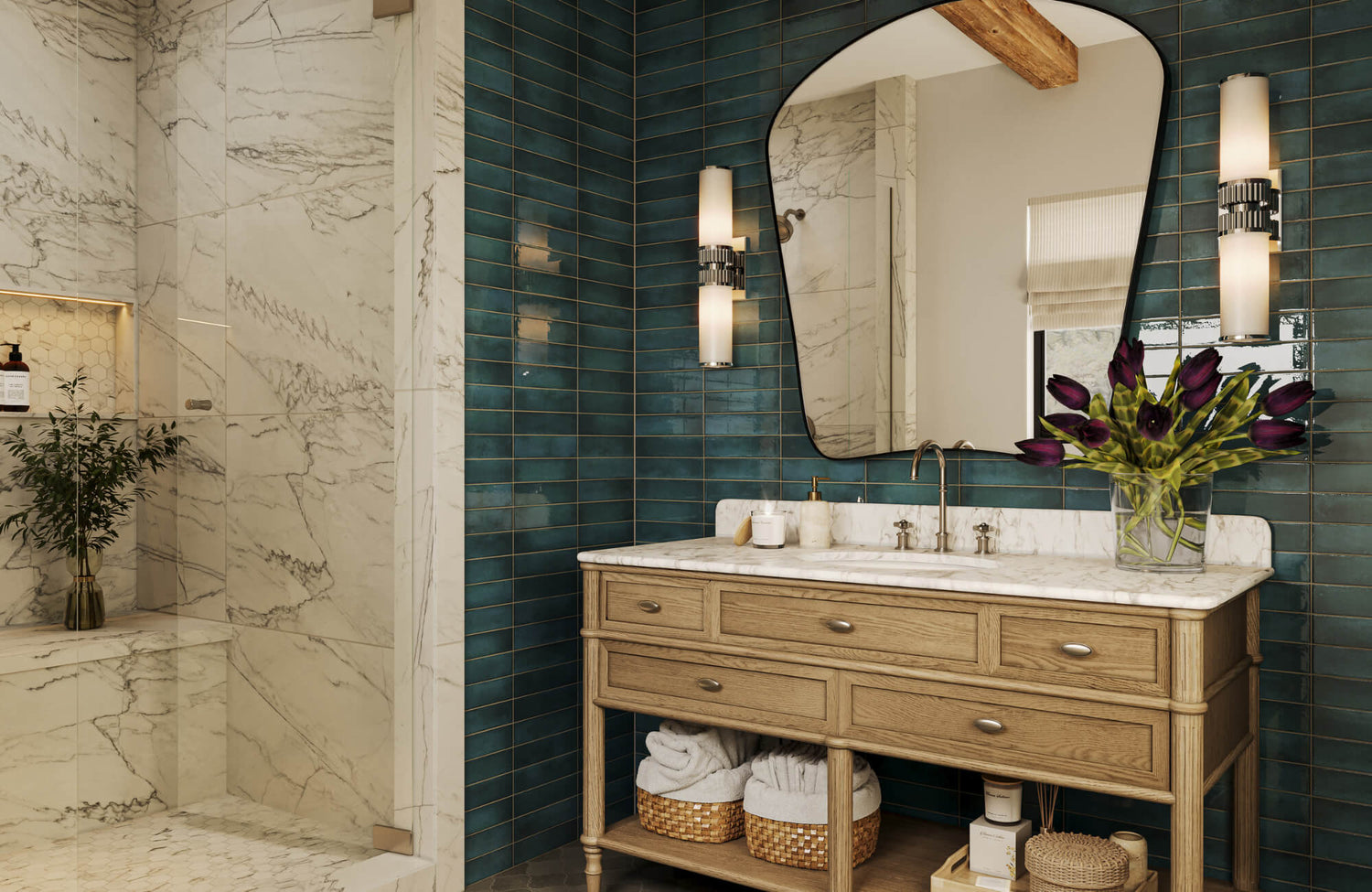
Wall sconces placed on either side of an arch mirror can frame the curve beautifully while adding functional lighting. The key is to position the sconces far enough from the mirror’s edge to maintain negative space. When done correctly, the light fixtures act as supporting elements, drawing attention to the mirror without competing with its shape.
In bathrooms and powder rooms, sconces also provide flattering, even illumination. Their vertical lines contrast with the curve of the arch, creating a dynamic interplay of shapes that feels intentional and refined.
Bridging the Lower Gap with Accessories
The space between the bottom of the mirror and the furniture below can be an opportunity rather than a problem. Carefully selected accessories such as low-profile lamps, sculptural objects, or greenery can bridge this gap and reinforce the connection between elements, as shown with Edward Martin’s Esmeralda Small Mirror in Polished Brass in the image above. The scale of these items should be modest, ensuring they do not encroach on the mirror’s silhouette.
This approach works well in living rooms and entryways, where layering adds depth and personality. The mirror remains the focal point, while the accessories provide context and warmth.
Using Tall Plants to Fill Wide Walls
On expansive walls, particularly in living areas or dining rooms, tall plants can help balance an arch mirror without crowding it. Positioned a few feet away from the mirror, a plant introduces organic texture and verticality that complements the curve. The key is to maintain clear space immediately around the mirror so its outline remains crisp, and Edward Martin’s design consultation can be especially helpful when weighing plant scale alongside mirror size, tile finishes, or nearby furniture selections.
Plants also soften the overall composition, echoing the natural curve of the arch and reinforcing a sense of calm and livability. For those who want reassurance on style combinations or have product-specific questions, contacting Edward Martin offers expert guidance to support confident, well-coordinated design decisions.
Trusting Your Eye and the Math
Determining how much wall space to leave around an arch mirror ultimately comes down to a blend of measurement and intuition. Guidelines like four to six inches of vertical spacing, two thirds width proportions, and generous negative space around curves provide a reliable starting point. From there, the specifics of your room, including ceiling height, furniture scale, and architectural features, should guide fine-tuning.
For those who value quality and aesthetics, the goal is not perfection but harmony. When an arch mirror is given the space it needs to breathe, it rewards you with elegance, balance, and a sense of craftsmanship that elevates the entire room. By trusting both your eye and the underlying math, you can create an installation that feels timeless, intentional, and uniquely suited to your home.