Choosing a mid century modern ceiling light is not simply about selecting a fixture you like. It is about understanding how form, proportion, and light interact with the architecture and daily rhythm of your space. Rooted in postwar optimism and thoughtful innovation, Mid Century lighting was designed to be both expressive and purposeful. As a result, the right ceiling light should feel integrated into the space, enhancing how the room looks, feels, and functions rather than standing apart as decoration alone.
With that in mind, making the right choice requires a balance of visual clarity and practical intent. From ceiling height and room scale to material finishes and light temperature, each decision builds toward a fixture that supports modern living while honoring the movement’s design principles. By looking at lighting as a system rather than an isolated object, you can create a space that feels cohesive, comfortable, and unmistakably Mid Century.

Analyzing Architectural Scale and Spatial Volume
Before style or finish comes into play, scale determines whether a mid century modern ceiling light feels intentional or misplaced. When the fixture responds correctly to ceiling height, room size, and spatial openness, it reinforces the architecture instead of competing with it.
Identifying the Ideal Drop Length for Different Ceiling Types
Vertical placement plays a decisive role in how the room is perceived. In spaces with standard 8-foot ceilings, keeping the fixture close to the ceiling preserves headroom and maintains a sense of openness. Flush and semi-flush designs work especially well, allowing you to introduce a distinctive mid century silhouette without visually lowering the ceiling or interrupting natural sightlines across the room.
As ceilings rise, however, the fixture must engage the vertical volume rather than hover awkwardly above it. In taller rooms or vaulted spaces, allowing the light to drop farther creates a visual link between the ceiling plane and the furniture below. A commonly referenced guideline is to allocate roughly 2.5 inches of fixture height for every foot of ceiling height, which helps the light feel proportionate rather than distant. In sloped or angular ceilings, adjustable downrods become essential, ensuring the fixture hangs level and reestablishes a strong horizontal reference point that visually grounds the space.
A fixture like our Clement Semi Flush in Aged Brass, shown in the image above, illustrates why this approach works so well in practice. Its low-profile silhouette keeps the light comfortably close to the ceiling, making it an ideal choice for rooms with standard heights where maintaining openness is essential. At the same time, the warm aged brass finish and balanced proportions introduce a clear mid century character without adding visual weight, allowing the fixture to enhance the space while preserving clean sightlines and an uncluttered feel.
Calculating Diameter Relative to Room Footprint
Although drop length addresses height, diameter determines how confidently the fixture occupies the room’s footprint. If the light is undersized, it fades into the ceiling and loses its impact; if it is oversized, it can dominate the space and feel intrusive. A practical way to find balance is to add the room’s length and width in feet, then translate that number directly into inches to estimate an ideal fixture diameter. This approach ensures the light has enough presence to anchor the room without overwhelming it.
This proportional relationship becomes even more important with sculptural mid century modern designs like Sputnik or Atomic fixtures. Their open, multi-armed forms rely on sufficient width to read clearly from below. In smaller rooms, respecting the same ratio prevents those expressive shapes from crowding the ceiling, allowing the fixture to feel dynamic yet controlled. When diameter and room scale align, the light also settles naturally into the space, enhancing its volume rather than disrupting it.

Navigating the Material Palette and Authentic Finishes
Material selection sets the emotional tone of a mid century modern ceiling light before it is ever switched on. The metals and diffusers you choose determine whether the fixture feels warm and inviting or crisp and forward-looking.
Warm Brass and Industrial Chrome
Metal finishes function as visual signals that shape how a room feels. Brushed or antiqued brass introduces an immediate sense of warmth, echoing the golden undertones of walnut, teak, and other woods commonly associated with mid-century interiors. Because brass absorbs and softens light, it naturally tempers glare and creates a more relaxed atmosphere, making it especially well-suited to spaces where you want to unwind or entertain without harsh brightness.
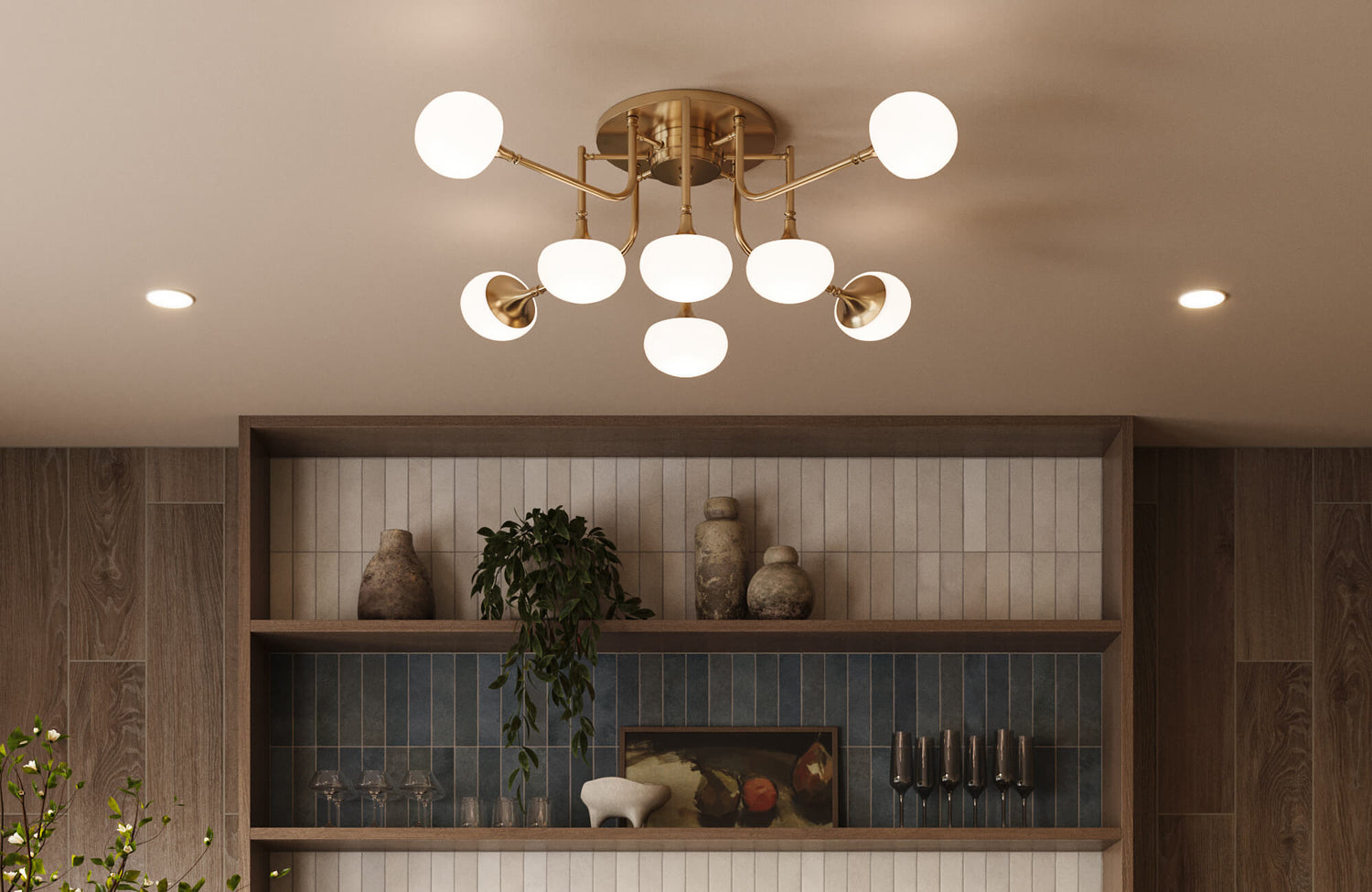
This warmth is especially noticeable in fixtures that lean into aged or patinated brass tones rather than high polish. Our Lennie 12" Pendant in Patina Brass/Bronze, seen in the photo above, embodies this approach, using a softened metallic finish to complement natural wood, stone, and muted tile surfaces. Instead of producing sharp reflections, it allows light to glow more gently, reinforcing the relaxed, inviting atmosphere that defines many mid-century interiors while still maintaining a clean, purposeful form.
Chrome and polished nickel move the mood in a different direction. These finishes reflect their surroundings with clarity, reinforcing the movement’s Space Age optimism and fascination with modern engineering. Light also bounces sharply off their surfaces, giving the room a cooler, more energetic presence. When deciding between the two, consider how existing hardware, furniture legs, and accents already behave in the space. The aim is not to match everything perfectly, but to let the finish either deepen the room’s warmth or sharpen its precision.
Hand-Blown Glass and Perforated Metal
Beyond the frame, the diffuser controls how light is experienced at eye level. Milk glass has long been a hallmark of mid century modern lighting because it transforms harsh illumination into an even, ambient glow. By dispersing light in all directions, it minimizes shadows and flatters both the room and the people in it, which is why it works so naturally in dining areas and shared living spaces.
Perforated and enameled metal shades take a more intentional, sculptural approach. Rather than softening light evenly, they shape it, allowing small points of light to escape while directing a stronger beam downward. This creates contrast and visual rhythm, adding architectural interest to corridors, kitchens, or work zones. When used thoughtfully, these materials don’t just illuminate the room; they actively define its depth and character.

Selecting a Silhouette Based on Iconic Design Families
Mid century modern lighting is guided by a shared philosophy, yet its silhouettes vary dramatically in mood and presence. The form you choose directly shapes how the room feels, influencing whether the space reads as energetic, serene, or somewhere in between.
Sputnik and Satellite Style
Sputnik and satellite-style fixtures capture the optimism of the Space Age through dynamic, radiating forms. With multiple arms extending from a central core, these lights behave like sculptural installations, pulling attention upward and activating the ceiling as a visual plane. This upward emphasis is especially effective in rooms where walls are kept intentionally minimal, allowing the fixture itself to become the architectural focal point.
Because of their complexity, these silhouettes thrive when the surrounding environment is restrained. Clean-lined furniture, open floor plans, and neutral palettes give the fixture room to breathe, preventing it from overwhelming the space. When placed thoughtfully in entryways or living rooms, a Sputnik light introduces movement and energy, setting a confident tone the moment you enter the room.
Our McKay Chandelier in Black Gunmetal exemplifies this Sputnik and Satellite influence through its radiating arms and exposed bulbs that draw the eye upward. As featured above, its structured, linear form echoes classic Space Age geometry, while the darker gunmetal finish gives it a modern, graphic edge. Set against clean surfaces and restrained materials, this light functions as a sculptural centerpiece, energizing the ceiling plane without overwhelming the room’s overall composition.
Organic Shapes and Danish Modern Minimalism
Danish modern silhouettes emphasize softness and continuity rather than spectacle. Saucer, onion, and gently curved forms rely on fluid lines and muted materials to create a sense of calm. Instead of commanding attention, these lights blend seamlessly into the space, reinforcing a feeling of balance and visual rest.
This understated quality makes organic shapes particularly effective in bedrooms, reading nooks, and other quiet zones. By drawing inspiration from natural forms while embracing industrial innovation, these fixtures illuminate without distraction. The result is a light that supports daily life subtly, aligning with the mid century belief that good design should enhance comfort without demanding attention.
A fixture like our Clement Chandelier in Aged Brass exemplifies this approach through its softly rounded form and restrained profile. Its gentle curves and warm brass finish introduce visual warmth without overpowering the room, allowing the light to feel integrated rather than assertive. By prioritizing proportion and material subtlety, this fixture reinforces the calm, human-centered qualities that define Danish modern minimalism, making it well-suited for spaces where serenity and balance take precedence.

Balancing Functional Light Layers and Bulb Technology
Balancing functional light layers and bulb technology is essential to creating mid century modern interiors that feel both visually striking and genuinely livable. Rather than relying on a single ceiling fixture, successful lighting schemes combine ambient and task lighting to support different activities throughout the day. Ambient fixtures establish a comfortable baseline by dispersing light evenly and softening contrasts, while task-oriented designs provide focused illumination exactly where it’s needed. Together, these layers prevent harsh shadows, reduce visual fatigue, and allow the room to shift effortlessly between social, work, and relaxation modes.
Equally important, however, is how bulb technology shapes the final experience. Warm color temperatures help maintain the inviting glow associated with vintage interiors, ensuring modern lighting doesn’t feel overly clinical. At the same time, contemporary LED options offer efficiency and dimming flexibility without sacrificing aesthetic authenticity. When light output, color temperature, and fixture design are thoughtfully aligned, the result is a ceiling light that not only honors mid century modern style but also enhances comfort, usability, and atmosphere from morning to night.

Coordinating Fixtures Across Open Concept Layouts
In an open-plan space, ceiling lights are visible from multiple angles at once, which means they must work together as a system. The challenge is to create cohesion without repetition, allowing each fixture to contribute to a unified rhythm rather than competing for attention.
Creating a Visual Hierarchy with Primary and Secondary Lights
A well-balanced layout begins by identifying a single fixture as the visual anchor. This primary light is typically placed over a dining table, living area, or central gathering point, where it can establish the dominant character of the space. Because it carries the most visual weight, this fixture can afford to be bold, sculptural, or expressive without overwhelming the room.
Once the main fixture is established, the surrounding lights should step back into supporting roles. Simpler silhouettes and lower-profile designs help guide the eye naturally through the space rather than pulling it in multiple directions at once. This hierarchy also creates breathing room between focal points, allowing each fixture to be appreciated while maintaining a sense of order across the open layout.
Our Hailey 48" 4 Lights Linear Pendant in Aged Gold/Opal Matte Glass, shown above, works beautifully as a primary anchor in open layouts, particularly over kitchen islands or dining tables. Its elongated, horizontal form establishes a clear focal point without feeling heavy, while the opal glass globes provide balanced, glare-free illumination. The aged gold finish also adds warmth and continuity, allowing the fixture to command attention through proportion and placement rather than excess ornamentation.
Matching Tonal Families Across Different Rooms
Visual continuity in open spaces is achieved through shared material cues rather than identical designs. When fixtures across adjoining zones repeat the same brass finish, wood accent, or matte surface, the space reads as intentional and connected. These subtle echoes create a throughline that carries your eye smoothly from one area to the next.
This approach also gives you the freedom to explore different mid century silhouettes without fragmenting the overall look. A Sputnik in the living area, for instance, can coexist comfortably with saucer or cone-shaped pendants in the kitchen as long as they share a common tonal language. The result is a layered, curated environment that feels cohesive while still allowing each area to express its own function and character.
Mastering Mid Century Modern Lighting as a Design System
Mastering mid century modern lighting ultimately means seeing the ceiling light as part of a larger design conversation rather than a standalone statement. When scale, silhouette, materials, light quality, and placement are thoughtfully aligned, the fixture answers the core question of how to choose the right light by doing more than illuminating a room. It reinforces architectural intent, supports everyday activities, and sets the emotional tone of the space. In doing so, lighting becomes the quiet framework that brings clarity, balance, and longevity to mid century modern interiors.
If you’re refining these details and want guidance tailored to your space, connecting with a knowledgeable team can help bring everything into focus. From evaluating proportions and finishes to selecting fixtures that align with your space’s architecture and lifestyle, thoughtful support ensures each choice works as part of a cohesive system. By approaching lighting decisions collaboratively, you can move from inspiration to execution with confidence, knowing the result will feel intentional, balanced, and enduring.