The arch mirror has become a staple in modern interiors, celebrated for its sculptural silhouette and the effortless elegance it adds to a room. Yet one question continues to surface for homeowners and design enthusiasts who want a curated, cohesive home: should the metal finish of an arch mirror match the other metals already in the space?
The short answer is no, but the more meaningful answer is far richer. Mixing metal finishes is not only acceptable, it often results in a more nuanced, collected, and visually engaging room. Understanding how to balance those finishes with intention is the key to harnessing the full potential of your arch mirror.

Liberating Your Design from the Matchy Matchy Rule
When you step away from the pressure to make every finish match, your home instantly opens up to more personality and visual interest. This sets the foundation by exploring why uniform metals often fall flat, and why embracing variation leads to richer, more expressive design.
Why Uniformity Feels Flat and Dated
For years, design norms steered homeowners toward consistent, uniform finishes. A brushed nickel kitchen faucet meant brushed nickel hardware and brushed nickel lighting. An oil-rubbed bronze mirror frame meant the same finish repeated everywhere else. While this approach offers predictability, it creates an overly coordinated aesthetic that lacks dimension. The eye moves through the room too quickly because there is nothing to pause on, no visual punctuation or tension. Uniformity tends to flatten the design, making even well-furnished rooms feel as though they were assembled all at once rather than thoughtfully collected over time. When everything matches, nothing stands out, and the result is a space that may feel safe but ultimately lacks soul.
Treating the Mirror as a Statement Piece
An arch mirror holds immediate presence. Its curvature introduces softness to angular rooms, and its generous reflective surface multiplies light and expands space. Because it already functions as a statement piece, it does not need to mimic the finishes surrounding it. Allowing the arch mirror to adopt a metal tone different from the rest of the room elevates its architectural shape and reinforces its importance within the composition, much like the way Edward Martin’s Esmeralda Wide Mirror in Iron Matte Black subtly commands attention in the image above. When the mirror’s frame contrasts its environment, it becomes a deliberate focal point and the balance of the room shifts in a dynamic, aesthetically pleasing way. Rather than blending into the background, the mirror becomes the element that anchors the entire design.
Building Layers and Depth Through Contrast
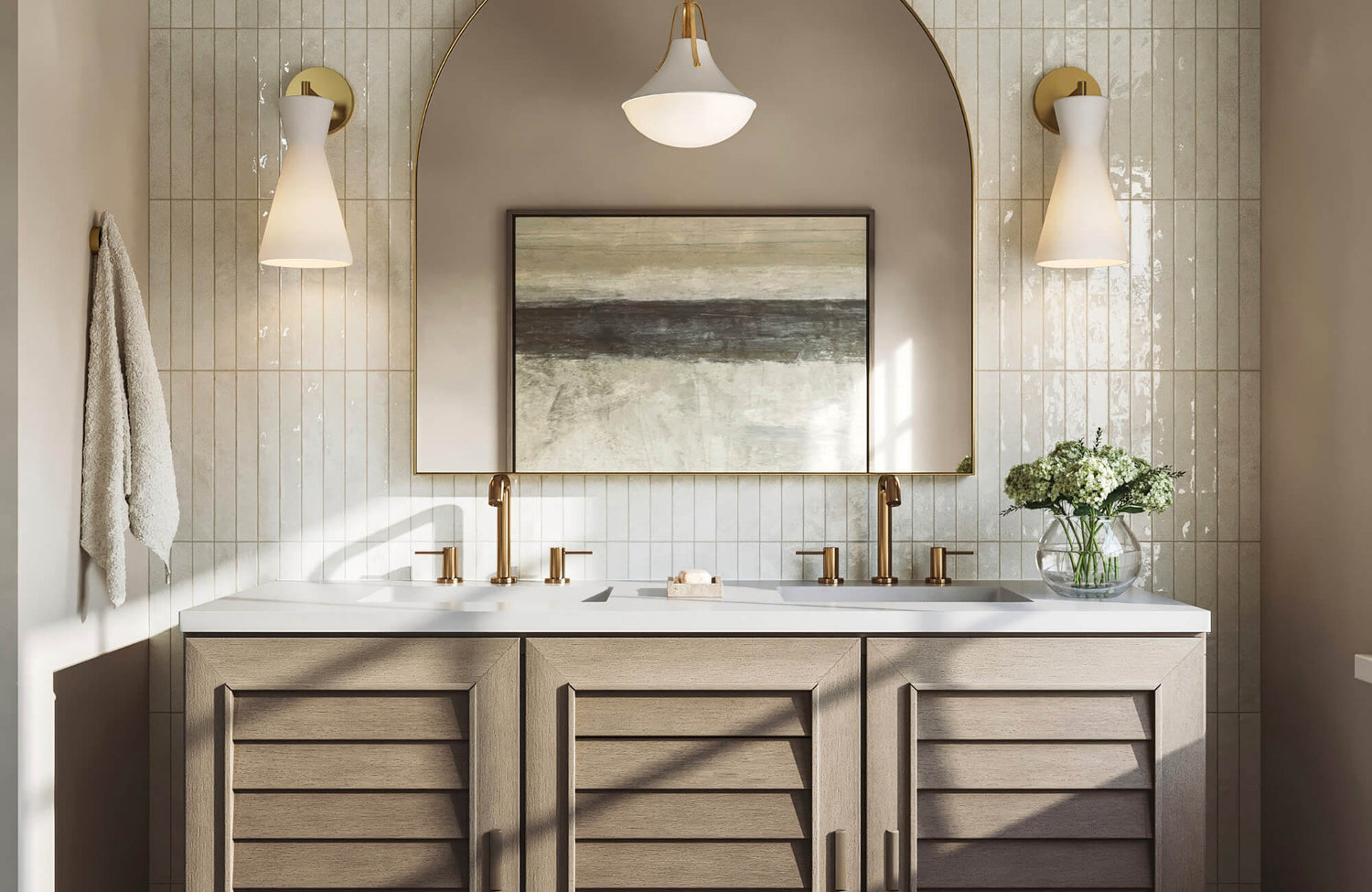
Contrast is the driving force behind well-layered interiors. Just as fabric textures and color temperatures create dimension, metal finishes contribute to depth in much the same way. An arch mirror with a black, brass, chrome, or mixed-metal frame interacts with surrounding finishes through subtle reflections and variations in sheen. Each difference, whether slight or bold, introduces depth. When designed thoughtfully, this interplay of finishes feels intentional and refined. Mixed metals help prevent monotony by adding rhythm throughout the space, encouraging the viewer to take in the room slowly and appreciate the layers. Allowing the arch mirror to deviate from other metals becomes a design choice that contributes to a richer, more dynamic visual experience.

Mastering the Ratio of Dominant and Accent Metals
Once you’re free from the idea that everything must match, the next step is understanding how to balance those mixed finishes so they feel intentional rather than chaotic. Here, we look at how thoughtful ratios create harmony and give your arch mirror a purposeful role in the room.
The 70–30 Rule of Metal Mixing
While mixing metals is not only acceptable but encouraged, balance is essential. A helpful guideline is the seventy-thirty ratio, in which one metal finish serves as the dominant tone while another acts as the complementary accent. The dominant finish usually appears on larger or more frequently used elements such as faucets, cabinet hardware, or lighting. The accent finish acts as a subtle complement, appearing in moments where visual emphasis is desired. This ratio prevents the space from feeling chaotic or overly eclectic, giving the eye a clear hierarchy to follow. When applied well, the rule creates subtle movement and coherence, allowing each finish to enhance rather than compete with the others.
Why the Arch Mirror Makes the Perfect Accent
Because of its scale and prominence, the arch mirror is uniquely positioned to serve as the thirty-percent accent finish in a room. Its frame offers just enough surface area to introduce a secondary metal without overwhelming the primary finish, which is why a piece like Edward Martin’s Clementine Mirror in Antiqued Gold Leaf works so effectively as shown in the image above. The arch shape naturally draws attention, so pairing it with an intentional contrast in metal amplifies its sculptural presence. A mirror with a brass frame can warm a predominantly black-finished room, while a matte black frame can stabilize a design grounded in polished nickel or chrome. The mirror becomes the balancing force that harmonizes disparate tones, bridging the gap between warmth and coolness or between modern and traditional elements.
Repeating the Accent Finish Elsewhere
Introducing a contrasting metal through the arch mirror becomes even more effective when echoed subtly in other parts of the room. The repetition does not need to be heavy-handed; even a single coordinating object can strengthen the intentionality of the design. A table lamp with a matching accent finish, a small picture frame, or a decorative bowl can reinforce the metal used on the mirror. These quiet callbacks help the room feel cohesive rather than haphazard. When the accent finish is repeated, the mirror feels connected to the overall palette instead of appearing as an isolated outlier. The key is gentle reinforcement, not duplication.

Winning Combinations That Always Work
After getting comfortable with the concept of mixing and balancing metals, it helps to see how these principles play out in real, reliable pairings. This walks through metal combinations that consistently deliver beautiful results, no matter your style or space.
The Classic Contrast of Black and Brass
Few pairings offer the depth and sophistication of black and brass. A brass-framed arch mirror introduces warmth, sheen, and a hint of timeless glamour to a room anchored in black fixtures. The contrast is bold yet harmonious, creating a balance between modern minimalism and classic refinement. Brass softens the sharpness of black, while black grounds the radiance of brass. Together, they generate a beautifully layered composition that feels both contemporary and inviting. This combination works particularly well in living rooms, entryways, and bathrooms where lighting and reflective surfaces interplay throughout the day.
Mixing Cool Chrome with Warm Gold
Chrome and polished nickel embody a crisp, cool aesthetic, while gold and brass bring richness and depth. When these tones coexist, the result is a nuanced design that feels curated rather than coordinated. An arch mirror framed in gold can introduce warmth into a chrome-heavy bathroom or kitchen, making the overall space feel more inviting without disrupting its modern sensibility. Conversely, a chrome-framed arch mirror in a room dominated by warm finishes introduces a refreshing counterbalance. The interplay of warm and cool metals mimics the natural tension found in thoughtfully designed interiors, where balance is created not through sameness but through contrast.
Using Black as a Neutral Anchor
Black is one of the most versatile metal finishes available, functioning almost as a non-color thanks to its timeless neutrality. An arch mirror with a black frame integrates effortlessly into nearly any palette, whether the surrounding finishes lean warm, cool, modern, or rustic. In spaces like the one shown above, Edward Martin’s Clancy Small Arch Mirror in Antiqued Iron demonstrates how a black-framed silhouette can ground mixed metals with ease. Black serves as an anchor that stabilizes brass, gold, chrome, and nickel without allowing them to feel mismatched. Its matte and powder-coated variations offer additional texture and depth, preventing the finish from feeling flat. When in doubt about how to integrate mixed metals, a black-framed arch mirror often becomes the stabilizing element that ties the entire room together.

When the Arch Shape Dictates the Finish
As you gain confidence with mixing metals and testing combinations, you’ll notice that the arch mirror’s shape can guide your finish choices even further. Lastly, we’ll explore how architecture, lines, and materials influence which finish feels most natural and elevated in your room.
Softening Industrial Lines with Warm Metals
Spaces that lean industrial often feature strong lines, exposed textures, and cool-toned finishes such as steel, black metal, or concrete. In these environments, a warm metal like brass or brushed gold can soften the overall atmosphere. The gentle curve of an arch mirror already tempers the hardness of industrial design, and pairing that shape with a warm metal finish enhances the effect. The result is a space that retains its architectural edge while gaining a layer of inviting warmth. The mirror becomes a transitional element that blends rugged character with refined elegance.
Reinforcing Architecture with Black Frames
In homes with existing arches, arched doorways, curved niches, or rounded windows, a black-framed arch mirror can echo and reinforce those architectural details. Black delivers crisp definition and highlights the silhouette of the mirror with striking clarity. When paired with similarly bold architectural lines, the finish feels intentional and cohesive. The black frame becomes a graphic element that emphasizes the curvature of the mirror while grounding the space. In modern or minimalist homes, this approach amplifies the architectural narrative without overwhelming it.
Using Wood Tones to Bridge Disparate Metals
When a space features multiple metal finishes, incorporating wood can act as the mediator that brings everything into harmony. Wood introduces natural warmth and organic texture, helping soften transitions between differing metal tones. This effect becomes even more cohesive when a mirror, such as Edward Martin’s Raelynn Mantel Mirror in Polished Brass, seen in the image above, is paired with surrounding wood cabinetry or shelving. Even when the mirror’s frame contrasts with other metals in the room, the presence of wood makes the overall palette feel intentional and grounded. Wood functions as a balancing material, allowing metals of varying temperatures and sheens to coexist without visual tension.
Confidence in Your Curation
Designing a home you truly love comes from embracing intentional choices rather than following rigid rules. An arch mirror does not need to match the other metals in the room; instead, it should complement the space in a way that enhances depth, character, and visual movement. Whether used as a statement piece, an accent finish, or an architectural reinforcement, the arch mirror offers enormous versatility, and if you ever feel unsure about how to bring these elements together, Edward Martin’s design consultation service can offer personalized guidance tailored to your project needs.
When paired thoughtfully with mixed metals, it transforms from a simple decorative accessory into a defining element that elevates the entire room. By understanding balance, contrast, and repetition, you gain the freedom to curate a home that feels collected, expressive, and uniquely yours. And whenever you need support choosing finishes, coordinating furniture, or exploring tile and rug options, you can always contact Edward Martin for expert recommendations that help you move forward with confidence.