There’s something undeniably captivating about a round mirror. Its smooth, endless curve draws the eye in, softening a room’s geometry and inviting a sense of calm. But beyond its aesthetic charm lies a subtle design magic—its ability to reshape how space is perceived. Round mirrors don’t just reflect what’s already there; they manipulate light, proportion, and balance to transform how a room feels. When chosen and placed thoughtfully, they can make even the smallest corners appear more expansive, brighter, and more harmonious.
From their influence on lighting and symmetry to their ability to complement different materials and styles, round mirrors act as both art and architecture. They blur boundaries, distribute light more evenly, and bridge the gap between minimalism and maximalism with effortless grace. In this article, you’ll discover how the right mirror, through shape, placement, and design, can alter not just the dimensions of a room, but the way you experience it.

Light as a Spatial Tool
Light has always been a defining element in shaping how a room feels and functions, and round mirrors take this concept to an elevated level. Their curved form doesn’t just reflect illumination but also transforms it. By scattering light in a smooth, radial pattern rather than directing it along rigid lines, circular mirrors help create a softer, more immersive glow that expands the perception of space. This gentle diffusion allows light to move freely throughout the room, reaching areas that might otherwise remain dim. When placed near a window, a round mirror can capture daylight and redistribute it in multiple directions, turning a simple wall into a secondary source of natural brightness. As a result, the environment feels more open and continuous, with shadows minimized and corners visually lifted.
Even after sunset, round mirrors continue to shape the spatial experience through their interaction with artificial light. Their curved surfaces diffuse illumination from sconces, pendant lamps, or candles, transforming sharp beams into subtle layers of radiance. This quality eliminates glare and visual harshness, balancing the contrast between light and dark areas. The effect is a cohesive luminance that enhances ambiance and deepens the room’s sense of dimension. Through this interplay of light and curvature, a round mirror becomes far more than a reflective accessory. It also acts as an architectural element that sculpts brightness, warmth, and spatial flow. Ultimately, it demonstrates how thoughtful reflection can amplify not just the physical light in a space, but the emotional atmosphere that light creates.
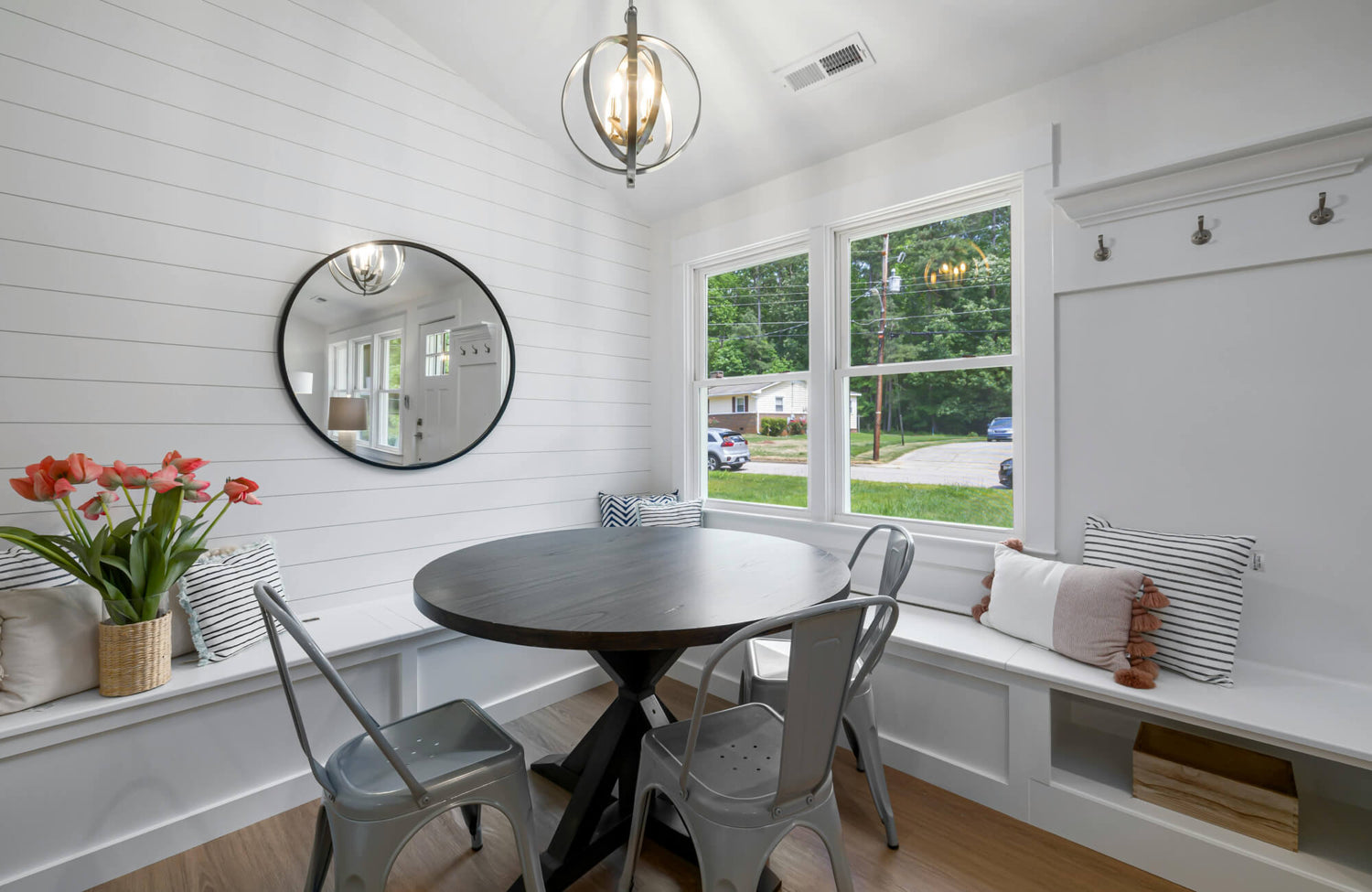
A beautiful example of this can be seen in our Fitz Mirror in Antiqued Iron, displayed in the image above. Its deep, black toned frame adds a refined contrast against lighter walls, accentuating the mirror’s glow and enhancing its spatial depth. When paired with wall sconces or natural daylight, this mirror evenly disperses illumination throughout the room, creating a soft, luminous atmosphere. This thoughtful balance of color, texture, and light also demonstrates how a well-crafted round mirror can unify function and form, making any space feel both grounded and effortlessly open.

Placement Strategy
The placement of a round mirror determines how effectively it enhances a room’s sense of space and flow. Even a beautifully designed mirror can lose its impact if mounted incorrectly, while thoughtful positioning can transform it into a functional focal point. Centering the mirror around 57 to 60 inches from the floor aligns it with the average eye level, ensuring a natural and proportional reflection. This placement allows you to see both yourself and the surrounding environment comfortably, avoiding distortions that make a room feel smaller or unbalanced. Because round mirrors have no corners to visually anchor them, precise centering becomes crucial. Aligning them with architectural or decorative features such as a console table, fireplace, or wall sconce creates visual harmony, making the mirror feel intentional rather than arbitrary. This attention to proportion and symmetry also anchors the design and helps the mirror integrate seamlessly into the room’s overall composition.
Beyond individual placement, round mirrors can be used in multiples to reshape how space is perceived. In narrow hallways, stairwells, or shared settings like a double vanity, pairing mirrors creates rhythm and symmetry that visually widens the area. One standout example of this can be seen in the photo above, featuring our Fitz Mirror in Antique Silver, whose soft silver tone and delicately aged finish complement both cool and warm palettes. When placed side by side above a dual sink, the mirrors not only balance proportion but also reflect light evenly across the room, enhancing brightness and harmony. This concept, known as serial reflection, multiplies light and depth, giving confined spaces a fluid, continuous feel. Additionally, each mirror captures subtle variations in illumination and movement, weaving them together into a cohesive visual rhythm. The result is an environment that feels both expansive and dynamic, proof that the strategic arrangement of round mirrors can amplify the artistry and balance within a room.

Geometric Proportion and Visual Balance
The relationship between mirror size and room perception is more than a matter of style; it’s a deliberate spatial technique. The scale of a round mirror can dramatically alter how light moves and how space is perceived, shaping whether a room feels open, balanced, or constrained. Oversized mirrors can act as architectural devices, while smaller ones arranged in clusters can introduce rhythm and movement. Understanding how to balance proportion ensures that each mirror complements its surroundings, enhancing spatial harmony rather than competing with it.
A large round mirror instantly becomes a transformative feature, often functioning like an architectural illusion. When proportioned correctly, about two-thirds the width of the furniture or wall beneath it, it mimics the effect of an open window, capturing and reflecting light to expand perceived depth. This generous curvature also draws the eye forward, creating a seamless transition between wall and reflection that visually enlarges the space. Conversely, smaller round mirrors arranged in groups can generate an equally powerful yet more playful result. Their varied sizes and staggered placement form a dynamic composition that enlivens otherwise plain or awkward walls, introducing rhythm and balance. This rhythmic modulation softens architectural rigidity, guiding the eye naturally across the surface and extending spatial perception. Whether through one commanding statement mirror or an artful constellation of smaller ones, proportion and balance determine how effectively a round mirror reshapes both the light and energy within a room.
A stunning example of proportion at play is our Esmeralda Round Mirror in Iron Matte Black. Its bold frame in a rich, black hue grounds the composition, while its expansive size enhances the openness of the room. When placed above a warm wood vanity, like in the picture above, it perfectly balances modern edge with natural warmth. The mirror’s clean silhouette also amplifies light and depth without overpowering the design, making it a sophisticated centerpiece that unites scale, proportion, and balance in one refined statement.

Materiality and Framing
The frame of a round mirror plays a quiet yet crucial role in defining how it interacts with light, texture, and overall mood. Although the glass surface captures reflections, the frame dictates how that reflection integrates into the surrounding environment, whether it draws the eye inward, diffuses brightness, or adds tactile warmth. Its material and finish can shift a mirror’s character from understated sophistication to bold luminosity. By carefully considering texture, sheen, and tone, you can ensure that the mirror not only complements your space but also enhances its spatial and emotional depth.
Furthermore, surface finish determines how a mirror communicates dimension and atmosphere. Matte or powder-coated frames absorb light, creating soft transitions and keeping focus on the reflection itself, a quality well-suited to calm, minimalist interiors. Glossy or metallic finishes, on the other hand, project brightness outward, extending the mirror’s visual influence and heightening its sense of openness. Beyond sheen, the use of organic materials such as wood, rattan, or jute introduces a natural, tactile counterbalance to the mirror’s smooth surface. These textures bring warmth and approachability, transforming the mirror from a cold, reflective plane into a grounded design element. Whether refined with high-gloss chrome or wrapped in woven fibers, a well-chosen frame bridges the gap between reflection and structure. It invites harmony between surface and space, making the mirror not only a spatial amplifier but also an emotional anchor that adds richness, balance, and cohesion to the entire room.

Style Adaptability and Design Integration
Round mirrors are among the most versatile design elements, effortlessly adapting to any interior style while maintaining their timeless balance and elegance. Their simple geometry gives them a unique flexibility. They can also recede quietly into the background or become a striking focal point depending on how they’re framed and placed. In minimalist environments, a round mirror enhances purity and precision, while in maximalist settings, it offers calm amidst visual intensity. Through careful styling, these mirrors unify the space, bridging contrasting elements and ensuring cohesion across diverse aesthetics.
In contemporary and minimalist interiors, the round mirror embodies restraint and refinement. A frameless or ultra-slim design upholds the principles of simplicity, allowing negative space and clean lines to define the atmosphere. This purity invites openness and breathability, transforming the mirror into a subtle yet powerful spatial anchor that enhances flow and proportion. Conversely, in maximalist or eclectic settings, the same circular form provides visual balance amid bold patterns and rich textures. Its curves soften the energy of the room, guiding the eye and grounding the exuberance. When framed in gilded, antique, or intricately detailed materials, it reinforces the grandeur without overwhelming it, offering both contrast and composure. Ultimately, the round mirror’s adaptability lies in its ability to harmonize opposites. Its simplicity complements minimalism, while its shape and ornamentation enrich complexity, making it one of the few design pieces that can truly transcend style boundaries.
This adaptability is beautifully captured by our Tristan Round Mirror in Polished Brass. Its gleaming golden tone introduces a touch of warmth and sophistication, effortlessly complementing both modern and traditional spaces. When placed above a natural wood vanity or against textured tile, as shown in the image above, the polished brass frame reflects light with a soft luster that enhances the room’s overall harmony. The mirror’s radiant finish not only adds a luxurious accent but also brings depth and brightness, demonstrating how a well-chosen round mirror can unify contrasting materials while elevating the space with refined elegance.
The Transformative Power of Round Mirrors
Round mirrors truly have the power to make a room feel bigger, brighter, and more balanced. Their soft curves reshape perception by scattering light, expanding depth, and harmonizing with any design style. Through deliberate placement, proper scaling, and thoughtful framing, they turn ordinary walls into portals of light and movement. More than reflective objects, they are also instruments of spatial illusion and emotional balance, proof that with the right mirror, a space doesn’t just look larger; it feels more open, alive, and complete.
If you’re inspired to incorporate this sense of openness and harmony into your own space, our team is ready to help you bring your vision to life. Whether you’re exploring mirror designs or coordinated finishes, we can guide you in selecting pieces that elevate both function and atmosphere. You can connect with our team through our contact page to discuss your project needs or request personalized recommendations. With expert insight and quality craftsmanship, your space can reflect the perfect balance of design, light, and timeless style.