Light defines atmosphere before any material or furnishing takes shape, shaping how a room feels, functions, and flows. In refined interiors, the interplay between wall-mounted lighting fixtures and ceiling-mounted luminaires not only determines brightness levels but also significantly impacts spatial perception and architectural character. While ceiling lights anchor ambient illumination, layered lighting design strategies for modern homes increasingly highlight the advantages of wall lights in achieving balanced, visually comfortable environments.
From enhancing vertical illumination to supporting energy-efficient LED performance, fixture placement becomes as critical as lumen output. Understanding when wall lights are more suitable than ceiling lights for specific spaces reveals how thoughtful lighting design enhances both beauty and functionality.

Vertical Illumination and Visual Comfort
Wall-mounted luminaires significantly enhance vertical illuminance, directly influencing perceived brightness and overall visual comfort. Because human vision responds more strongly to illuminated vertical surfaces than to horizontal floor lighting, wall lights often create a balanced and inviting atmosphere that ceiling-only systems struggle to achieve.
Enhancing Perceived Brightness Through Vertical Illuminance
Vertical illumination plays a central role in how brightness is perceived within residential and commercial interiors, often influencing comfort more than horizontal lux levels alone. While recessed ceiling downlights focus on task surfaces below, LED wall sconces distribute light across eye-level planes, allowing walls to contribute to the overall ambient glow. As vertical surfaces brighten, contrast between walls and ceilings also softens, creating a more cohesive visual field.
Because perceived brightness depends on what the eye naturally encounters, enhanced vertical lighting can reduce the need for excessive wattage. In living rooms and corridors, this approach supports energy-efficient ambient lighting without compromising clarity. The result is improved luminance balance achieved with a lower overall lumen demand.
Reducing Glare with Indirect Wall Lighting
Effective glare control defines the quality of a well-designed lighting scheme, particularly in spaces intended for comfort and visual ease. Ceiling fixtures with narrow beam angles, for instance, can produce concentrated hotspots that elevate Unified Glare Ratings and strain the eyes, especially in intimate settings. Indirect wall lighting, on the other hand, offers a more refined alternative by diffusing illumination upward or outward, concealing the light source and allowing reflected light to shape the room. As this softer glow washes across adjacent walls and ceilings, transitions between bright and dim zones become seamless, enhancing overall visual comfort.
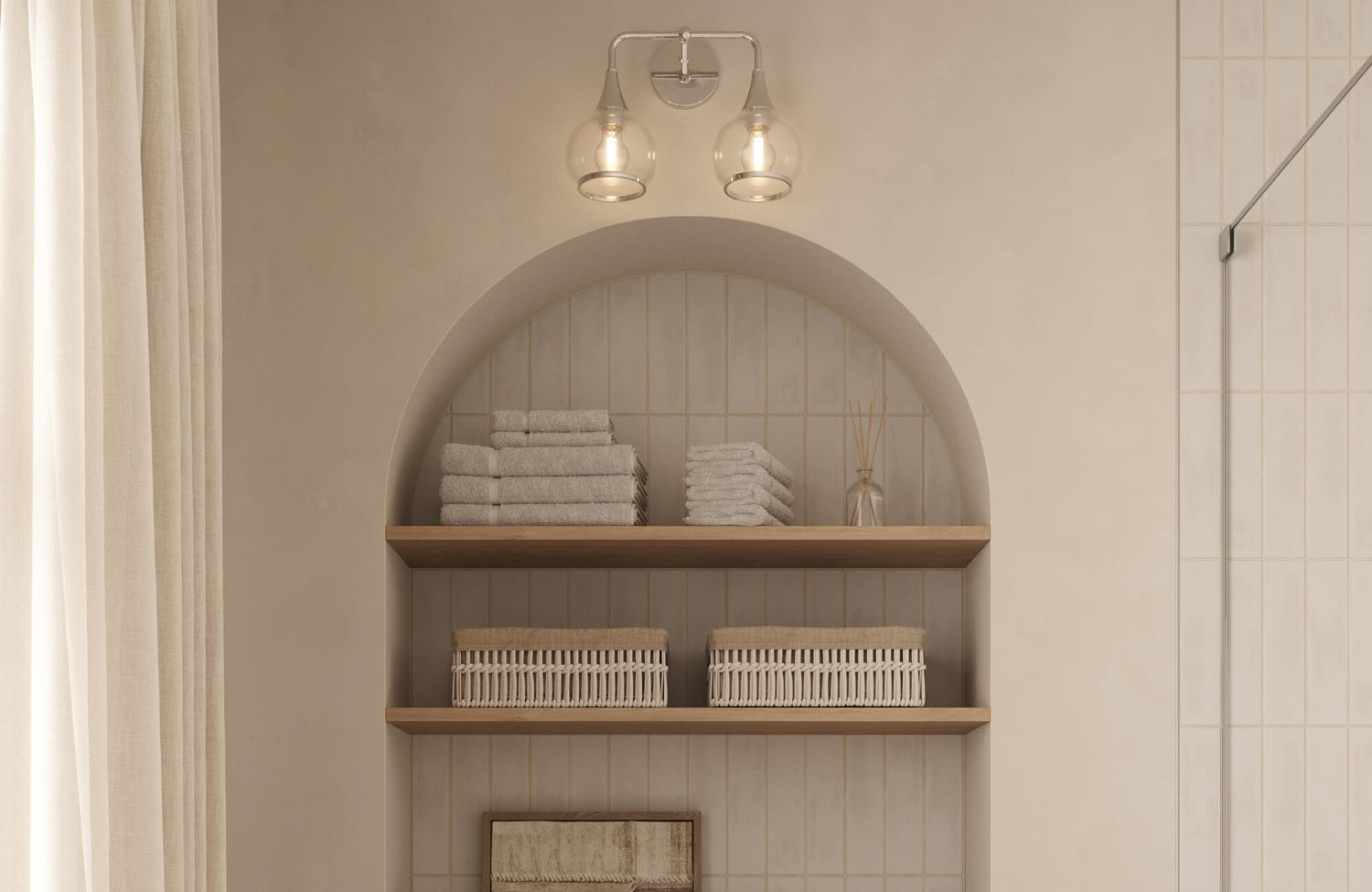
Edward Martin’s Shonda Wall Sconce in Vintage Brass exemplifies this principle through its vertically oriented silhouette and softly diffused glass form, which tempers brightness and refines the overall visual experience. As shown in the photo above, its sculptural presence complements textured plaster walls and organic materials, reinforcing a calm and cohesive lighting composition. The upward and outward orientation of the fixture also supports a balanced luminance hierarchy, helping the space feel composed and visually comfortable without harsh contrast.
Supporting Human-Centric Lighting Principles
Human-centric lighting aligns interior illumination with natural biological rhythms to promote comfort and well-being. Because wall lights operate closer to eye level, they create a gradual light gradient similar to daylight interacting with vertical surfaces. For example, warm LED color temperatures between 2700K and 3000K encourage relaxation while maintaining visual clarity. High Color Rendering Index values above 90 also preserve accurate tones in materials and skin, enhancing the authenticity of the space. When paired with dimming controls, wall-mounted luminaires allow smooth adjustments throughout the day. This integrated approach strengthens the functional and emotional benefits of well-planned wall lighting.

Low Ceiling Optimization and Spatial Perception
Rooms with limited ceiling height require lighting solutions that preserve openness while maintaining sufficient illumination. In such environments, wall lights frequently provide a more proportionate and spatially efficient alternative to centralized ceiling fixtures.
Low-Profile Wall Lights for Small Rooms
Compact interiors often feel visually crowded when oversized pendants or elaborate chandeliers dominate the ceiling plane, drawing attention downward and emphasizing limited height. In contrast, low-profile LED wall lights for small rooms preserve essential head clearance while subtly distributing illumination across vertical surfaces. Because the light radiates laterally rather than projecting sharply downward, the space feels more open and proportionate.
This side-mounted approach also softens spatial boundaries and enhances perceived width within tight footprints. At the same time, minimizing dependence on multiple recessed ceiling cans keeps the overhead plane clean and architecturally uncluttered. The overall effect is a refined, space-conscious lighting solution that supports both visual balance and functional performance.
Uplighting Techniques to Visually Raise Ceilings
Indirect uplighting from thoughtfully positioned wall-mounted fixtures can transform how ceiling height is perceived without altering the structure itself. As light reflects onto high-reflectance ceiling surfaces, vertical brightness increases gradually, creating a gentle lift that expands the room’s apparent volume. This upward glow also reduces shadow concentration along upper wall junctions, allowing transitions between wall and ceiling to feel softer and more continuous.
When combined with light neutral paint colors and matte finishes, reflectance values are amplified, further reinforcing a sense of openness. Even moderate lumen output, when directed strategically, can reshape spatial perception with remarkable effectiveness. In basements, powder rooms, and other compact areas, uplighting serves as a sophisticated architectural enhancement rather than merely a lighting technique.
Minimizing Shadow Pockets and Light Scalloping
Recessed ceiling downlights frequently produce scalloped light patterns along vertical walls, which can interrupt visual continuity and create uneven brightness levels. These concentrated pools of illumination often leave shadow pockets between fixtures, subtly fragmenting the spatial composition. By contrast, strategically spaced wall sconces distribute light more uniformly across surfaces, encouraging smoother luminance transitions from one section of the wall to the next.
This consistent wall washing effect also enhances architectural symmetry while maintaining balanced ambient lux levels throughout the room. As harsh contrasts are reduced, visual comfort improves, and the space feels more cohesive. Through controlled vertical illumination, wall-mounted lighting refines both the technical performance and aesthetic harmony of compact interiors.

Task Lighting Precision in Functional Spaces
Functional zones demand precision, clarity, and accurate color rendering to support daily activities. In many cases, wall-mounted lighting delivers superior task performance compared to ceiling fixtures alone.
Bathroom Vanity Lighting for Shadow-Free Illumination
Overhead vanity lights often direct illumination downward, creating shadows beneath the eyes and chin that interfere with grooming precision. Positioning LED wall sconces on both sides of a mirror introduces balanced cross-illumination at eye level, significantly improving facial uniformity and reducing contrast. This side-mounted configuration also enhances visibility while maintaining comfortable luminance ratios across reflective surfaces.
In addition, high CRI bathroom wall lighting ensures accurate skin tone rendering, which is essential for makeup application and shaving. Diffused lenses further soften output and minimize glare on mirrors. As shown in the picture above, the Rycroft Wall Sconce in Aged Brass exemplifies this approach with its elongated cylindrical form and warm metallic detailing, flanking the mirror to deliver even, shadow-free illumination while complementing the vanity’s brass fixtures and wood accents. For professional-grade bathroom lighting design, symmetrical wall-mounted fixtures remain a best-practice solution.
Bedside Wall-Mounted Reading Lights
Bedrooms require focused illumination that supports nighttime activities without disrupting overall ambiance. Adjustable wall-mounted reading lights, for instance, provide controlled beam direction, allowing light to fall precisely on reading material rather than dispersing across the entire room. This targeted approach reduces dependence on ceiling fixtures and preserves a calm, restful atmosphere. Integrated dimmers also enable smooth brightness adjustments tailored to personal comfort. Moreover, warm LED color temperatures around 2700K reinforce circadian-friendly bedroom lighting design. Through this combination of precision and adaptability, wall-mounted task lights deliver both efficiency and ease.
Kitchen and Workstation Supplementary Lighting
Ceiling fixtures establish baseline illumination in kitchens and dining work zones, yet detailed tasks demand more focused and layered lighting. Wall-mounted luminaires positioned near prep areas or built-in cabinetry enhance vertical visibility, helping achieve recommended illumination levels of approximately 300 to 500 lux for safe food preparation. By supplementing overhead lighting, they also reduce shadows cast by upper cabinets or the body itself, improving contrast detection on countertops and work surfaces. This layered configuration supports both functional clarity and visual comfort, particularly in multifunctional kitchen-dining spaces.

Layered Lighting and Architectural Emphasis
Sophisticated interiors rely on layered lighting to create depth, hierarchy, and mood. Within this composition, wall lights serve as both architectural accents and ambient enhancers.
Wall Grazing for Textural Highlighting
Wall grazing techniques use carefully angled illumination to draw out the depth and relief of textured surfaces, allowing materials such as brick, stone, and wood paneling to reveal their full dimensional character. When wall sconces are positioned at calculated setback distances, light travels closely along the surface plane, creating controlled shadow interplay that enhances architectural detail. Unlike ceiling-mounted downlights, which primarily wash surfaces from above, grazing also emphasizes vertical texture with greater precision and drama. Selecting the appropriate beam spread ensures a uniform highlight without overexposure or glare. This deliberate interplay between light and material enriches spatial perception. As a result, wall grazing becomes a powerful tool in elevated interior lighting design.
Creating Intimate Ambiance with Distributed Light
Distributed wall lighting fosters intimacy by layering illumination gently across vertical planes rather than concentrating brightness at a single overhead source. Placing multiple sconces around a room creates soft gradients of light that reduce glare and enhance warmth, particularly in dining areas and hospitality settings. Because the luminance is balanced at eye level, the environment feels more enveloping and visually comfortable. Dimmable LED drivers also allow smooth intensity adjustments that respond to mood and time of day. When integrated with zoned controls, these fixtures enable flexible scene-setting without disrupting the overall lighting composition. Through this layered approach, wall-mounted lighting shapes atmosphere with subtle sophistication.
Highlighting Artwork and Decorative Features
Accent wall lighting brings visual focus to artwork and sculptural elements by directing controlled light precisely where it is needed, allowing each piece to emerge with clarity and intention. Meanwhile, adjustable wall-mounted fixtures refine beam angles to preserve color integrity and surface detail, especially when paired with high CRI LED technology. When luminaires are positioned beside or slightly above focal objects, harsh shadows soften, and glare becomes less intrusive, resulting in a more balanced presentation. This thoughtful placement also enhances depth while maintaining accurate pigment representation and material texture. At the same time, the surrounding ambient light remains harmonious, ensuring that highlighted features stand out without overwhelming the room.

Energy Efficiency and Smart Lighting Integration
Sustainable design increasingly prioritizes performance efficiency and intelligent lighting control systems. Wall-mounted luminaires align with these goals by enhancing perceived brightness while reducing total energy demand.
High-Efficacy LED Wall Lights for Ambient Coverage
Modern LED wall sconces deliver exceptional lumen-per-watt performance, allowing designers to achieve comfortable ambient lighting with lower overall energy consumption. Because vertical illumination enhances perceived brightness, fewer lumens are required to create a balanced and visually sufficient environment. This efficiency also reduces connected load while maintaining consistent illuminance across walls and adjacent surfaces. Advanced LED drivers further support stable output, minimal flicker, and extended operational lifespan, reinforcing long-term performance reliability.
As featured in the photo above, our Arlette 23" LED Wall/Vanity Light in Natural Brass, Universal Voltage exemplifies high-efficacy LED wall lighting that blends energy efficiency with refined design. Its integrated LED technology delivers even, glare-controlled illumination across the vanity wall, enhancing vertical brightness without excess wattage. The elongated profile also ensures uniform light distribution along the mirror plane, improving clarity while maintaining a streamlined aesthetic. With universal voltage compatibility, this wall light fixture offers both sustainable performance and architectural sophistication in modern interiors.
Zoned Lighting Control for Reduced Power Consumption
Smart wall lighting systems integrate naturally into zoned lighting strategies, enabling fixtures to operate according to occupancy and functional need rather than illuminating an entire ceiling grid at once. With occupancy sensors, dimmers, and programmable scenes, specific wall-mounted luminaires can be activated independently, significantly reducing unnecessary energy use. This selective control also enhances user comfort by aligning brightness levels with activity and time of day. Over time, automated scheduling and daylight-responsive adjustments further improve efficiency. By combining adaptability with conservation, zoned wall lighting supports sustainable residential lighting design without sacrificing ambiance.
Long-Term Maintenance and Lifecycle Benefits
Wall-mounted fixtures often simplify maintenance due to their accessible installation height, reducing service complexity compared to recessed ceiling systems. Long-life LED modules, for instance, decrease replacement frequency, while lower operating temperatures help preserve driver stability and overall performance. Modular construction also allows component upgrades without full fixture replacement, extending usability as technology evolves. This flexibility improves long-term return on investment and aligns with sustainable lifecycle practices. Over extended use, wall lighting systems deliver consistent durability, service efficiency, and cumulative energy savings.
A Refined Balance in Modern Lighting Design
Choosing between wall lights and ceiling lights depends on ceiling height, room function, and desired ambiance, yet wall-mounted luminaires often deliver distinct advantages in targeted applications. By enhancing vertical illumination, reducing glare, and supporting precision task lighting, they improve both comfort and spatial clarity. Their role in energy-efficient LED lighting design for modern homes further strengthens long-term sustainability and performance. When integrated into a layered lighting strategy, wall lights add depth, architectural emphasis, and adaptable mood control for beautifully balanced interiors.
For a cohesive and performance-driven lighting plan, Edward Martin’s design services provide expert guidance tailored to your space and style. Contact us to create a beautifully balanced interior where every light is thoughtfully placed and purposefully designed!