Large rugs often surprise buyers with their high price tags, but the reasons behind this cost go far beyond simple size or aesthetic value. The rug-making industry is shaped by complex manufacturing requirements, intricate fiber technologies, demanding logistical challenges, and labor-intensive craftsmanship standards—all of which escalate significantly as rug dimensions increase.
This article explores the technical, economic, and material-based factors that contribute to the premium pricing of oversized area rugs. We will examine elements such as production constraints, loom limitations, pile density requirements, and the economics of natural versus synthetic fibers. By the end, you’ll have a clear, comprehensive view of why large rugs command a higher investment and what truly drives their elevated market cost.

Material Consumption and Fiber Requirements
Large rugs demand significantly greater quantities of material, and this surge in fiber usage compounds as the design grows in both weight and density. As a result, the foundational cost of an oversized rug rises sharply before any craftsmanship or finishing is even considered.
Premium Natural Fiber Inputs
Natural fibers such as New Zealand wool, silk, and mohair require specialized sourcing and careful processing, creating an inherent baseline of expense that multiplies at larger scales. Because these materials originate from controlled agricultural environments, their availability is naturally limited, further increasing their cost when used in substantial quantities. This scarcity becomes even more pronounced when manufacturers must obtain perfectly matched fibers for uniform dyeing.
To maintain seamless coloration across an expansive surface, producers also often purchase excess fiber, which contributes to material waste and drives prices upward. As the rug’s size increases, so does the need for consistent fiber texture and purity, amplifying production challenges. These intertwined factors collectively make large wool rugs and oversized silk rugs significantly more expensive than their smaller counterparts.
Engineered Synthetic Fiber Complexity
Performance-driven fibers like solution-dyed nylon and enhanced polypropylene undergo intricate polymer engineering, and this technical complexity becomes even more demanding when these fibers are produced in large volumes. Each filament must match in color saturation, tensile strength, and surface resilience to maintain a uniform appearance across the full span of an oversized rug. Because larger formats reveal even the slightest flaw, manufacturers also rely on premium-grade synthetics that offer exceptional consistency. These higher-quality fibers carry increased costs due to the precision involved in their extrusion and finishing treatments.
As the rug expands, the need for structural stability intensifies, placing additional emphasis on fiber integrity. This is why thoughtfully engineered designs, such as Edward Martin’s Charlise Polypropylene & Polyester Pile Rug in Bone / Denim (displayed in the photo above), which blends resilient synthetics for durability and visual depth, illustrate how advanced fiber technology supports both performance and aesthetic refinement in larger rug formats.

Production Constraints and Loom Capabilities
The manufacturing of large rugs demands specialized loom systems with extended weaving fields, and the limitations of these machines significantly reduce production efficiency. As weaving slows and mechanical strain increases, the cost of each oversized rug rises steadily throughout the production cycle.
Limited Industrial Loom Width
Most commercial looms are built for standard-size rugs, meaning large-format pieces require rare wide-width looms that few manufacturers possess. Because these expanded looms must distribute tension evenly across a far broader warp field, they operate at slower speeds to maintain structural integrity. Each pass of the weft also requires careful monitoring, as even minor tension shifts become increasingly visible the larger the rug becomes. This deliberate pace restricts the number of rugs produced, ultimately raising the cost per unit. Moreover, the prolonged loom occupancy reduces availability for other production runs, intensifying the financial impact. Consequently, large handwoven rugs and oversized machine-made rugs naturally carry higher pricing due to these operational constraints.
Extended Weaving Cycles
As rug size increases, every production method, whether hand-knotting, tufting, or machine weaving, requires exponentially more passes, knots, and time. This extended labor commitment inherently slows outputs and heightens production costs. Because artisans must maintain absolute precision across a large textile surface, weaving also becomes a steady, concentrated process rather than a rapid one. Any deviation in rhythm or tension becomes magnified, compelling artisans to work with heightened attention. Throughout these prolonged cycles, productivity drops while labor hours multiply, driving costs even further. For this reason, oversized hand-knotted rugs often represent the most time-intensive textiles on the global market.

Skilled Craftsmanship and Technical Labor
Producing large rugs requires artisans with advanced precision, as the scale magnifies every knot, pattern line, and structural detail. This elevated skill requirement translates into higher labor costs that directly influence the final price of the rug.
Multi-Artisan Synchronization
Large rugs often rely on multiple artisans weaving together in coordinated harmony, as the surface area is too vast for a single craftsperson to manage efficiently. This shared workflow demands that each artisan match tension, speed, and technique, creating a synchronized rhythm that prevents visual inconsistencies. Because any slight discrepancy becomes immediately noticeable, communication and alignment play a crucial role throughout the process.
As the weaving progresses, the team must also continually adjust its collective pace to maintain cohesion. This level of collaboration requires highly trained artisans who understand both technical precision and group pacing. Such craftsmanship, as shown in the photo above, is reflected in pieces like the Mallory Wool Pile Rug in Aloe, where the consistency of the wool pile, the clarity of the pattern, and the balanced texture demonstrate how coordinated artisan work results in a beautifully unified surface, especially important as rugs increase in size.
High-Precision Pattern Execution
On an oversized rug, every motif, border, and geometric form becomes intensely visible, making pattern accuracy essential. Even slight variations in knot placement or line spacing can distort the design once expanded across a large surface. To preserve proper scale and visual symmetry, artisans also rely on detailed pattern charts and guided mapping systems. This high level of precision demands constant recalibration as the rug grows. Because pattern misalignment is far more difficult to correct in large formats, artisans must maintain near-perfect consistency from start to finish. This heightened level of detail makes oversized patterned rugs considerably more expensive than standard sizes.

Structural Stability and Engineering Requirements
Large rugs must withstand far greater tensile stress, surface load, and movement than smaller rugs, requiring advanced engineering to maintain long-term stability. These specialized structural solutions significantly increase production complexity and overall cost.
Reinforced Foundation and Backing Systems
To remain flat and stable, oversized rugs require heavily reinforced warp threads that can support the rug’s weight without stretching. Manufacturers incorporate dense cotton, jute, or composite backings, each selected for their ability to stabilize the entire textile plane. This multilayered foundation minimizes shifting and ensures the rug holds its shape even under frequent movement. As the size increases, the reinforcement must also scale, adding to material load and production intricacy. Because each structural layer must integrate seamlessly, manufacturers conduct multiple tension and stability checks throughout assembly. These engineered foundations make large, durable area rugs significantly more costly to construct.
Enhanced Edge Binding and Perimeter Support
The perimeter of an oversized rug endures substantial stress during transport, installation, and routine movement, making reinforced edge finishes essential. Artisans strengthen these borders with tightly woven serging, advanced binding tapes, or hand-stitched edging. These reinforcement techniques also help preserve shape and prevent unraveling, especially since the edges bear much of the rug’s weight when lifted or rotated. As the rug grows larger, the length of these borders increases, amplifying labor and material requirements. Each edge must maintain perfect alignment with the rug’s body, ensuring both functionality and visual precision. This enhanced perimeter engineering makes large bordered rugs notably more expensive.

Dyeing, Color Consistency, and Pattern Scaling
Achieving color accuracy and pattern cohesion across a large rug requires sophisticated dyeing methods and advanced scaling processes. Because the larger surface area reveals even the smallest inconsistencies, precision becomes critical at every stage.
Large-Batch Dye Lot Coordination
Producing a uniform color across an oversized rug requires large batches of fiber dyed with exceptional consistency. Even a slight variation in dye concentration, water chemistry, or temperature can create visible shifts in hue once woven. To avoid these discrepancies, manufacturers closely monitor dye baths, continually adjusting formula ratios as the fibers absorb pigment. When an exceptionally large rug requires additional dye lots, achieving a perfect match becomes even more challenging, often leading to increased waste. As the fiber volume increases, so does the need for precision, making the dyeing process significantly more labor-intensive. These demands elevate the cost of color-consistent large rugs, particularly those with saturated or complex hues.
Proportionally Scaled Pattern Mapping
Large rugs cannot rely on simple pattern enlargement, as motifs and line weights do not scale proportionally without distortion. Designers must recalibrate every element, from borders and medallions to background filigree, to ensure the pattern maintains visual harmony across an expanded surface. Using CAD-driven mapping systems, they refine line thickness, spacing, and motif placement so the final design appears intentional and cohesive rather than stretched or blurred. This meticulous process becomes especially important in rugs with dense, intricate detailing, where any inconsistency becomes immediately noticeable.
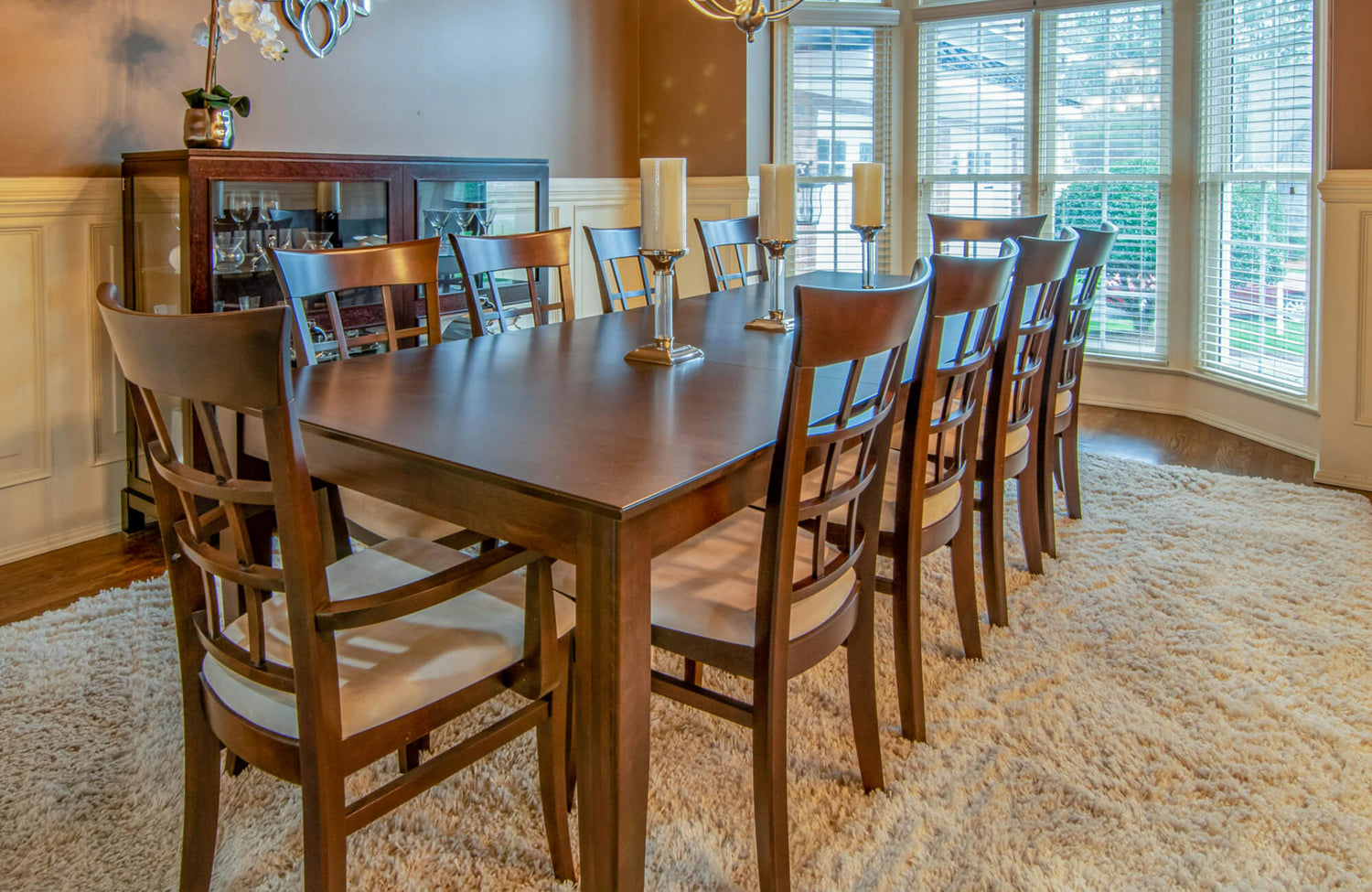
Our Georgette Polyester Pile Rug in Navy / Rose, as featured in the photo above, illustrates how a richly layered pattern can remain crisp and balanced even at a large scale, thanks to precise pattern engineering. Its refined motif distribution, controlled color transitions, and cohesive layout also demonstrate how sophisticated scaling techniques preserve both artistic integrity and overall visual rhythm in oversized rug formats.

Post-Weaving Finishing and Quality Control
Once weaving is complete, large rugs require extensive finishing work to refine texture, strengthen construction, and ensure visual consistency. These labor-intensive processes demand larger workspaces, specialized equipment, and highly trained technicians.
Large-Surface Washing and Drying Processes
Oversized rugs must be washed on extended washing beds that can fully accommodate their dimensions without folding or distortion. This cleaning process uses substantial water volume and specialized rollers to evenly distribute pressure. Because uneven washing can alter pile direction or fiber softness, technicians monitor the rug closely as it moves through each phase. Drying also becomes more complex, as moisture retention increases with size and weight. Industrial drying rooms, airflow systems, and extended drying cycles ensure the rug emerges perfectly balanced in texture. These extensive procedures significantly contribute to the price of professionally finished large rugs.
Detailed Hand Inspection and Surface Correction
Quality control becomes increasingly complex as the inspection surface expands, requiring technicians to evaluate every inch of the rug for inconsistencies. They examine knot tightness, pattern accuracy, pile height, and dye uniformity, addressing even the smallest deviations. When corrections are needed, technicians also perform delicate repairs using fiber-matching tools and specialized techniques. These refinements ensure the rug meets premium quality standards while preserving structural integrity. Because large rugs present more opportunities for flaws, the inspection process takes longer and requires advanced expertise. This meticulous work greatly influences the cost of luxury oversized rugs.

Freight, Handling, and Storage Logistics
Oversized rugs create complex logistical demands due to their substantial weight, extended dimensions, and rigid construction. These challenges increase costs at every stage, from packaging and transport to warehouse handling and long-term storage.
Oversized Freight Requirements
Large rugs exceed standard shipping thresholds, requiring freight-class transport where dimensional weight calculations significantly increase shipping fees. Because carriers prioritize space efficiency, oversized shipments are billed at premium rates that reflect the volume they occupy rather than their actual mass. Freight services also impose surcharges for non-conveyable items, meaning rugs that cannot travel on automated belts or standard sorting lines cost more to process. To prevent crushing, bending, or creasing, manufacturers must pack large rugs in reinforced tubes or wide-diameter rolls that further increase their cubic footprint. These space-intensive formats make loading and stacking more difficult, reducing the number of freight units that fit into each truck or container. As a result, freight shipping for oversized rugs becomes one of the most substantial logistical contributors to their final retail price.
Handling, Labor, and Warehouse Movement
Moving oversized rugs through distribution centers requires more labor and specialized equipment compared to standard-size textiles. Because the rolls are heavy, wide, and difficult to maneuver, warehouse teams often need multi-person assistance or lifting devices such as pallet jacks, extended-arm dollies, or forklift attachments. These additional labor demands increase handling time and operational costs for every transfer point the rug passes through. Each movement also carries a higher risk for edge abrasion or pile compression, prompting handlers to work more slowly and carefully. This increased attention ensures product integrity but reduces warehouse efficiency. All these factors combine to elevate the labor and handling cost of large area rug logistics.
Storage Space and Inventory Constraints
Warehousing large rugs requires significantly more storage space because their long rolls cannot be compactly stacked like smaller sizes. Many warehouses must allocate full-length rack positions or dedicate open floor space to prevent bending or deformation of the rug’s core. These spatial limitations also reduce overall storage capacity, forcing retailers to absorb higher per-unit overhead costs. Additionally, oversized rugs typically move more slowly through inventory due to their niche sizing, which further increases carrying time and associated storage fees. Retailers may even invest in climate-controlled storage to prevent fiber swelling, moisture absorption, or latex backing degradation. Together, these constraints make storage for oversized rugs a major contributor to their higher market price.
Enduring Value Behind the Cost of Large Rugs
Large rugs command higher prices because their construction merges intensive material requirements with advanced craftsmanship that smaller rugs simply do not demand. As each step of production expands in scale, the need for precision deepens, allowing no margin for error across broad textile surfaces. This careful engineering ensures that oversized rugs maintain structural stability, color accuracy, and long-term durability in ways that justify their investment. Ultimately, the elevated cost reflects both the artistry and engineering that allow large rugs to perform beautifully and reliably in demanding interior environments.
For homeowners or designers seeking guidance in selecting the right rug for their space, Edward Martin’s design services provide expert support tailored to your project, and you can easily contact us to explore personalized recommendations that bring your vision to life!