Fresh flowers bring softness, texture, and natural elegance to a space, yet the beauty of an arrangement depends just as much on the vase as on the blooms themselves. In professional floral styling, the best vase for fresh flowers is chosen not only for its appearance but also for how it supports stem structure, hydration, and visual proportion. From sculptural glass cylinder vases to refined ceramic vessels for flower arrangements, each shape and material influences how flowers unfold within an interior. Understanding how to choose the right vase for different flower types allows floral arrangements to feel more balanced, sophisticated, and professionally composed.

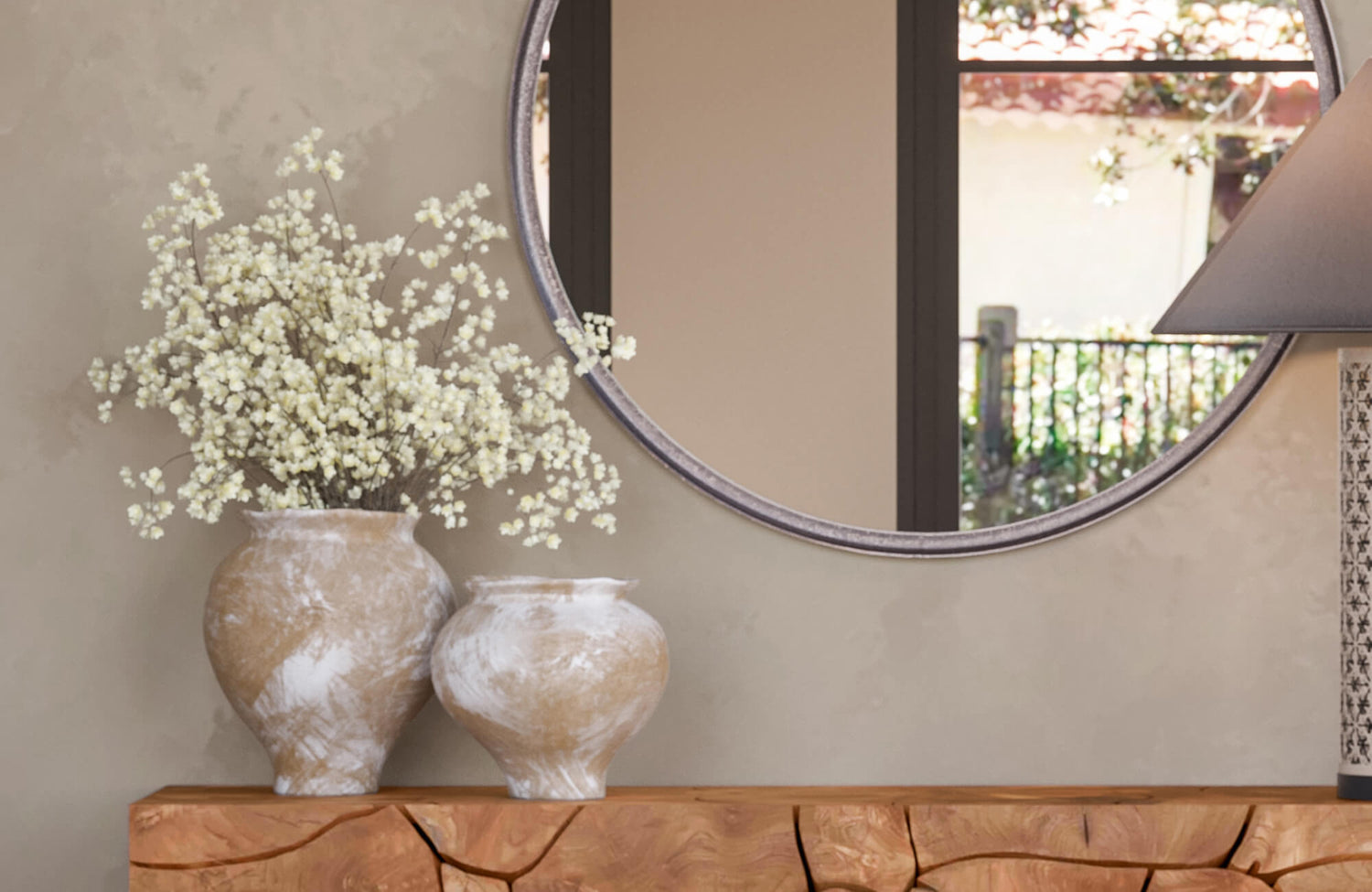
The subtle arched silhouette and slender metallic frame of the Esmeralda Wide Mirror in Iron Matte Black pair beautifully with the ceramic vase
Why Vase Selection Matters In Floral Design
In floral design, the vase acts as both a structural framework and a visual anchor that influences how an arrangement is perceived within a space. Beyond aesthetics alone, the vessel also affects stem positioning, hydration efficiency, airflow circulation, and the overall compositional harmony of the flowers.
Structural Support And Stem Positioning
A thoughtfully designed vase provides the structural support needed to maintain floral balance and arrangement integrity over time. Narrow-neck vessels gently gather stems together, creating a controlled vertical form that prevents flowers from spreading too widely, while broader openings encourage a softer and more organic silhouette. Professional florists carefully evaluate neck diameter and vessel depth because improper spacing can disrupt weight distribution and weaken the arrangement's natural architecture.
Flowers with substantial bloom mass, such as hydrangeas and peonies, also require greater lateral support to preserve their rounded morphology without collapsing under their own weight. This becomes especially important in asymmetrical or garden-style arrangements where directional movement contributes to the overall composition. By maintaining stable stem placement and balanced spacing, the vase allows floral forms to appear fuller, more refined, and visually harmonious.
Hydration And Flower Longevity
The dimensions and material composition of a vase play an essential role in maintaining proper hydration mechanics for fresh flowers. Deep vessels accommodate larger water reservoirs, allowing moisture-sensitive blooms such as lilies, tulips, and hydrangeas to absorb water more efficiently through their vascular tissues. Materials like ceramic and thick-walled glass also help regulate water temperature, slowing bacterial growth that can obstruct stem capillaries and accelerate floral senescence.
When stems become overcrowded inside a narrow vessel, water circulation and oxygen exchange become less effective, ultimately reducing bloom longevity. Adequate spacing between stems improves airflow throughout the arrangement while helping petals retain their firmness and vibrancy. By supporting cleaner water conditions and consistent hydration, the right vase significantly extends the freshness and visual vitality of floral arrangements.

The bold geometric silhouette and natural travertine texture of the Cavendry Travertine Vase Set pair beautifully with the organic floral motif of the Petaline Wallpaper in Taupe
Best Vase Shapes For Different Flower Types
Each vase silhouette interacts differently with floral forms, influencing how blooms spread, bend, and occupy visual space within an arrangement. Choosing the appropriate vase shape allows flowers to maintain their natural posture while enhancing dimensional layering and compositional movement.
Cylinder Vases For Structured Bouquets
Cylinder vases are defined by their straight vertical walls and symmetrical geometry, making them one of the most versatile vessel styles in floral design. Their elongated profile provides reliable support for long-stemmed flowers such as roses, tulips, lilies, and sunflowers by helping stems remain upright and evenly grouped. Because the opening is usually narrower than the body, cylinder vases create a controlled floral silhouette that feels polished without appearing overly rigid. Taller versions also accommodate deeper hydration levels, which is especially beneficial for flowers with high transpiration rates and substantial water requirements.
Designs such as Edward Martin’s Cavendry Travertine Vase Set, as displayed in the photo above, reinterpret this structured silhouette through bold geometric proportions and natural stone texture, allowing cylinder-style arrangements to feel both sculptural and architecturally refined. Its elongated form provides excellent support for tall branches and organic greenery, while the organic pitting of the travertine softens the precision of its Brutalist-inspired design. Through their clean, linear structure, cylinder vases create an understated elegance that allows floral textures and bloom coloration to remain the primary focal point.
Trumpet Vases For Fuller Arrangements
Trumpet vases feature a gradually flared opening that allows flowers to spread outward with a softer and more expansive appearance. This silhouette creates visual fullness while still maintaining centralized stem support beneath the arrangement, making it especially effective for layered floral compositions. Flowers with abundant petals, such as peonies, dahlias, carnations, and garden roses, benefit from the widened aperture because it prevents bloom compression and preserves petal structure.
The elevated profile of trumpet vases also introduces greater verticality, contributing to a more refined and luxurious presentation within dining rooms and entryway displays. Because the rim expands gradually, flowers are able to cascade naturally while maintaining balanced visual distribution throughout the arrangement. The resulting composition feels lush and romantic while still retaining the structural harmony associated with professional floral styling.
Compote Vases For Garden-Style Florals
Compote vases are shallow pedestal vessels traditionally associated with European-inspired floral arranging and garden-style compositions. Their broad basin and low-profile structure encourage multidirectional stem placement, allowing flowers and foliage to move more organically throughout the arrangement. Blooms such as ranunculus, lisianthus, garden roses, and seasonal greenery pair especially well with compote vessels because their softer forms complement asymmetrical spacing and layered texture.
Floral mechanics like pin frogs and chicken wire armatures are also often incorporated within the shallow basin to stabilize stems while preserving a natural appearance. The elevated pedestal base introduces sculptural height without creating excessive vertical mass, making these vessels especially effective for tablescapes and conversational settings. This relaxed yet intentional composition style creates an atmosphere of effortless elegance that feels refined and naturally expressive.
Bottle Vases For Organic Branch Arrangements
Bottle vases are defined by their slender necks and elongated silhouettes, making them especially effective for styling tall branches, delicate stems, and sculptural botanical arrangements. Unlike traditional bouquet vessels that emphasize fullness, bottle vases create a more restrained composition where negative space and vertical movement become central to the design. Their narrow opening also naturally supports sparse arrangements while guiding stems into graceful directional lines that feel organic and architectural at the same time.
Branches such as eucalyptus, cherry blossom, olive stems, and dried botanicals pair especially well with bottle vases because their height and natural asymmetry complement the vessel’s refined proportions. Glass, ceramic, and stone bottle vases are frequently incorporated into contemporary and Japandi-inspired interiors where simplicity, texture, and botanical form are intentionally emphasized. This understated silhouette creates a sculptural styling approach that feels calm, modern, and effortlessly sophisticated.

The Farrow Porcelain Vase, Medium features a rounded silhouette wrapped in hand-drawn geometric linework
Best Vase Materials For Flowers
The material composition of a vase contributes not only to its decorative appearance but also to its functional performance in floral preservation. Factors such as porosity, insulation, weight distribution, and surface texture all influence how flowers behave within the vessel over time.
Porcelain Vases
Porcelain vases are admired for their refined surface finish, delicate craftsmanship, and timeless decorative appeal within floral styling. Their smooth, vitrified composition creates a nonporous surface that helps resist moisture absorption while maintaining cleaner water conditions for fresh flowers. Compared to heavier ceramic vessels, porcelain often feels lighter and more sculptural, making it especially suitable for elegant floral arrangements featuring orchids, roses, or delicate branching stems. Glossy glazed finishes also reflect light softly across the arrangement, adding subtle luminosity that enhances bloom coloration and visual depth.
Pieces such as the Farrow Porcelain Vase, Medium, as shown in the photo above, further elevate this material through its softly voluminous silhouette and intricate hand-applied blue linework inspired by the artistry of Imperial Japan. The dimensional telescoping pattern creates an engraved visual effect across the crisp white porcelain surface, allowing the vase to function as both a floral vessel and an artisanal decorative accent. Because porcelain combines durability with a polished aesthetic, it is frequently incorporated into classic, transitional, and luxury-inspired interiors where refined craftsmanship becomes part of the overall composition.
Glass Vases
Glass vases remain among the most widely used vessels in floral design because of their versatility, clarity, and nonporous construction. Their transparent surface allows stems and water levels to remain visible, creating a sense of lightness that complements both minimalist and contemporary interiors. Because glass does not absorb moisture, it is less likely to harbor bacteria compared to unfinished porous materials, making maintenance significantly easier throughout the arrangement’s lifespan.
Thick-walled glass vessels also provide improved durability and moderate thermal insulation, helping stabilize water temperature more effectively than thinner constructions. The reflective qualities of clear glass subtly enhance natural light, giving floral arrangements a fresher and more luminous appearance. This balance between practicality and visual simplicity makes glass an enduring staple within both professional floristry and interior styling.
Ceramic Vases
Ceramic vases are valued for their structural weight, artisanal texture, and superior insulation properties within floral arrangements. Their dense composition provides enhanced stability for heavy blooms and thick stems, making them especially effective for flowers such as hydrangeas, sunflowers, and branching botanicals. Glazed ceramic surfaces also minimize moisture absorption while creating a smoother finish that is easier to clean and less susceptible to bacterial retention.
Beyond functionality, ceramic vessels introduce tactile richness through matte glazes, earthy pigmentation, and handcrafted detailing that contribute warmth and depth to interior environments. Their opaque construction also conceals stems and water lines, resulting in a cleaner and more elevated visual presentation. The combination of durability, insulation, and decorative sophistication makes ceramic one of the most versatile materials for long-lasting floral styling.
Crystal Vases
Crystal vases are distinguished by their exceptional brilliance and optical clarity, qualities that instantly elevate the presentation of fresh flowers within formal interiors. Their refractive surface captures and disperses light across the arrangement, intensifying bloom coloration while introducing a refined sense of luminosity throughout the space. Structured bouquets featuring roses, orchids, or lilies pair especially well with crystal because their elegant silhouettes complement the vessel’s decorative sophistication without overwhelming it visually.
Intricate cuts and etched detailing further enhance dimensional texture, allowing the vase itself to contribute to the arrangement’s ornamental impact. Crystal vessels are frequently associated with luxury entertaining and traditional floral styling because they create an atmosphere of timeless refinement and visual opulence. When styled thoughtfully, crystal vases transform floral arrangements into statement pieces that feel both graceful and architecturally luminous.

The organic grain movement and tapered silhouette of the Dorien Walnut Round Dining Table pair beautifully with the sculptural ceramic vase for a warm and balanced dining composition
Choosing The Right Vase Size
The dimensions of a vase significantly influence visual proportion, compositional balance, and the overall spatial presence of a floral arrangement. Selecting the appropriate size ensures that flowers feel intentionally scaled within the vessel while maintaining harmony with the surrounding interior environment.
Height-To-Arrangement Ratio
Professional florists commonly follow the principle that a floral arrangement should measure approximately one-and-a-half to two times the height of the vase to achieve balanced visual proportion. This ratio creates a natural transition between the vessel and the flowers, preventing the arrangement from appearing either disproportionately top-heavy or visually diminished.
Taller compositions introduce dramatic vertical movement that works especially well in grand entryways and formal dining settings where scale contributes to spatial impact.
Shorter arrangements, by contrast, establish a more intimate atmosphere that feels approachable and conversational within coffee tables or casual living spaces. When oversized vessels are paired with minimal floral material, the arrangement can appear sparse because the eye perceives an imbalance between botanical volume and container mass. Proper scaling ultimately contributes to a more cohesive and professionally styled floral composition.
Vase Opening And Stem Density
The diameter of the vase opening determines how stems interact spatially within the arrangement and directly influences the overall floral silhouette. For instance, narrow openings create greater stem compression, supporting upright bouquets with stronger verticality and a more controlled appearance. Wider openings allow flowers to branch outward naturally, encouraging multidirectional movement and layered botanical depth within the composition. Proper stem spacing is also essential because excessive crowding can bruise petals, obstruct airflow, and reduce water accessibility at the cut stem ends. Florists carefully balance stem density with opening diameter to preserve both structural integrity and visual rhythm throughout the arrangement. By selecting the correct opening size, floral arrangements retain a more natural posture while appearing fuller and more visually balanced.

The clean lines and softened whitewashed finish of the Alice 54" Round Dining Table pair beautifully with the ribbed glass vase, bringing modern warmth and understated elegance
Best Vase Types For Popular Flowers
Different flower varieties respond uniquely to vase shapes depending on their stem rigidity, bloom mass, hydration needs, and natural growth habits. Pairing flowers with appropriate vessels enhances both their visual presentation and their overall longevity after cutting.
Roses
Roses perform exceptionally well in cylinder and trumpet vases because these silhouettes provide the moderate stem support needed to maintain a balanced bouquet structure. Their elongated stems benefit from deeper vessels that reinforce vertical elegance while preventing flowers from separating unevenly within the arrangement. Cylinder vases create a cleaner and more compact silhouette, whereas trumpet vases allow rose blooms to open outward with greater softness and dimensional fullness.
Moderate neck openings also preserve appropriate bloom spacing, helping petals retain their layered structure without becoming compressed. Glass and ceramic vessels are both commonly used, depending on whether the arrangement leans toward contemporary minimalism or traditional sophistication. Through thoughtful vase selection, rose arrangements achieve a timeless elegance that feels refined and visually balanced.
Peonies
Peonies flourish in wider vessels that provide enough room for their voluminous blooms to open naturally without becoming compressed. Their layered petals and substantial bloom diameter pair especially well with rounded glass or ceramic vases that support softer, garden-style arrangements with balanced visual weight. Ribbed glass vessels, like the one featured in the arrangement above, work particularly well because their broad silhouette stabilizes dense stems while adding subtle texture and light reflection around the flowers.
The transparent body also highlights the natural structure of peony stems, reinforcing the airy elegance associated with organic floral styling. Because peonies possess a lush and romantic appearance, they are often arranged in low, rounded vases that encourage fullness, dimensional layering, and gentle outward movement. When paired with greenery such as eucalyptus, these vessels help create a composition that feels refined, fresh, and naturally abundant.
Tulips
Tulips thrive in tall cylinder vases because their stems continue elongating and curving even after being cut. The vertical structure of the vase accommodates this natural phototropic movement while preserving the graceful arc that gives tulips their sculptural quality. Deep water reservoirs are also equally important because tulips require consistent hydration in order to maintain stem firmness and bloom integrity throughout their vase life.
Minimalist vessels pair especially well with tulips since their fluid silhouette already provides significant visual movement without requiring ornate decorative support. Transparent glass containers additionally highlight the elegant curvature of the stems, reinforcing the organic softness of the arrangement. This restrained yet expressive styling gives tulips a modern elegance that feels effortless and refined.
Hydrangeas
Hydrangeas require wide, water-rich vessels because of their substantial bloom size and exceptionally high moisture demands. Their dense flower heads absorb water rapidly, making deep reservoirs essential for maintaining cellular hydration and preventing premature wilting. With this, ceramic and broad glass vases provide the stability necessary to support the considerable weight of hydrangea stems while preserving compositional balance.
Spacious openings also allow the blooms to retain their rounded morphology without becoming compressed against neighboring flowers. Rounded vessel silhouettes pair particularly well with hydrangeas because they mirror the soft volumetric shape of the blooms themselves. With the proper vase support and hydration conditions, hydrangeas maintain their lush appearance and create a luxurious sense of abundance within floral compositions.
Elevating Floral Arrangements Through Thoughtful Vase Selection
The best vase for flowers enhances far more than the appearance of an arrangement, as it also supports floral structure, hydration efficiency, and overall compositional balance. From elegant glass cylinder vases for roses and tulips to substantial ceramic vessels designed for hydrangeas, each material and silhouette influences how flowers behave within a space. Understanding how vase shape, proportion, and stem density interact allows floral arrangements to feel more cohesive, luxurious, and professionally styled. When thoughtfully selected, decorative flower vases become an essential design element that brings lasting beauty, texture, and sophistication into the home.
Edward Martin’s design services also provide thoughtful guidance in selecting decorative vases and styling pieces that complement the scale, texture, and atmosphere of a space. Contact us to explore curated furniture, artisanal décor, and expertly layered interiors designed with timeless balance and sophistication!