Choosing the right rug starts with understanding what it is made of. Fiber content influences how a rug feels underfoot, how it handles daily use, how it reacts to moisture and sunlight, and what kind of care it will need over time. A wool rug, for instance, will age very differently from one made of polypropylene, viscose, cotton, or jute, even when the surface design looks similar.
This guide walks you through practical ways to identify rug materials through texture, sheen, backing, weave structure, and simple shopping questions. By learning what to look for, you can better judge where a rug belongs, how it is likely to perform, and whether it fits the way you live.

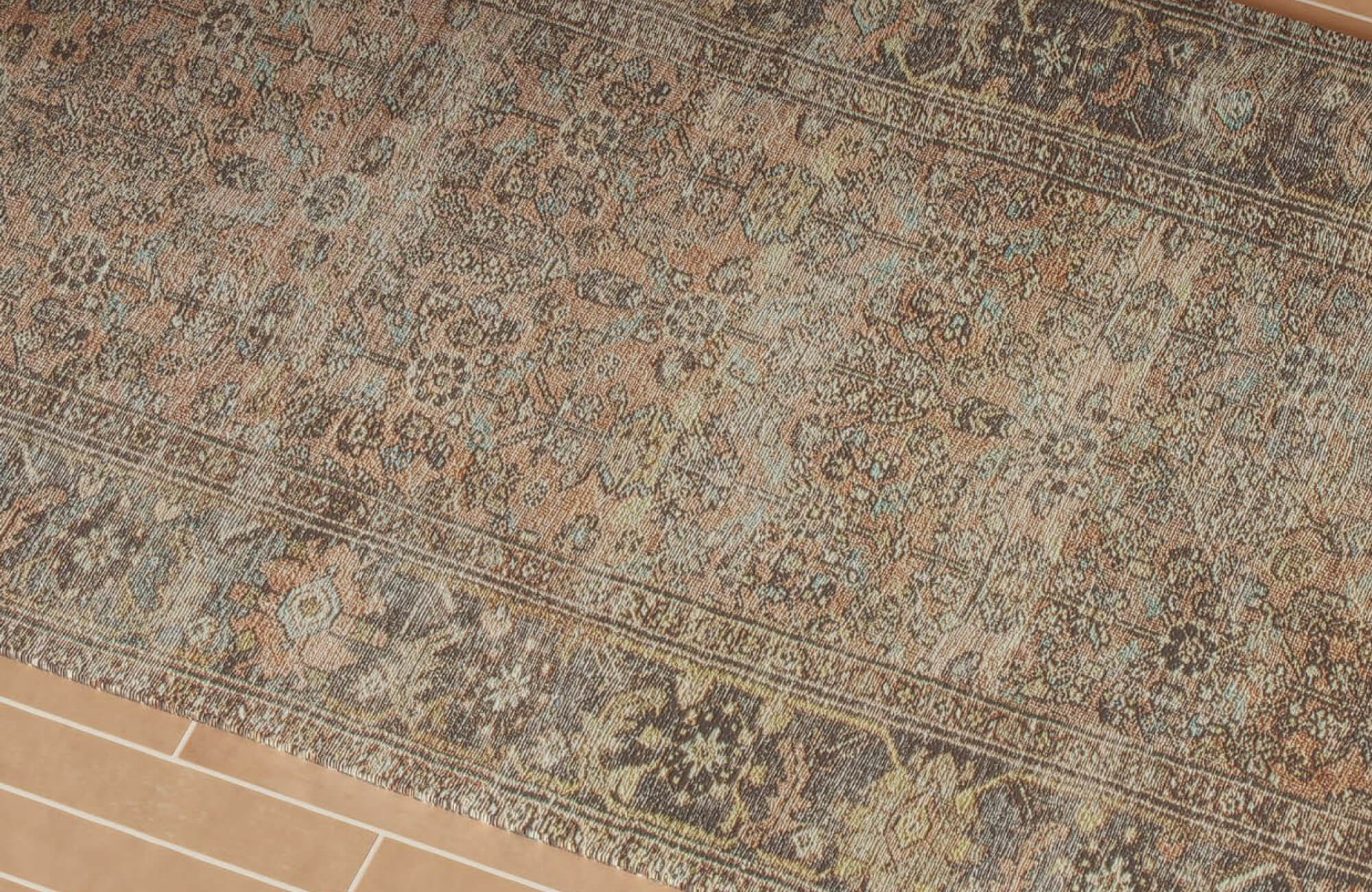
The Broderick Rug in Smoke / Terracotta shows how dense pile, muted color variation, and subtle raised patterning can help reveal fiber texture and construction.
The Most Common Rug Fibers
Before inspecting a rug closely, it helps to understand the materials you are most likely to encounter. Natural fibers such as wool, cotton, jute, and silk each have distinct textures and performance qualities, while synthetic and semi-synthetic options like polypropylene, polyester, nylon, and viscose are often engineered for color consistency, easy care, or affordability.
Wool vs Synthetic
Wool and synthetic fibers differ in structure, feel, and long-term performance. Wool is a natural protein fiber from sheep fleece, valued for its springy hand-feel, warmth, and resilience. Its crimped structure helps the pile recover after compression, which is why quality wool rugs often hold their shape well in active rooms. Wool also absorbs and releases moisture vapor, contributing to a breathable feel without making the surface feel damp under normal conditions.
Synthetic fibers such as polypropylene, polyester, and nylon are manufactured for practical consistency. Polypropylene is commonly used because it resists moisture and stains, and when solution-dyed, its pigment is built into the fiber for strong fade resistance. Edward Martin's Broderick Rug in Smoke / Terracotta offers a clear visual example of how a synthetic pile can still feel dimensional: its dense, raised texture and muted gray, beige, and tan patterning show how polypropylene can create softness and surface interest without relying on the natural crimp of wool. Polyester often offers a smooth touch and clear color, while nylon is typically the most resilient of the three. These materials are often easier to clean and more budget-friendly than wool, though lower-quality versions may feel slick, overly shiny, or less responsive underfoot.
The clearest distinction is how the fibers age. Wool tends to soften and develop character with proper care, while many synthetics maintain color well but may flatten, compress, or show surface wear depending on pile density and construction. Wool is also naturally flame-resistant and biodegradable, while synthetic fibers can melt under heat and may rely on backing systems or treatments for added stability.
Cotton vs Jute
Cotton and jute are both plant-based, but they play very different roles in rug construction. Cotton comes from the soft seed fibers of the cotton plant and is spun into flexible yarns that create a smooth, matte surface. It is often used in flatweaves such as kilims and dhurries, as well as in rug foundations, fringes, and backing fabrics. Cotton rugs tend to feel casual and lightweight, making them useful for layering, relaxed rooms, and smaller pieces that may be washable when the care label allows.
Jute is a bast fiber taken from the stalk of the Corchorus plant. It is thicker, drier, and more rigid than cotton, giving jute rugs their familiar natural texture and earthy appearance. That structure adds visual warmth, but it also makes jute less forgiving in damp conditions. Because jute absorbs moisture quickly and dries slowly, it is better suited to dry interiors than bathrooms, damp entryways, or spill-prone areas.
Silk vs Viscose
Silk and viscose are often confused because both can create a luminous surface, but their performance is not comparable. True silk is a natural protein fiber produced by silkworms. It is fine, strong for its weight, and highly reflective, making it especially suited to detailed hand-knotted rugs, accent motifs, borders, and formal spaces where the rug will not be exposed to frequent spills or abrasion.
Viscose is a regenerated cellulose fiber made from plant pulp through chemical processing and is often marketed as “art silk,” “bamboo silk,” or similar terms. It can imitate silk’s shine when new, but it has much weaker recovery and moisture resistance. Viscose may crush, mat, shed, or stiffen when exposed to water or repeated use. If a rug has a bright glassy sheen, feels cool and slick, and shows strong directional shading, viscose may be the material rather than silk.

The Pascal Rug in Rust / Multi adds patterned warmth over Tatum 24 x 48 Matte Porcelain Tile in Cross-Cut Sand, pairing a detailed woven surface with clean, neutral flooring.
Inspect the Texture and Feel
Once you’re familiar with common rug fibers, your next best tool is touch. The way a rug responds to pressure, friction, and weight can reveal a great deal about its material and construction.
Test the Softness
Softness might seem subjective, but it’s rooted in measurable factors like fiber diameter, texture, and elasticity. Wool has a naturally crimped structure that provides loft and resilience, giving it a springy, cushioned hand-feel. Finer grades like Merino feel smoother, while coarser varieties still offer comfort and durability. Silk, with its triangular filaments, delivers exceptional smoothness and glide, thanks to reduced surface friction.
Synthetics, by contrast, often mimic softness through fiber engineering and pile construction. Polyester and polypropylene can feel smooth to the touch, but they lack the warmth and responsiveness of animal fibers. Edward Martin's Pascal Rug in Rust / Multi helps illustrate a more practical kind of softness: its low-profile runner shape, tightly patterned surface, and detailed rust, blue, cream, and tan motif create comfort through texture and flexibility rather than deep pile. In a tiled kitchen or transitional area, that balance matters because the rug needs to soften the floor visually and physically without becoming too plush for daily movement. Nylon is the softest among synthetics, yet still cooler and firmer in feel. Cotton offers a velvety, matte softness; less plush, but quiet and comforting. Jute, on the other hand, is coarse and rigid, better appreciated for its natural texture than comfort.
What you’re assessing is how the rug compresses under pressure and how it rebounds. That interaction between fiber and touch can also help you determine where the rug will work best, whether it’s a spot for lounging or a decorative accent.
Check for Shedding
Friction also reveals how stable a rug’s fibers are, especially when it comes to shedding. Wool rugs often shed initially due to leftover fibers from the shearing and weaving process. Higher-quality wool, like that in our Mallory Wool Pile Rug in Forest, is tightly spun and resilient, so shedding diminishes with use. Loosely spun or blended yarns may continue to shed over time due to fiber breakage.
Viscose, by nature, is fragile. Its low wet modulus and sensitivity to abrasion mean it sheds readily, even under light rubbing. Once the structure begins to break down, the fiber doesn’t recover. In humid conditions, this process accelerates, often leaving behind powdery residue.
Synthetics like polypropylene and polyester, in contrast, are generally designed to resist shedding. Their long, extruded filaments hold up well under repeated friction. If shedding occurs, it’s usually tied to issues in the rug’s backing, not the fiber itself. Cotton, especially in flatweaves, may shed slightly due to its short staple length, but this typically resolves with regular care.
A simple in-store palm rub test can also help; if fibers cling to your hand or you see fluff buildup, take note of the fiber type and construction quality. Shedding isn’t always a red flag, but it does offer insight into the rug’s lifecycle and maintenance needs.
Feel the Weight
Weight can also be a useful clue. Heft often indicates fiber density, pile height, and construction integrity. Wool rugs tend to feel substantial, thanks to their crimped fibers and tightly packed pile. In hand-knotted pieces, the sheer volume of yarn contributes to both comfort and long-term stability.
Jute rugs are also weighty, not because of pile height but due to the coarseness and size of the bast fibers. This gives them a grounded, firm feel. Cotton rugs, by contrast, are much lighter, making them easy to fold, layer, or transport, perfect for casual or multifunctional settings.
Synthetic rugs vary as well; for example, polypropylene and polyester piles can feel light, but added foam or latex backings may give the illusion of density. Nylon, especially in commercial-grade constructions, has more fiber mass and feels heavier in hand, though it still lacks the plush weight of wool.
Lifting a rug or checking its edge can reveal construction shortcuts, too. A large rug that feels unusually light may be made with thin, low-density materials or minimal backing support. A more substantial rug, especially one with visible fiber depth and a secure edge, often suggests stronger construction and longer performance.

The Hutchinson Rug in Marine / Crimson is shown with its backing exposed, highlighting how the underside, edge stitching, and surface pattern work together to communicate construction.
Examine the Backing and Weave
A rug’s surface can suggest what it is made of, but the underside often reveals how it was constructed. Backing, knots, weave tightness, and edge finishing can help distinguish hand-knotted, hand-tufted, flatwoven, and machine-made rugs while also giving clues about durability, breathability, and care.
Look at the Backing
The backing is one of the clearest indicators of construction. In hand-knotted rugs, the reverse usually shows a softened mirror image of the front because the design is built directly into the foundation. You may see individual knots, slight shifts in spacing, and small variations in tension. These details are signs of handwork rather than defects.
Machine-made rugs tend to look more uniform on the back. Many polypropylene and polyester rugs use a woven, jute, latex, or synthetic backing to stabilize the pile. The reverse may appear grid-like, rubbery, or mechanically consistent, and it usually will not show the front pattern with the same clarity as a hand-knotted rug. Edward Martin’s Hutchinson Polyester Face Rug in Marine / Crimson is a useful example of this type of construction, with a stable bonded base that supports the surface design while keeping the rug relatively lightweight and easy to maintain.
Tufted rugs sit between these categories. Their yarn is punched through a fabric foundation with a tufting tool, secured with adhesive, and covered with a cloth backing. This creates a plush surface at a more accessible price point, but the backing hides the yarn insertion points and may be less durable over time than a true hand-knotted foundation, especially if exposed to excess moisture or improper cleaning.
Check the Knot Type
Knot structure offers deeper insight in handmade rugs. Traditional hand-knotted pieces often use either Persian, or Senneh, knots or Turkish, or Ghiordes, knots. A Persian knot is asymmetrical, allowing for fine curves and intricate pattern detail. A Turkish knot is symmetrical, creating a slightly thicker and more textured pile that often suits geometric designs.
Knot density is measured in knots per square inch, or KPSI. Higher density can support sharper pattern resolution, especially in silk or fine wool rugs, but density should not be judged on its own. Fiber quality, yarn strength, pile height, and overall construction all influence how well a rug performs. A moderately dense wool rug made with strong, well-spun yarn may outlast a denser piece made with weaker fibers.
To identify real knots, examine the back near a detailed part of the design. Hand-knotting usually shows small differences in spacing or tension, while machine-made rugs tend to show mechanically uniform rows or looped structures rather than individually tied yarn. Consistency can be a sign of efficient production, but slight irregularity is often what confirms hand craftsmanship.
Spot Weave Patterns
Weave patterns help explain how a rug will feel, function, and age. Flatweave rugs, including kilims and dhurries, have no raised pile. Their warp and weft threads interlace to form a thin, flexible surface that is often reversible and easy to layer. Cotton flatweaves feel soft and casual, wool versions offer more body and resilience, and jute creates a thicker, more textured effect.
Pile rugs have yarn raised above the foundation, which creates softness, cushion, and visual depth. Cut pile feels plusher, while loop pile is usually more compact and textured. Wool and nylon perform especially well in pile constructions because they can recover from compression more effectively than many other fibers. Polyester and polypropylene can also create soft surfaces, though performance depends heavily on pile density and backing quality.
Soumak, hooked, braided, and tufted constructions add further variation. Soumak uses wrapped threads to create a slightly raised, embroidered texture without a full pile. Hooked rugs pull loops through a backing, while tufted rugs use adhesive to secure punched yarn. Edward Martin's Hutchinson Rug in Marine / Crimson is a helpful example of why the underside matters: its folded edge reveals a gray backing and red stitched border, while the face carries a detailed blue, red, cream, and dark traditional-style pattern. That contrast between decorative surface and simpler reverse helps readers understand how backing, edge finishing, and surface design work together in a constructed rug. When evaluating any weave, look at yarn thickness, pile length, tightness, and edge finishing. A compact, well-secured structure usually signals better stability than a loose weave with long, fragile fibers.

The Haverford Rug in Platinum / Bronze softens the seating area, while Preston 8 x 48 Matte Porcelain Tile in Pine adds a warm wood-look foundation beneath the neutral furnishings.
Use Simple At-Home Tests
If visual cues fall short, simple at-home tests can offer more clarity, but they should always be done with care. The burn test is one of the most accurate methods for identifying fibers, though it should only be used on a tiny strand taken from a hidden area and never on the visible surface of the rug. Natural materials like wool and cotton burn or char, while synthetics melt and produce a chemical odor. Always observe the flame behavior, smell, and ash carefully, and avoid this method entirely if you are unsure how to do it safely.
Flame-free methods are often more practical for everyday rug owners. The water absorption test reveals how quickly a fiber draws in moisture, while the rub test can help check dye stability, shedding, and fiber strength. Edward Martin's Haverford Rug in Platinum / Bronze is the type of piece where gentle, non-destructive inspection is especially useful: its muted gray, beige, and tan surface, compact pile, and placement under living room furniture make pressure, edge stability, and surface response more relevant than aggressive testing. If a rug pills, sheds, transfers color, or changes texture with light rubbing, it may indicate delicate materials, weak construction, or a finish that requires more careful maintenance. Together, these observations can help confirm what your rug is made of and how it may perform in real-life conditions.

The Georgette Rug in Clay / Navy brings soft color variation and a worn traditional pattern into a relaxed living room layered with woven textures, light upholstery, and warm tile flooring.
Pay Attention to Sheen and Color
Sometimes, what you see under light can be just as revealing as what you feel. A rug’s sheen and color behavior offer strong clues about its fiber composition, dye method, and overall quality, especially when observed from different angles or over time.
Examine the Shine
The way a rug reflects light often reveals important clues about its material composition. For example, silk produces a soft, fluid shimmer thanks to its prism-like filaments, creating a gentle glow that shifts with movement. In comparison, viscose attempts to mimic this effect, but its shine tends to be brighter and less refined, and it often dulls with wear or moisture. Meanwhile, wool offers a more understated, matte sheen that scatters light softly, adding warmth and depth to the surface. Polyester and polypropylene, on the other hand, reflect light more uniformly, resulting in a glossier, more plastic-like finish with little variation.
Note Color Saturation
Beyond surface sheen, how a rug absorbs and holds dye can also reveal important details about its fiber composition. Wool and silk take in dye deeply, resulting in rich, layered tones with natural variation throughout the pile. While cotton absorbs color cleanly, its finish is typically flatter and lacks the same depth due to its smoother texture. By comparison, synthetics like polypropylene are solution-dyed during production, locking pigment into the fiber for strong fade resistance, though the final look can appear overly bold or uniform.
Edward Martin's Georgette Rug in Clay / Navy shows how color saturation can also be read through softness and variation rather than intensity alone. Its faded pink, blue, cream, tan, and muted navy tones create a layered traditional pattern that feels gently worn instead of flatly printed. In a light living room with cream upholstery, woven accents, and warm flooring, that softened palette helps demonstrate how color can contribute to both material identification and design mood. Viscose, while initially vivid, tends to lose clarity and richness over time as it degrades with use and moisture, so color that appears bright at first should still be evaluated alongside texture, sheen, and fiber stability.
Spot Fading Patterns
Over time, fading patterns can reveal even more about a rug’s material. Wool and silk generally fade slowly and evenly, developing a subtle patina that enhances their character. In contrast, cotton is more prone to noticeable fading, especially with repeated washing or direct sunlight. Viscose is particularly delicate; it often fades unevenly and may lose both color and structural integrity in areas exposed to frequent use. Synthetics, particularly those that are solution-dyed, are highly resistant to fading, but when discoloration does occur, it’s often abrupt and inconsistent.
Altogether, these visual characteristics—how a rug reflects light, absorbs color, and responds to fading all offer a reliable way to identify fiber types and anticipate how the rug will look and last over time.

The Vela Sofa, Leticia Dining Chair in Cream, and Lina Outdoor Coffee Table in Cream create a calm outdoor seating arrangement, with the patterned rug grounding the space through texture and scale.
Ask the Right Questions When Shopping
Asking about care not only gives you a clearer idea of upkeep but also helps verify the rug’s composition. If you are comparing several materials or trying to coordinate a rug with existing furniture, flooring, and room proportions, Edward Martin’s design services can offer guidance on which fiber, scale, and construction best support the space.
Ask for the Label
Always start by checking the label, which usually lists the fiber content, country of origin, and backing material. Tags like “100% Wool Pile” or “Polypropylene with Jute Backing” can offer a clear view of what you're buying. For natural fibers like wool or silk, labeling adds reassurance, while terms like “art silk” often indicate viscose, not real silk.
Some vintage or hand-knotted rugs may lack labels, so it’s worth asking the seller for fiber verification or documentation. Trusted dealers typically provide this information, helping you confirm authenticity and material quality.
Question the Origin
Knowing where a rug was made can reveal a lot about its quality, fiber type, and construction method. Each country has distinct weaving traditions and manufacturing strengths that impact both durability and design.
India is renowned for handmade rugs, particularly hand-knotted and hand-tufted styles crafted from wool. These rugs often reflect skilled artistry and long-lasting quality. In contrast, Turkey and Egypt lead in machine-made rug production, using Wilton looms to create intricate, power-loomed designs with synthetic blends. Additionally, China specializes in hand-tufted, printed, and indoor-outdoor rugs made from synthetic fibers like polyester and polypropylene, valued for their easy care and affordability.
Asking about origin can also help you spot authentic craftsmanship over style-based imitations, which is essential when choosing a rug that balances budget, design, and long-term performance.
Inquire About Maintenance
Proper rug care begins with understanding what it’s made of; asking about maintenance can often reveal more than you’d expect. Sellers typically offer useful cleaning advice that also helps confirm the rug’s fiber type and construction quality. Wool, polyester, and polypropylene rugs are among the easiest to maintain. These materials naturally resist stains, and synthetics like polyester and polypropylene also repel moisture. Routine vacuuming without a beater bar and spot cleaning with a mild detergent and a splash of vinegar usually keep them looking their best.
Maintenance needs become even more important when a rug is used in a transitional or outdoor setting. Edward Martin's Marroway Indoor/Outdoor Rug in Brown / Black, 7'10" x 10'9" demonstrates this clearly through its low-profile construction, brown and black geometric pattern, and placement in a covered patio arrangement with seating, greenery, and hard flooring. In this kind of setting, the right rug needs to handle surface debris, changing humidity, and regular foot contact without requiring delicate care. That makes construction and fiber choice as important as color or pattern.
Delicate fibers like viscose, jute, sisal, rayon, and linen require extra care. They’re more prone to staining and damage from moisture, so it’s best to stick to dry blotting or consult a professional cleaner to avoid permanent damage or color distortion. Cotton and acrylic rugs fall somewhere in the middle. Small cotton pieces may be machine-washable if labeled accordingly, while larger ones typically need dry cleaning powders or professional care. Acrylic tends to behave like wool and synthetics, responding well to basic spot cleaning and vacuuming.
Asking about care not only gives you a clearer idea of upkeep but also helps verify the rug’s composition, making it easier to choose something that fits your lifestyle.
Rug Material Identification Made Simple
Identifying a rug’s material becomes easier once you know which visual, tactile, and structural cues to observe. From the way a fiber responds to light and absorbs color to how it feels under your hand or performs in at-home tests, every detail tells part of the story. When combined with the right questions about origin, fiber content, and care, these clues allow you to assess quality, performance, and longevity.
Whether you are choosing a statement piece or a practical everyday rug, understanding material, construction, and care helps you make a better decision for your home. If you have narrowed down your options but still need help confirming the right fit, you can contact Edward Martin for guidance on material selection, placement, and long-term maintenance before making a final choice.