Mirrors are more than just reflective surfaces for checking our appearance; they are powerful design tools that shape the light, space, and aesthetic of a home. Once a symbol of immense wealth and luxury, mirrors have a fascinating history that tracks alongside key moments in human innovation and artistic expression. This article will explore the journey of the mirror from ancient artifacts to modern-day home decor essentials.
The story of the mirror is a reflection of society itself, revealing how evolving technology, changing artistic styles, and shifts in social class made this once-rare object a ubiquitous part of interior design. We will uncover the secrets behind their craftsmanship and the cultural significance that transformed them from functional objects into celebrated works of art.

The Earliest Reflections
The history of mirrors reveals how human ingenuity transformed simple reflective surfaces into objects of craftsmanship, symbolism, and design. Tracing their development from natural phenomena to engineered artifacts offers valuable insight into both cultural practices and technological innovation.
From Water to Obsidian
The earliest “mirrors” were pools of still water, used by ancient peoples to glimpse their reflections. By around 6000 BCE, innovation led to the use of volcanic glass, or obsidian, as a more durable reflective surface. Archaeological findings in Anatolia, particularly at Çatalhöyük, reveal finely polished obsidian mirrors, demonstrating both advanced lapidary skills and an early awareness of the decorative and symbolic role of reflection.
The Rise of Polished Metals
As metallurgy advanced, societies began crafting mirrors from polished copper, bronze, and later silver. These metal mirrors, common in Mesopotamia, Egypt, and China, were often circular with ornamented backs, highlighting their dual function as both practical tools and luxury objects. Although they lacked the high reflectivity of modern glass mirrors, their gleaming surfaces symbolized wealth, ritual purity, and status. In Egypt, bronze mirrors frequently appeared in tombs, reflecting their role not only in daily grooming but also in spiritual beliefs about the afterlife.
Mirrors in Greco-Roman Society
By the classical era, mirrors had become integral to personal care and domestic life. Greek artisans refined bronze mirrors into handheld forms with hinged lids or elaborately decorated handles, while the Romans introduced silver and experimented with early glass-coated versions. Mirrors were often linked with Venus, the goddess of beauty, reinforcing their symbolic ties to vanity, love, and self-reflection. In elite Roman households, these objects served not only functional purposes but also stood as markers of technological sophistication and cultural refinement, bridging everyday utility with artistic achievement.

The Venetian Secret
The Renaissance marked a turning point in mirror-making, when artistry and technology merged to produce objects of unprecedented clarity and brilliance. At the center of this revolution stood Venice, whose artisans transformed mirrors from functional tools into luxury commodities that reshaped European interiors and social status.
Murano’s Glassblowing Monopoly
In the 15th and 16th centuries, Venetian glassmakers on the island of Murano developed groundbreaking techniques that revolutionized mirror production. Using cristallo, a nearly colorless, high-purity glass, they perfected methods of casting, flattening, and polishing sheets of glass. Paired with the closely guarded practice of mercury-silvering, these innovations produced mirrors of unparalleled reflectivity. To protect this lucrative expertise, Venice imposed strict regulations, confining artisans to Murano and treating their craft secrets as matters of state.
Mirrors as a Symbol of Power
The results were objects of extraordinary desirability. Venetian mirrors became coveted possessions among Europe’s elite, with some valued higher than entire estates. Their rarity and cost positioned them as symbols of wealth, refinement, and cultural authority. Monarchs and aristocrats commissioned elaborate frames gilded in gold leaf or carved from rare woods, elevating mirrors into both works of art and political statements. In grand palaces, large-scale mirrors amplified candlelight and architectural symmetry, creating dazzling spectacles that reflected not only the viewer but also the magnificence of their surroundings.
The Spread of Mirror Making
Despite Venice’s efforts to guard its monopoly, knowledge of mirror-making gradually spread across Europe. In the 17th century, French entrepreneurs, supported by the crown, enticed Murano artisans to Paris, leading to the founding of Saint-Gobain. This diffusion broke Venice’s exclusivity and paved the way for large-scale production.
As techniques advanced and costs declined, mirrors became more widely accessible, transitioning from rare luxuries to essential elements of domestic interiors and architectural design. This democratization laid the foundation for their enduring presence in homes around the world.

The Industrial Age
The Industrial Revolution fundamentally transformed the mirror industry, shifting production from artisanal workshops to mechanized factories. Innovations in chemistry and manufacturing allowed mirrors to become widely accessible, embedding them into everyday domestic life for the first time.
The Silvering Process Breakthrough
One of the most pivotal advancements came in 1835, when German chemist Justus von Liebig developed a technique for depositing a thin layer of metallic silver onto glass. This chemical silvering process replaced the dangerous mercury amalgam method, producing mirrors that were safer, clearer, and more durable. Rapidly adopted across Europe, it standardized quality and laid the foundation for mirrors to be manufactured on an industrial scale.
Mass Production and Affordability
With this breakthrough in place, further innovations in glassmaking, such as cylinder glass and later float-glass techniques, made it possible to produce larger, more uniform sheets. When combined with automated silvering and polishing machinery, factories achieved unprecedented speed and consistency. These advances also dramatically lowered costs, allowing mirrors to transition from exclusive luxuries into widely attainable household items, particularly for the expanding middle class.
Mirrors in the Victorian Home
By the mid-19th century, mirrors had firmly established their place in Victorian interiors, reflecting both aesthetic ideals and social aspirations. Large wall mirrors brightened parlors and dining rooms, enhancing ornate décor while amplifying natural light, and smaller vanity mirrors supported the period’s growing emphasis on personal grooming. In architecture, mirrors were strategically placed to create illusions of grandeur, reinforcing Victorian values of refinement, prosperity, and display.

Beyond the Reflection
In contemporary design, mirrors are no longer viewed solely as utilitarian objects but as architectural and artistic tools that shape perception, atmosphere, and spatial experience. Their integration into interiors reflects both aesthetic intention and functional strategy.
The Illusion of Space
One of the most compelling uses of mirrors lies in their ability to visually expand interiors. By reflecting architectural elements and extending sightlines, they create the perception of greater volume, an especially valuable technique in compact urban dwellings. Designers often employ full-height wall panels or mirrored closet doors to elongate proportions and dissolve boundaries, effectively blurring the line between structure and reflection.
Focal Points and Feature Walls
Mirrors also serve as intentional design statements. For instance, large, framed mirrors or geometric installations can act as striking focal points, guiding the eye much like artwork. When arranged as feature walls, they introduce rhythm, symmetry, and visual intrigue to otherwise static planes. Variations such as antiqued glass or tinted finishes add texture and depth, allowing mirrors to function simultaneously as decorative accents and architectural layers.
Light and Brightness Amplification
Equally transformative is the role of mirrors in enhancing light. Strategically positioned, they amplify both natural and artificial illumination, reducing reliance on additional fixtures while brightening interiors. In addition, placing mirrors opposite windows maximizes daylight penetration, softening shadows and expanding visual comfort. In hospitality and retail spaces, mirrored surfaces often serve to distribute light evenly, highlighting architectural details and elevating the user experience.
Carrying that idea into a contemporary context, Edward Martin’s Shirley Large Mirror in Antique Brass Iron, as shown in the photo above, demonstrates how thoughtful design can work hand in hand with light. Its organic silhouette seems almost shaped by illumination itself, reflecting and diffusing brightness throughout a room while also standing out as a sculptural focal point.

Modern Day Mirror Design
In today’s design landscape, mirrors are no longer static reflective tools but dynamic design elements shaped by innovation, technology, and sustainability. Their evolving role demonstrates how tradition and modernity converge to meet the needs of contemporary living.
Sleek and Minimalist Mirrors
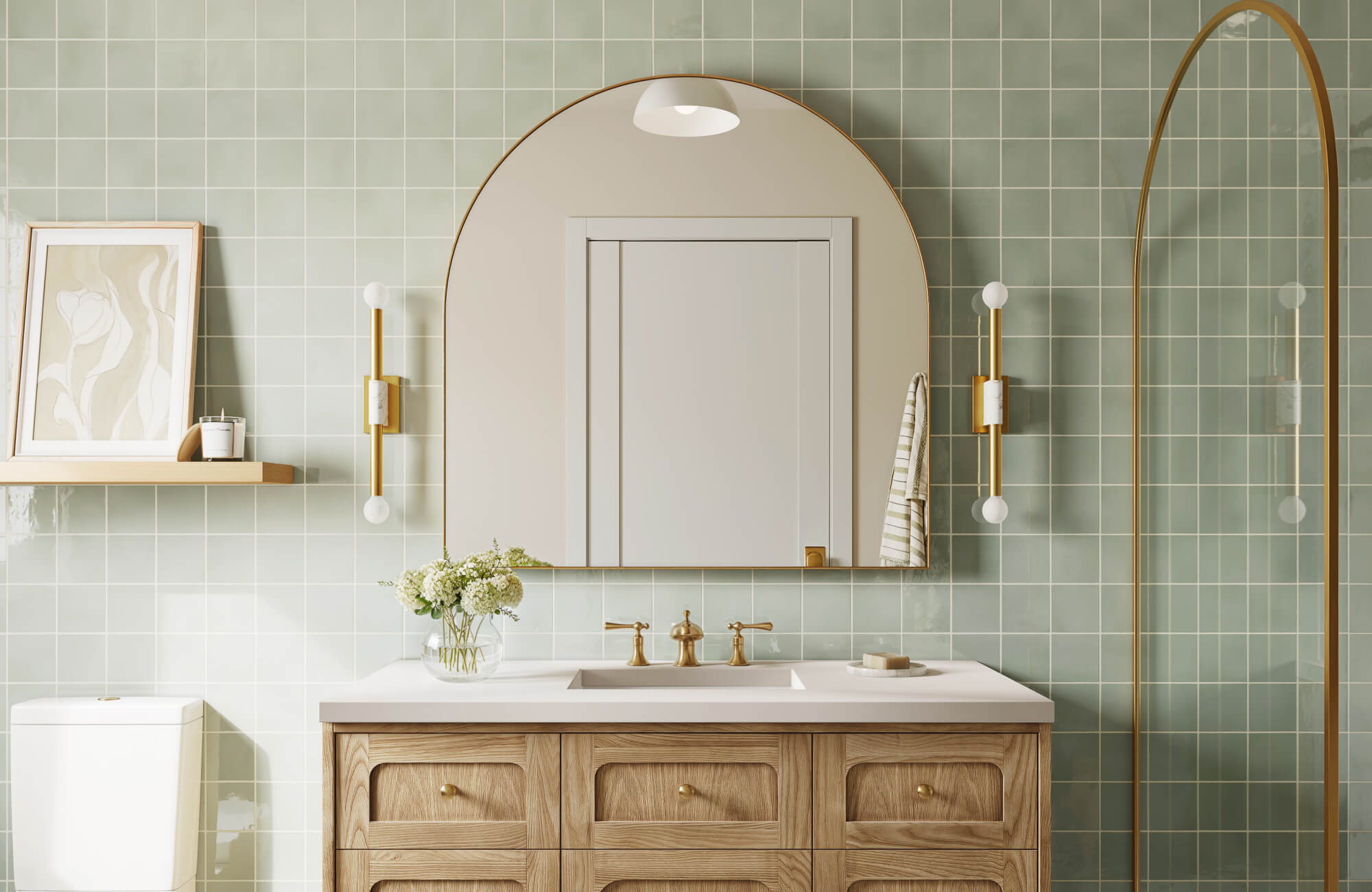
Modern interiors often favor pared-back aesthetics, and mirror design has adapted accordingly. Frameless edge treatments, geometric silhouettes, and slim-profile mounts complement minimalist architecture by emphasizing clean lines and open space. Additionally, shapes such as round, arched, square, and organic mirrors offer versatile solutions for different spatial needs while maintaining a cohesive, streamlined look.
This philosophy finds expression in Edward Martin’s Clancy Small Arch Mirror in Antique Brass, as displayed in the picture above, where restraint and refinement are carefully balanced. Its softened arch introduces a gentle curve that offsets rigid geometry, while the warm brass frame adds subtle richness and an understated touch that enhances light-filled, modern interiors without disrupting their simplicity.
The Rise of Smart Mirrors
As technology advances, mirrors have taken on a new dimension. Smart mirrors equipped with LED lighting, touch-sensitive controls, and integrated displays deliver real-time updates ranging from weather forecasts to fitness metrics. In bathrooms and dressing areas, features like anti-fog glass and adjustable light temperatures also enhance precision and comfort, blending modern convenience with timeless functionality.
Mirrors as Sustainable Decor
Alongside minimalism and technology, sustainability has become a defining influence in mirror production. Eco-conscious practices such as lead-free silvering, recycled glass substrates, and low-emission coatings reduce environmental impact without compromising clarity. Designers favor reclaimed or responsibly sourced frames, ensuring mirrors reflect not only style but also ethical responsibility. A thoughtful expression of this ethos is found in Edward Martin’s Fitz Mirror in Antique Brass, where clean lines and a refined finish show how timeless design can be achieved with sustainable craftsmanship.
Extending that same commitment to mindful living, Edward Martin’s design consultation service helps clients translate values into interiors, offering expert guidance tailored to project needs and ensuring choices reflect both style and environmental goals. For personalized recommendations, product questions, or support in selecting mirrors, tiles, rugs, or furniture, simply contact Edward Martin to explore solutions designed around your home.
The Enduring Allure of the Mirror
From simple volcanic stones to the high-tech smart mirrors of today, the mirror has been a constant presence in human history. Its journey from a precious, unattainable luxury to an everyday home staple is a testament to the power of innovation.
The mirror's ability to create light, also expand space, and serve as both a work of art and a functional tool ensures its enduring place in the world of home decor. Whether you’re looking to brighten a dark corner or add a grand focal point, there is a mirror perfectly suited for your space!