Rugs play a defining role in interior design, shaping the overall feel of a space while subtly connecting architecture, furnishings, and materials into a cohesive whole. In homes that balance modern clarity with classic elegance, the most successful rug styles are those that feel enduring rather than decorative, adapting naturally as interiors evolve. Through disciplined pattern language, refined color palettes, and thoughtful construction, these rugs bridge stylistic eras without visual conflict. Their appeal lies in proportion, texture, and material integrity rather than trend-driven statements. This article explores cool rug styles that work seamlessly in both modern and classic homes, offering long-term versatility and elevated design value.

Transitional Rugs
Transitional rugs blend traditional ornamentation with contemporary restraint, allowing them to move effortlessly between classic and modern interiors. Their adaptability comes from softened motifs, versatile color systems, and construction designed for everyday living.
Reinterpreted Traditional Motifs
Transitional rugs draw inspiration from Persian, Oriental, and European design traditions, yet reinterpret these motifs through softened edges and layered detailing that feel refined rather than ornate. Instead of a sharp contrast, patterns unfold gradually across the surface, encouraging the eye to move fluidly through the space rather than stopping at bold medallions or borders. This softened visual language also preserves historical character while remaining compatible with modern furniture silhouettes and open-plan layouts. Because the pattern often reads as texture from a distance, the rug anchors the room without overpowering it. The result is a design that feels collected, balanced, and adaptable over time.
Muted and Versatile Color Systems
Muted color systems are essential to rugs that move effortlessly between modern and classic interiors, as they soften transitions between materials while maintaining visual continuity. Tones such as sage, aloe, soft gray, and stone-based neutrals balance warmth and coolness, allowing a rug to complement both traditional finishes and contemporary surfaces without visual tension. This approach is especially effective in kitchens and open-plan spaces, where cabinetry, countertops, and flooring must read as a cohesive palette rather than competing elements. Edward Martin’s Mallory Rug in Aloe exemplifies this balance, with its subtle green-gray undertone echoing the cool cabinetry, marble surfaces, and natural wood accents, as shown in the photo above. Its restrained coloration also grounds the space while enhancing the calm, tailored aesthetic, making it a practical example of how muted rugs support timeless, adaptable design.
Performance-Driven Construction
Most transitional rugs are power-loomed using polypropylene, polyester, or wool blends to ensure durability, color stability, and consistent pile height. Low- to medium-pile constructions allow the rug to perform well in busy areas while maintaining a refined surface appearance. These construction choices support stable furniture placement and reduce visible wear over time. Maintenance is also easier compared to high-pile alternatives, making the rug suitable for everyday living. The balance of performance and polish is what makes transitional area rugs a reliable long-term investment.

Vintage and Distressed Rugs
Vintage and distressed rugs introduce warmth, depth, and visual softness that feel equally appropriate in modern interiors and classic homes. Their appeal lies in layered color, controlled aging, and the ability to make spaces feel grounded and lived-in rather than styled.
Intentional Distressing Techniques
Intentional distressing in modern rug design is less about visible wear and more about achieving a softened, timeworn appearance through controlled finishing. Rather than aggressive abrasion or broken motifs, this approach relies on subtle surface variation, washed color effects, and even tonal distribution to suggest age without visual fragmentation. Our McGowan Rug in Moss / Sand reflects this modern vintage sensibility, with its calm, mineral-inspired palette and gently blended fibers creating depth without pronounced distress marks.
As displayed in the photo above, its understated texture complements clean architectural lines, stone flooring, and natural wood elements, reinforcing a refined, contemporary setting. This type of controlled aging also allows the rug to add warmth and character while remaining polished, making it especially suitable for modern, transitional, and classic interiors that favor restraint over rusticity.
Layered Tonal Depth
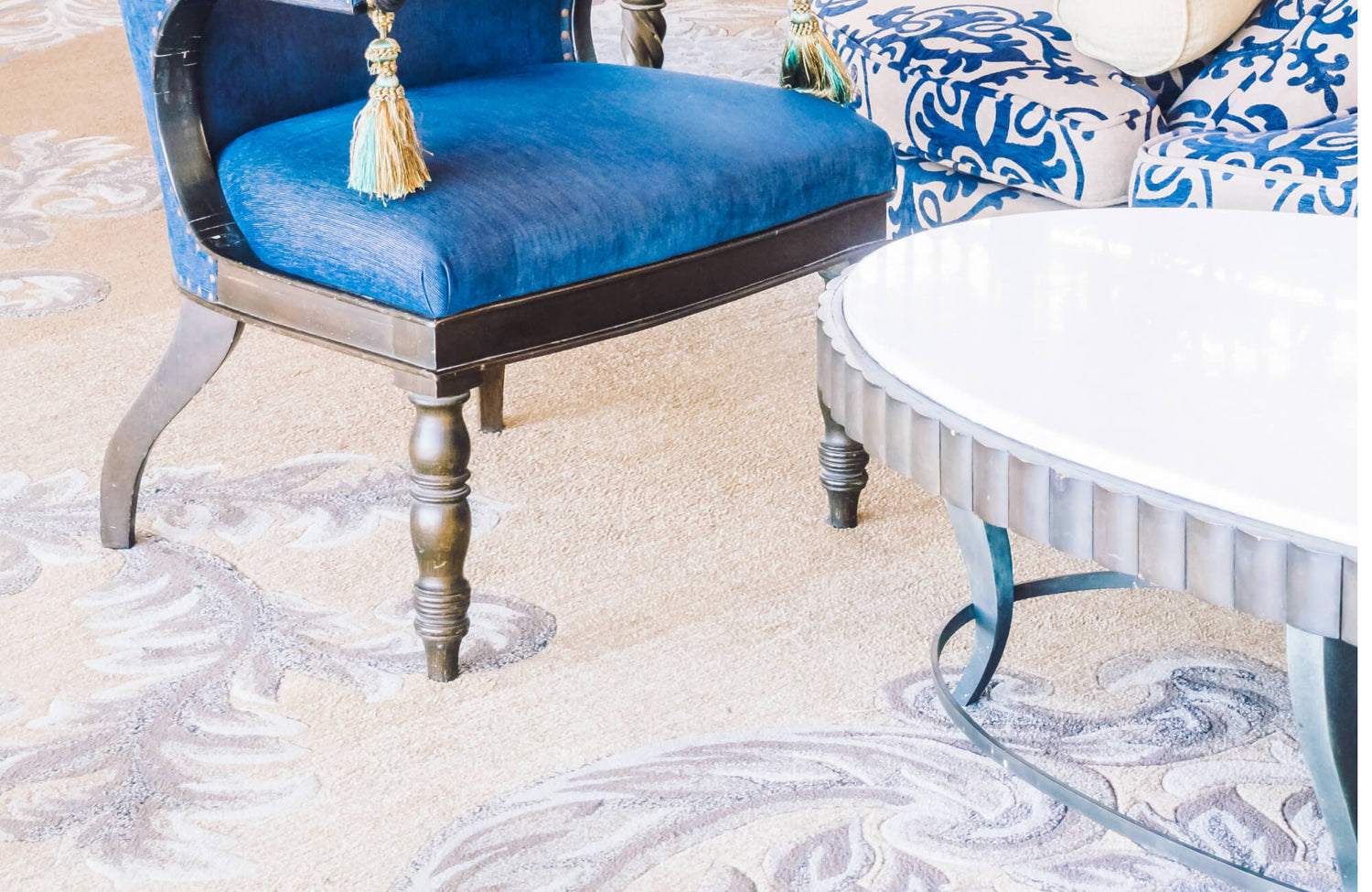
Instead of relying on bold contrast, distressed rugs build richness through gradual tonal variation that adds depth without visual heaviness. Colors shift subtly across the surface, creating movement that feels organic rather than decorative. Muted blues, warm neutrals, and softened earth tones also integrate seamlessly with both modern palettes and classic color schemes. This layered coloration grounds furniture groupings while allowing surrounding materials such as wood, stone, or metal to remain visually prominent. The rug supports the space rather than competing within it. This tonal complexity is a key reason vintage-style rugs remain versatile across changing interiors.
Modern Materials for Practical Living
Many vintage-inspired rugs are produced using polyester or blended fibers engineered for stain resistance, durability, and color retention. These materials allow the rug to withstand everyday wear while preserving the softened look associated with aged textiles. Low-pile constructions further enhance practicality, particularly in dining rooms and living areas where furniture movement is frequent. Maintenance also becomes more manageable compared to true antiques, which often require delicate care. This makes vintage-style rugs accessible for real homes rather than display-only spaces. The combination of character and performance is what gives these rugs long-term relevance.

Neutral Textured Rugs
Neutral-textured rugs rely on material depth rather than pattern to enhance interiors, allowing architectural features and furnishings to take visual precedence. Their understated presence creates balance, warmth, and continuity across modern and traditional spaces.
Texture as the Primary Design Element
Rather than decorative motifs, neutral textured rugs create interest through looped pile, ribbed weaves, or subtle hand-loomed variations that emphasize surface depth. As light moves through the room, these textures catch highlights and shadows, introducing movement without visual noise. This effect is especially valuable in modern interiors where clean lines dominate, and softness is needed to counterbalance hard surfaces. In traditional spaces, the same texture also acts as a refined backdrop that supports layered furnishings and architectural detailing. Because the interest is tactile rather than graphic, the rug feels timeless rather than trend-specific. Texture becomes a quiet but powerful design tool.
Natural Fiber Performance
Wool, jute, and sisal are commonly used for textured neutral rugs because their inherent properties support both performance and aesthetics. Wool, in particular, offers elasticity, thermal insulation, and natural stain resistance, making it ideal for long-term residential use. Meanwhile, jute and sisal introduce structure and tactile contrast, lending themselves to interiors that feel relaxed yet still polished. Together, these fibers age gracefully, developing character rather than simply looking worn. Their organic composition also aligns with sustainable and biophilic design principles, allowing natural-fiber rugs to reinforce a sense of authenticity across a wide range of styles.
Seamless Style Adaptability
In traditional interiors, neutral textured rugs soften ornate millwork, antiques, and polished finishes without competing visually, creating a quieter foundation that lets architectural detail take the lead. In modern spaces, the same rugs reinforce clean architectural lines while keeping the room from feeling stark or unfinished, adding warmth without visual clutter. Their neutral palette also allows for effortless layering with evolving décor and furniture styles, so as design elements change, the rug remains relevant rather than dated. This adaptability supports long-term interior planning, allowing neutral textured rugs to function as dependable foundations that move easily across stylistic boundaries.

Geometric Rugs
Geometric rugs bring visual order to interiors by introducing rhythm, structure, and proportion in a way that feels intentional rather than decorative. When thoughtfully designed, they bridge classic symmetry and modern clarity, allowing structured patterns to enhance a space without overpowering it.
Balanced Pattern Scale
Timeless geometric rugs rely on grids, trellis motifs, and linear repeats that echo architectural proportions rather than competing with them, allowing the pattern to feel integrated with the room instead of layered on top of it. By keeping the scale measured and deliberate, these designs reinforce the underlying structure of a space while still allowing furniture and finishes to remain visually dominant. The geometry then guides the eye through the room, creating a sense of movement that reads as composed and continuous rather than abrupt. This balance is especially effective in interiors where architectural details or clean modern lines already establish a strong framework, because a controlled pattern scale allows the rug to anchor the room with confidence and restraint.
Restrained Color Relationships
Color plays a critical role in helping geometric rugs adapt effortlessly across both modern and classic interiors. Muted pairings such as ivory with charcoal, sand with stone, or warm gray with soft beige allow the pattern to read as refined rather than overly graphic, tempering contrast so the design doesn’t overpower the space. This restraint also softens the geometry, enabling it to integrate seamlessly with traditional wood tones as well as contemporary materials like concrete, glass, or metal. Instead of demanding attention, color supports cohesion and visual continuity, and as interiors evolve, these disciplined palettes ensure the rug remains relevant, versatile, and easy to live with over time.
Precision Construction
The clarity of a geometric rug depends heavily on construction, since clean lines and repeated forms require technical precision to maintain their integrity. For instance, machine-woven and hand-tufted methods are often selected to achieve crisp pattern definition while delivering the durability needed for everyday living. Lower pile heights also help preserve line clarity beneath furniture and regular movement, reducing distortion that can blur the design. Dense weaving and stable backing further support dimensional consistency over time, and when construction and design work in concert, geometric rugs provide both architectural structure and long-term performance.

Flatweave and Low-Pile Rugs
Flatweave and low-pile rugs offer exceptional versatility, combining minimal profile with durable construction that adapts easily to different interior styles. Their understated presence allows them to function as foundational layers in both traditional and modern spaces.
Time-Tested Weaving Methods
Kilim and dhurrie constructions produce tightly woven, pile-free surfaces that feel lightweight yet resilient underfoot. This structure resists crushing and distortion, making these rugs particularly well-suited to busy areas and layered interiors. Because the profile remains thin, flatweaves sit comfortably beneath furniture without disrupting proportion or flow. Many designs are also reversible, extending usability and reinforcing their practical value. This craftsmanship emphasizes longevity and balance, supporting interiors that evolve over time.
Flexible Design Range
Flatweave rugs span a broad aesthetic spectrum, from classic folk-inspired motifs to contemporary abstract compositions, allowing them to move effortlessly between design styles. Their visual lightness also supports open-plan layouts by maintaining clear sightlines and spatial continuity. In traditional interiors, they layer naturally with other textiles, contributing to a collected, curated look, while in modern spaces, their simplicity reinforces clean architectural lines. This ability to adapt without asserting dominance makes flatweaves a reliable design choice across varied settings.
Everyday Performance Benefits
Everyday performance is a defining advantage of low-pile rugs, particularly in living spaces where comfort, durability, and ease of maintenance must work together seamlessly. Their shallow fiber height also resists crushing, supports smooth furniture movement, and allows for more efficient cleaning compared to high-pile alternatives, making them well-suited for active households. Edward Martin’s Liddy Rug in Ocean / Platinum demonstrates how performance and design can coexist, pairing a low-profile polyester pile with a softly layered blue-gray pattern that feels calm and refined rather than utilitarian. As featured in the photo above, its cool, desaturated tones ground the seating area while complementing light upholstery, natural wood, and architectural details without overwhelming the space. This balance of resilience, visual softness, and cool-toned elegance makes cool rugs ideal for everyday living in modern, transitional, and classic interiors alike.
Timeless Rugs That Elevate Every Interior
Rugs that succeed in both modern and classic interiors do so by prioritizing balance, material quality, and intentional design over fleeting trends. When patterns are softened, color palettes are restrained, and construction supports everyday living, a rug becomes a unifying element rather than a visual interruption. Each rug style discussed offers a distinct way to ground a space while allowing architecture, furnishings, and finishes to remain expressive. These versatile area rugs also support long-term design flexibility, making them ideal for interiors that evolve over time. Choosing cool rugs for modern and traditional homes ultimately results in spaces that feel cohesive, elegant, and enduring.
For homeowners and designers seeking guidance in selecting rugs that feel timeless and tailored, Edward Martin’s design services provide expert insight rooted in material knowledge and aesthetic balance. To create a space that feels cohesive, elevated, and enduring, contact us to explore personalized design support and curated rug solutions!